
We read your photo as:
A particle changes its velocity from 3000 m/s in the y-direction to 4000 m/s in the x-direction in 20 ns. What is its average acceleration?
Physics
ScanSolve AI Answer
Answer
Step-by-step solution
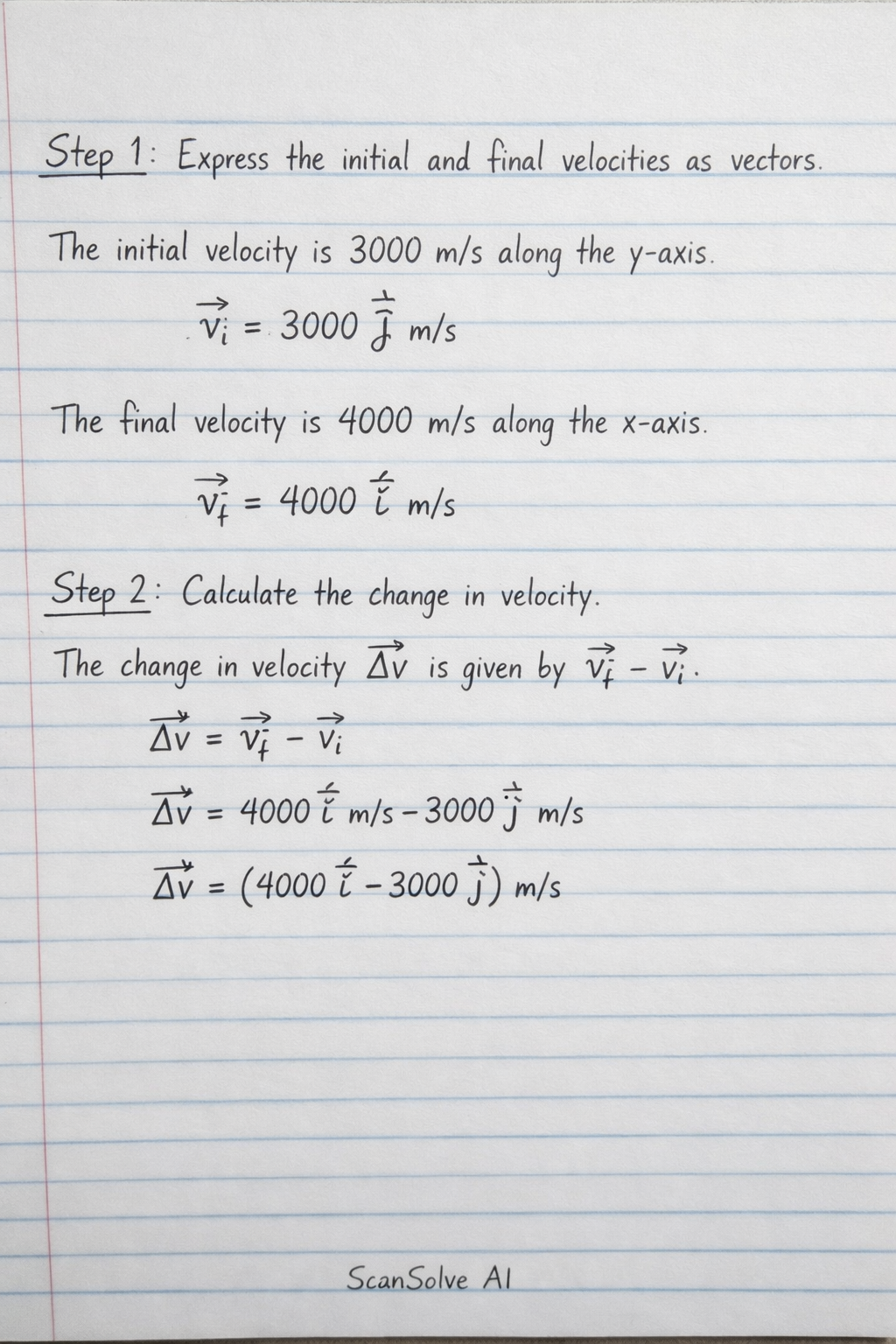
5 stepsExpress the initial and final velocities as vectors.
The initial velocity is along the y-axis.
The final velocity is along the x-axis.
Calculate the change in velocity.
The change in velocity is given by .
Calculate the average acceleration vector.
The average acceleration is given by .
Assuming "20 NS" means 20 nanoseconds, the time interval .Calculate the magnitude of the average acceleration.
The magnitude of a vector is .
Calculate the direction of the average acceleration.
The direction is given by .
Since the x-component is positive and the y-component is negative, the acceleration vector is in the fourth quadrant. The angle is below the positive x-axis.
The average acceleration has a magnitude of and a direction of .
Was this helpful?
Try one yourself
A new problem that tests the same skill.
Still stuck on this one?
Ask a follow-up, and the answer starts from this question.
Got a different question?Ask your own question
More Physics Questions
QA particle's velocity changes from 3000 m/s in the y-direction to 4000 m/s in the x-direction over…QA particle's velocity is given by v(t) = 20t − 5t2. What is its acceleration?QA particle of mass 2 kg moves in a circular path of radius 5 m with uniform speed 5 m/s. Calculate…QA particle goes from point A to point B, moving in a semicircle of radius 1 m in 1 second. Find the…QA particle has a velocity of 1i + 6j + 5k m/s. It has a constant tangential acceleration of 4 m/s²…
Browse by topic:Mechanics
Handwritten Step-by-Step Solution
Get this as a handwritten image on WhatsApp — like a tutor wrote it for you.
Try on WhatsApp