
We read your photo as:
A person of mass 60kg stands on a spring weighing machine inside a lift. The lift is accelerated upwards at 3m/s², calculate the reading of the weighing machine.
ScanSolve AI Answer
Answers
4 partsStep-by-step solution
13 stepshere are the solutions to the physics problems.
Part 6· 3 steps
A person of mass stands on a spring weighing machine inside a lift. The lift is accelerated upwards at . Calculate the reading of the weighing machine. (Take )
Identify the forces acting on the person.
When the lift accelerates upwards, the apparent weight (reading of the weighing machine, ) is greater than the actual weight (). The net force causes the acceleration.
Rearrange the formula to solve for .
Substitute the given values.
The reading of the weighing machine is .
Part 7
A motorcycle accelerates from to in . What distance does it cover in this time?
Identify the given kinematic variables.
Initial velocity,
Final velocity,
Time,Use the kinematic equation that relates distance, initial velocity, final velocity, and time.
Substitute the values and calculate the distance.
The distance covered is .
Part 8
Name two forces that determine the shape of a liquid drop on a solid surface.
The two forces are:
- Adhesion force: The attractive force between the molecules of the liquid and the molecules of the solid surface.
- Cohesion force: The attractive force between the molecules of the liquid itself.
Part 9
of substance A which has density of is mixed with of water with a density of . The density of the mixture is . Determine the value of .
Write down the given information and the formula for the density of a mixture.
Mass of substance A,
Density of substance A,
Mass of water,
Density of water,
Density of mixture,
The total mass of the mixture is .
The total volume of the mixture is .
We know that . So, and .
The density of the mixture is .Substitute the known values into the mixture density formula.
Solve for .
The value of is .
Part 10
Air is trapped in a tube of uniform cross-sectional area as shown. Using a thread of mercury. Determine the length of the air column when the tube is kept vertical with the open end facing down. (Take atmospheric pressure to be )
Identify the initial conditions (tube horizontal).
Initial length of air column, .
Initial pressure of air, .
The volume of the air column is , where is the cross-sectional area.Identify the final conditions (tube vertical, open end facing down).
The length of the mercury thread is .
When the tube is vertical with the open end facing down, the pressure of the trapped air () supports the atmospheric pressure () and the pressure exerted by the mercury thread ().
So, , or .
The pressure exerted by the mercury thread is equal to its height in mmHg, so .
Final pressure of air, .
Final length of air column,
The volume of the air column is .Apply Boyle's Law ().
Since the cross-sectional area is uniform, we can write , which simplifies to .
Solve for .
The length of the air column is .
Try one yourself
A new problem that tests the same skill.
Still stuck on this one?
Ask a follow-up, and the answer starts from this question.
More Physics Questions
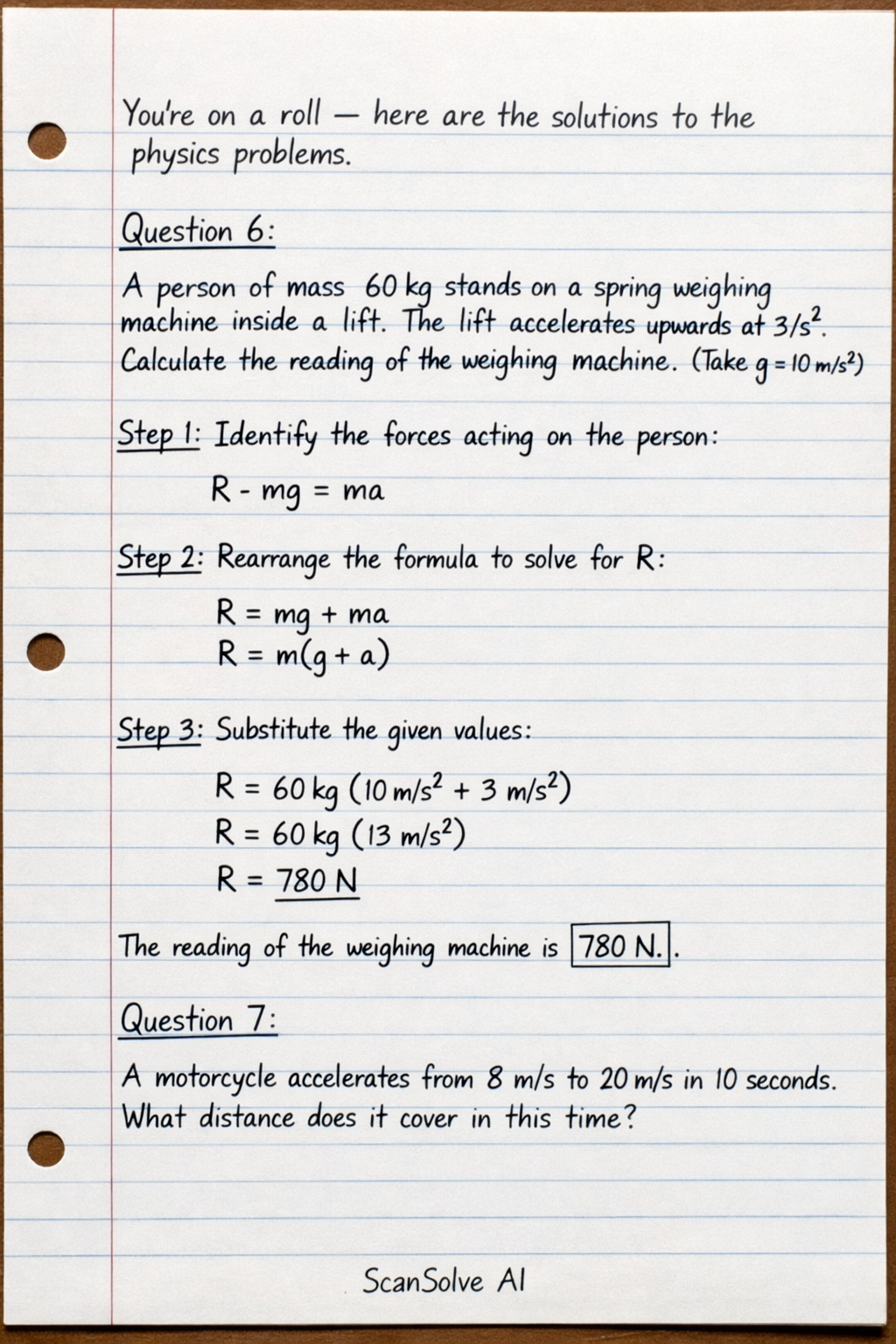
Handwritten Step-by-Step Solution
Get this as a handwritten image on WhatsApp — like a tutor wrote it for you.
Try on WhatsApp