
A regular concrete block weighing 5kg, has dimensions 8cm x 20cm x 50cm . Calculate the greatest possible pressure the block will exert on the ground.[g=10m/s ]
Physics
ScanSolve AI Answer
Answer
Step-by-step solution
4 stepsCalculate the force (weight) exerted by the block.
The force is the weight of the block, which is mass multiplied by the acceleration due to gravity.
Determine the smallest possible contact area.
To exert the greatest pressure, the block must rest on its smallest face. The dimensions are 8 cm, 20 cm, and 50 cm. The smallest area will be formed by the two smallest dimensions.
Convert the smallest area to square meters.
Since , then .
Calculate the greatest possible pressure.
Pressure is defined as force per unit area.
The greatest possible pressure the block will exert on the ground is .
Was this helpful?
Try one yourself
A new problem that tests the same skill.
Still stuck on this one?
Ask a follow-up, and the answer starts from this question.
Got a different question?Ask your own question
More Physics Questions
QA block of mass 5kg rests on a horizontal surface the coefficient of friction The block & The…QA cubic container with side 0.4 m is placed on a floor. The floor can support a maximum pressure of…QRecord the weight of the wooden block shown in Fig. 3.1. (b) Calculate the mass of the wooden block…QCalculate the density of a block of mass 20g and volume 10cm Give your answer in S.I unit.QCalculate the surface area and volume of a concrete block with dimensions 390 mm x 190 mm x 190 mm.
Browse by topic:Civil Engineering
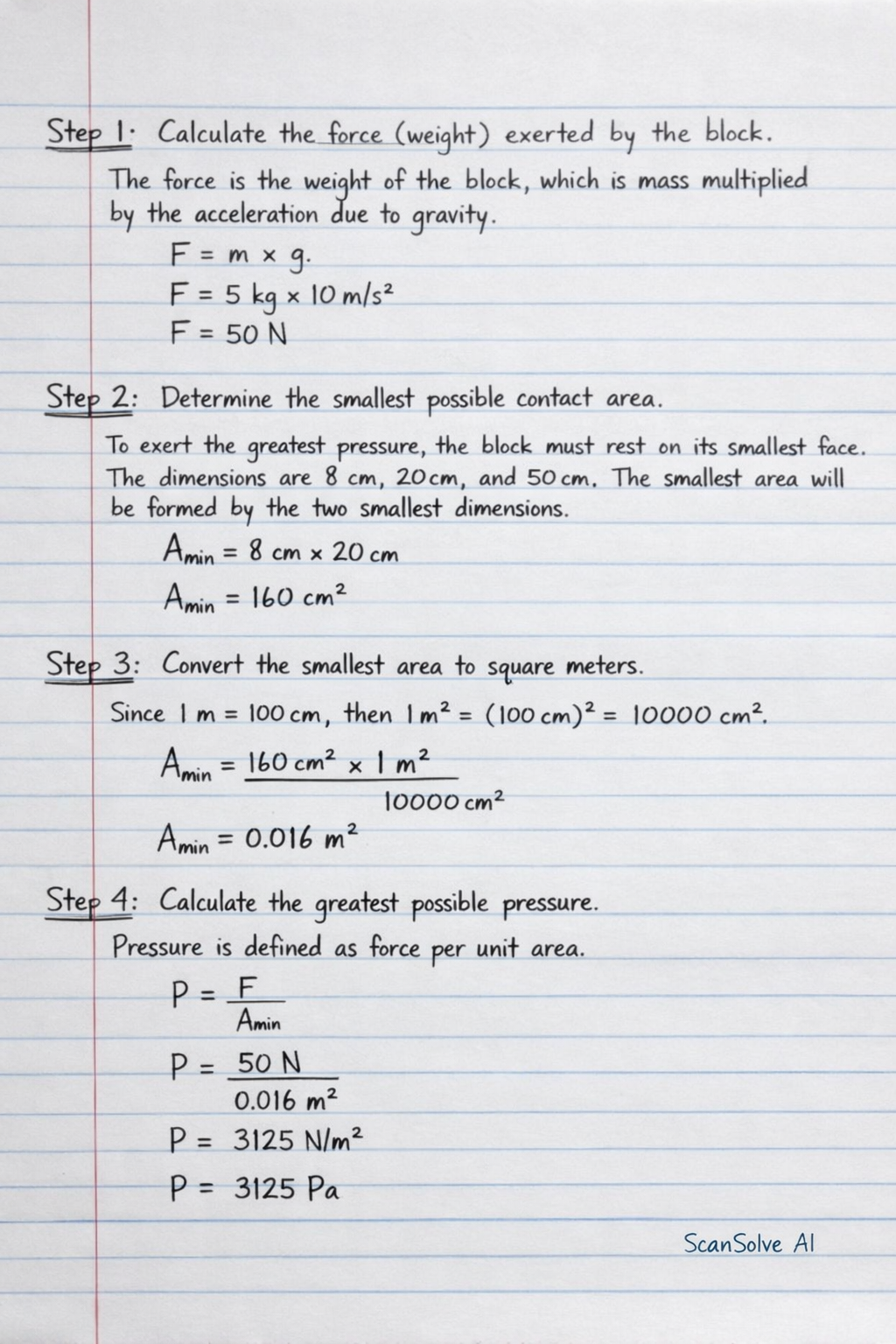
Handwritten Step-by-Step Solution
Get this as a handwritten image on WhatsApp — like a tutor wrote it for you.
Try on WhatsApp