
We read your photo as:
A satellite of mass m revolves around a planet of mass M in a radius n times the radius of the moon (R). Due to cosmic dust, it experiences a resistance F = αv². Find how long it will stay in the orbit?
ScanSolve AI Answer
Answer
Step-by-step solution
5 stepsDetermine the orbital velocity and total energy of the satellite.
For a satellite in a circular orbit of radius around a body of mass , the gravitational force provides the centripetal force:
From this, the orbital velocity is:
The total mechanical energy of the satellite is the sum of its kinetic energy () and potential energy ():
Substituting the expression for :
Relate the rate of energy loss to the resistance force.
The resistance force due to cosmic dust is given as . This force dissipates energy. The rate of energy dissipation (power ) is:
The rate of change of the satellite's total energy is equal to the negative of the power dissipated (since energy is being lost):
Set up the differential equation for the change in radius over time.
Substitute the expressions for and into the energy loss equation:
Rearrange the equation to solve for :
Integrate to find the total time.
Separate the variables and integrate from the initial radius to the final radius (assuming the satellite eventually crashes on the Moon's surface):
Solve for :
This can be rewritten as:
Match the result with the given options.
Let's examine option c: .
If in option c represents the final orbital velocity at the Moon's surface, , then substituting this into option c gives:This exactly matches our derived result. (Note: We assume 'a' in the options refers to , the resistance coefficient).
The final answer is .
Try one yourself
A new problem that tests the same skill.
Still stuck on this one?
Ask a follow-up, and the answer starts from this question.
More Physics Questions
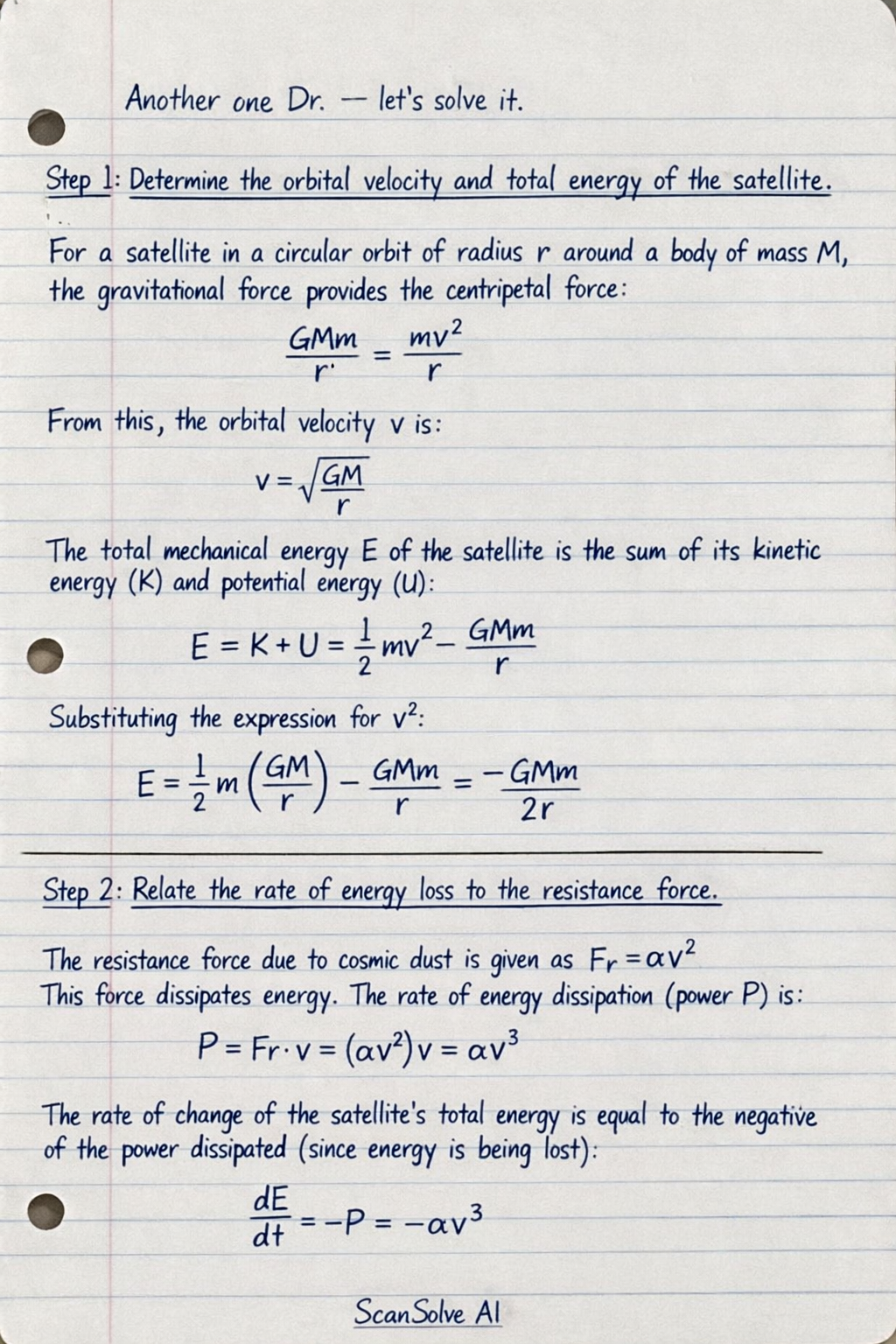
Handwritten Step-by-Step Solution
Get this as a handwritten image on WhatsApp — like a tutor wrote it for you.
Try on WhatsApp