
We read your photo as:
A steel cylinder of 2m diameter and 0.5m length, with density 7800 kg/m3, rotates at 1500 rev/min. Calculate its volume, mass, and moment of inertia.
Physics
ScanSolve AI Answer
Answers
4 partsStep-by-step solution
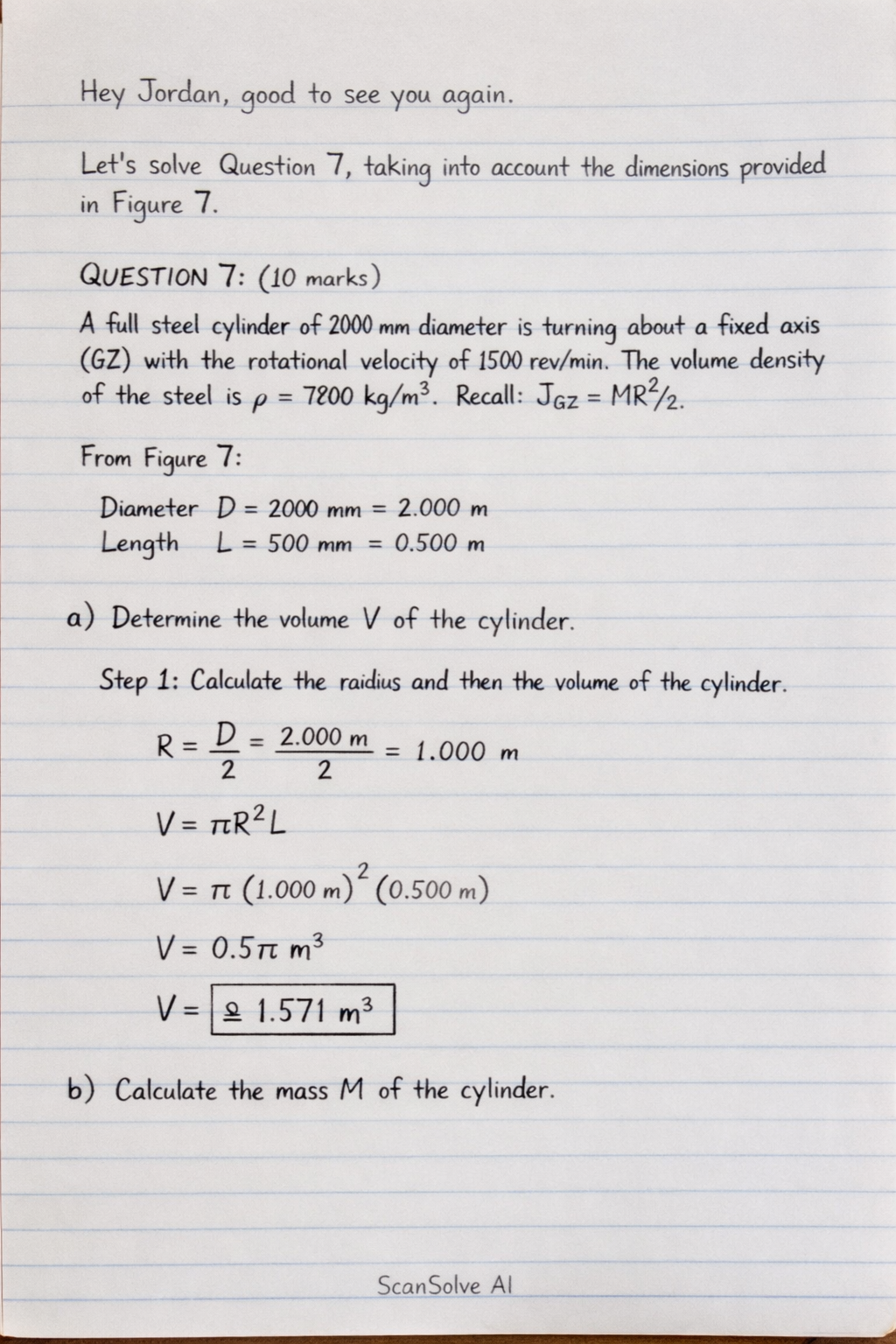
5 stepsLet's solve Question 7, taking into account the dimensions provided in Figure 7.
Part 7
(10 marks)
A full steel cylinder of diameter is turning about a fixed axis (GZ) with the rotational velocity of . The volume density of the steel is . Recall: .
From Figure 7:
Diameter
Length
Part a
Determine the volume of the cylinder.
Calculate the radius and then the volume of the cylinder.
Part b
Calculate the mass of the cylinder.
Calculate the mass of the cylinder using its volume and the given density.
Part c
Determine the moment of inertia of the cylinder.
Calculate the moment of inertia using the given formula, mass, and radius.
Part d
Express the angular velocity .
Convert the rotational velocity from revolutions per minute to radians per second.
Part e· 1 step
Determine the kinetic energy .
Calculate the rotational kinetic energy using the moment of inertia and angular velocity.
Was this helpful?
Try one yourself
A new problem that tests the same skill.
Still stuck on this one?
Ask a follow-up, and the answer starts from this question.
Got a different question?Ask your own question
More Physics Questions
QA full steel cylinder of 2000 mm diameter is turning about a fixed axis (GZ) with the rotational…QA stone of mass 100g is whirled in a horizontal circle of diameter 80.0cm at 150 revolutions per 5…QA wheel has a moment of inertia of 7,5 kgm² and a mass of 18 kg. It runs at 3 000 r/min. Calculate…QCalculate the moment of inertia if the area described in QUESTION 5.3.1 above rotates about the…QCalculate the volume of the following cylinder.
Browse by topic:Mechanics
Handwritten Step-by-Step Solution
Get this as a handwritten image on WhatsApp — like a tutor wrote it for you.
Try on WhatsApp