
We read your photo as:
A trolley of height 0.2m moving on a horizontal bench of height 3.2m strikes a barrier at the edge of the bench. The object on top of the trolley flies off on impact and lands on the ground 2.5m from
ScanSolve AI Answer
Step-by-step solution
6 stepsHere are the solutions to your questions:
b) A trolley of height 0.2m moving on a horizontal bench of height 3.2m strikes a barrier at the edge of the bench. The object on top of the trolley flies off on impact and lands on the ground 2.5m from the edge of the bench as shown in the figure below. Use this information to answer the questions that follow.
-
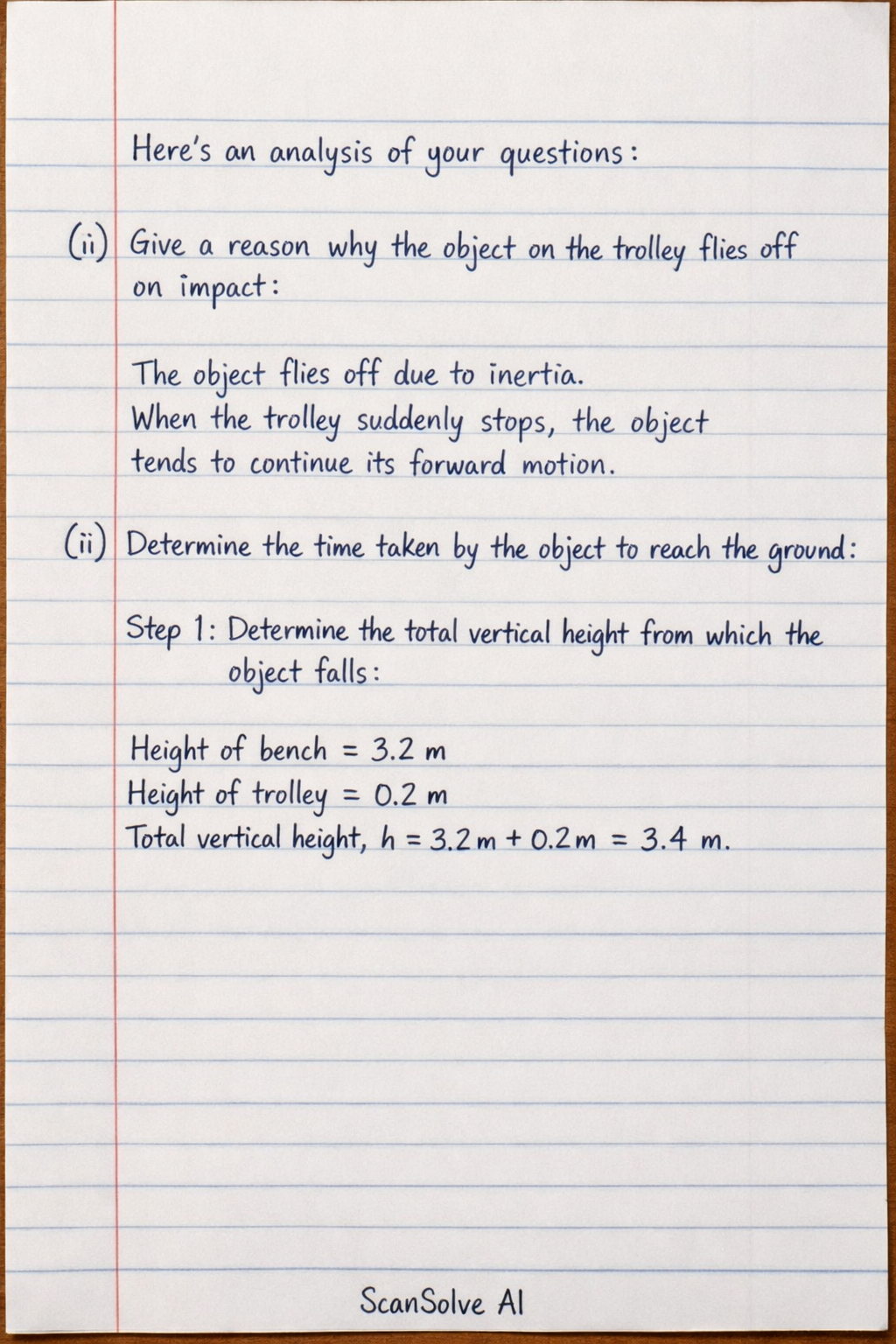
(i) Give a reason why the object on the trolley flies off on impact. The object flies off due to inertia. When the trolley suddenly stops, the object tends to continue its forward motion.
-
(ii) Determine the time taken by the object to reach the ground.
Determine the total vertical height from which the object falls.
Height of bench $= 3.2 \text{ m}$ Height of trolley $= 0.2 \text{ m}$ Total vertical height, $h = 3.2 \text{ m} + 0.2 \text{ m} = 3.4 \text{ m}$Use the kinematic equation for vertical motion.
Since the object flies off horizontally, its initial vertical velocity $u_y = 0 \text{ m/s}$. Acceleration due to gravity, $g = 9.8 \text{ m/s}^2$. $$ h = u_y t + \frac{1}{2}gt^2 $$ $$ 3.4 \text{ m} = (0 \text{ m/s})t + \frac{1}{2}(9.8 \text{ m/s}^2)t^2 $$ $$ 3.4 = 4.9t^2 $$Solve for .
$$ t^2 = \frac{3.4}{4.9} $$ $$ t = \sqrt{\frac{3.4}{4.9}} $$ $$ t \approx 0.833 \text{ s} $$ The time taken by the object to reach the ground is $\boxed{\text{0.833 s}}$.16. a) A boy throws a tennis ball vertically upwards from a truck moving at a constant velocity. Give the reason why the ball lands back exactly the same point where it was projected.
The ball lands back at the same point because it maintains the same horizontal velocity as the truck due to inertia. No horizontal forces act on the ball (neglecting air resistance) while it is in the air.16. b) Define momentum and state its SI unit.
- Definition: Momentum is the product of an object's mass and its velocity.
- SI unit: or .
16. c) A trailer of mass 30 tonnes travelling at a velocity of 72km/h runs onto a stationary bus of mass 10 tonnes. The impact takes 0.5seconds before the two vehicles move off together at a constant velocity for 15 seconds. Determine,
- (i) The common velocity.
Convert given values to SI units.
Mass of trailer, $m_1 = 30 \text{ tonnes} = 30 \times 1000 \text{ kg} = 30000 \text{ kg}$ Initial velocity of trailer, $u_1 = 72 \text{ km/h} = 72 \times \frac{1000 \text{ m}}{3600 \text{ s}} = 20 \text{ m/s}$ Mass of bus, $m_2 = 10 \text{ tonnes} = 10 \times 1000 \text{ kg} = 10000 \text{ kg}$ Initial velocity of bus, $u_2 = 0 \text{ m/s}$ (stationary)Apply the principle of conservation of linear momentum.
The total momentum before collision equals the total momentum after collision. $$ m_1 u_1 + m_2 u_2 = (m_1 + m_2) V $$ where $V$ is the common velocity after impact.Substitute the values and solve for .
$$
(30000 \text{ kg})(20 \text{ m/s}) + (10000 \text{ kg})(0 \text{ m/s}) = (30000 \text{ kg} + 10000 \text{ kg}) V
$$
$$
600000 \text{ kg m/s} + 0 = (40000 \text{ kg}) V
$$
$$
600000 = 40000 V
$$
$$
V = \frac{600000}{40000}
$$
$$
V = 15 \text{ m/s}
$$
The common velocity is $\boxed{\text{15 m/s}}$.
Still stuck on this one?
Ask a follow-up, and the answer starts from this question.
More Physics Questions
Handwritten Step-by-Step Solution
Get this as a handwritten image on WhatsApp — like a tutor wrote it for you.
Try on WhatsApp