
We read your photo as:
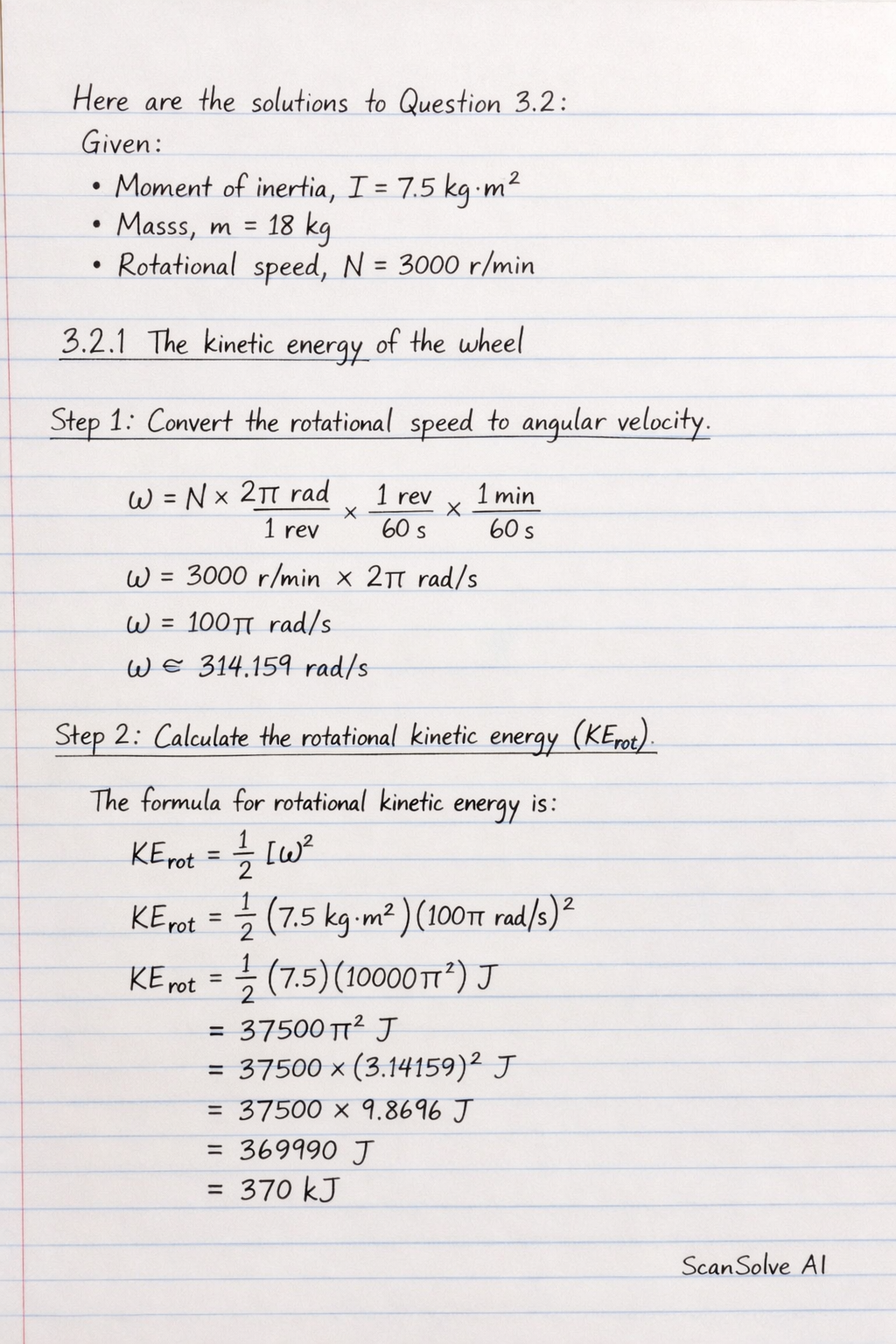
A wheel has a moment of inertia of 7,5 kgm² and a mass of 18 kg. It runs at 3 000 r/min. Calculate: The kinetic energy of the wheel. The radius of gyration of the wheel in cm
Physics
ScanSolve AI Answer
Answer
Step-by-step solution
4 stepsHere are the solutions to Question 3.2:
Given:
- Moment of inertia,
- Mass,
- Rotational speed,
3.2.1 The kinetic energy of the wheel
Convert the rotational speed to angular velocity in radians per second.
Calculate the rotational kinetic energy ().
The formula for rotational kinetic energy is:
The kinetic energy of the wheel is .
3.2.2 The radius of gyration of the wheel in cm
Calculate the radius of gyration ().
The moment of inertia is also given by . We can rearrange this to solve for :
Convert the radius of gyration from meters to centimeters.
The radius of gyration of the wheel is .
Was this helpful?
Try one yourself
A new problem that tests the same skill.
Still stuck on this one?
Ask a follow-up, and the answer starts from this question.
Got a different question?Ask your own question
More Physics Questions
QThe radius of a wheel is 56cm. Calculate. (a) the circumference of the wheel. (b) the distance moved…QA wheel and axle have radii 80cm and 10 cm respectively. If the efficiency of the machine is 0.85…QA steel cylinder of 2m diameter and 0.5m length, with density 7800 kg/m3, rotates at 1500 rev/min…QCalculate the circumference of the wheel. (2mks)QA wheel starts from rest and accelerates uniformly at 2 rad/s2 for 5 seconds. What is its final…
Browse by topic:Mechanics
Handwritten Step-by-Step Solution
Get this as a handwritten image on WhatsApp — like a tutor wrote it for you.
Try on WhatsApp