
We read your photo as:
An electromagnetic plane wave has an electric field given by E = E₀ sin(kx – ωt). The symbols k and ω are known respectively, as _ and _.
ScanSolve AI Answer
Answer
Step-by-step solution
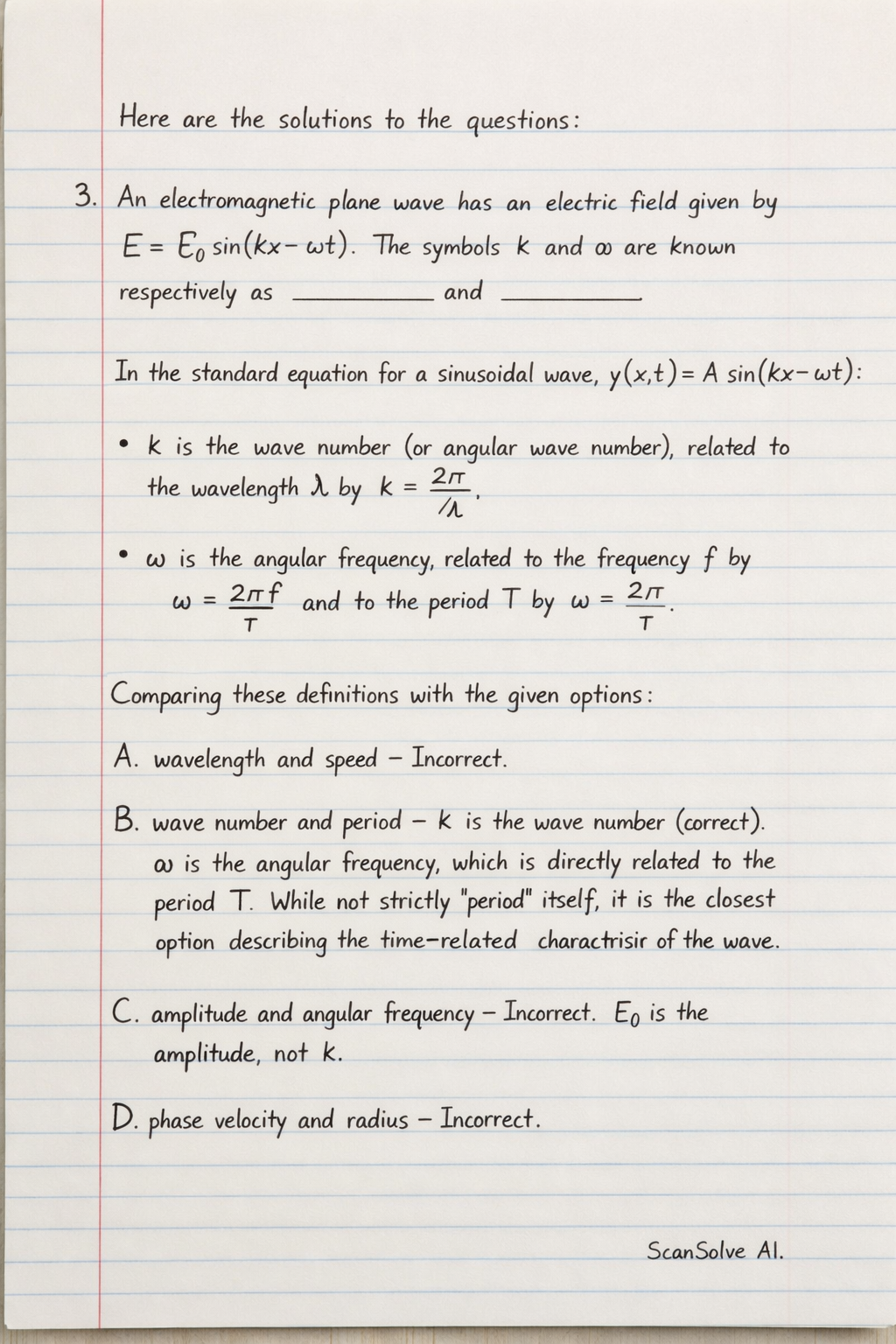
5 stepsHere are the solutions to the questions:
3. An electromagnetic plane wave has an electric field given by . The symbols and are known respectively, as _________ and _________.
In the standard equation for a sinusoidal wave, :
- is the wave number (or angular wave number), which is related to the wavelength by .
- is the angular frequency, which is related to the frequency by and to the period by .
Comparing these definitions with the given options:
- A. wavelength and speed - Incorrect.
- B. wave number and period - is the wave number (correct). is the angular frequency, which is directly related to the period . While not strictly "period" itself, it is the closest option describing the time-related characteristic of the wave.
- C. amplitude and angular frequency - Incorrect, is the amplitude, not .
- D. phase velocity and radius - Incorrect.
Given the options, the most appropriate choice is B, acknowledging that "period" is used in relation to angular frequency.
The correct option is B.
4. What instrument is represented in the diagram below?
The diagram shows a circle with the letter 'A' inside it. This is the standard circuit symbol for an ammeter.
- A. An Amplifier (symbol is typically a triangle)
- B. A Galvanometer (symbol is typically a circle with 'G')
- C. An Ammeter (symbol is a circle with 'A')
- D. A Voltmeter (symbol is a circle with 'V')
The correct option is C.
5. Three resistors , and are connected in parallel in an electric circuit. What is the total resistance in the circuit?
For resistors connected in parallel, the reciprocal of the total resistance () is the sum of the reciprocals of individual resistances:
Substitute the given resistance values (, , ).
Find a common denominator, which is 30.
Add the fractions.
Invert the result to find .
Calculate the numerical value.
Comparing with the options, is the closest value.
The correct option is D.
6. Which of the following statements about Electric field lines is/are false?
Let's evaluate each statement:
- I. Electric field lines are continuous curves drawn tangent to electric field vectors. This statement is true. The tangent to an electric field line at any point gives the direction of the electric field at that point.
- II. Electric field lines begin on a positive charge and end on a negative charge. This statement is true. This is the convention for drawing electric field lines.
- III. No two field lines can cross. This statement is true. If field lines were to cross, it would imply that the electric field has two different directions at the point of intersection, which is physically impossible.
Since all three statements (I, II, and III) are true, none of them are false.
The correct option is D.
Try one yourself
A new problem that tests the same skill.
Still stuck on this one?
Ask a follow-up, and the answer starts from this question.
More Physics Questions
Handwritten Step-by-Step Solution
Get this as a handwritten image on WhatsApp — like a tutor wrote it for you.
Try on WhatsApp