
We read your photo as:
An object of weight 800 N is pulled up a plane inclined at 15° using an effort of 750 N as shown in figure Q1a. Determine the coefficient of friction between the object and the plane.
ScanSolve AI Answer
Answer
Step-by-step solution
4 stepsTo determine the coefficient of friction, we need to analyze the forces acting on the object parallel and perpendicular to the inclined plane.
Given:
- Weight of the object,
- Angle of inclination,
- Applied effort (pulling force),
Resolve forces perpendicular to the inclined plane.
The normal force () acts perpendicular to the plane, balancing the perpendicular component of the weight ().
Resolve forces parallel to the inclined plane.
Since the object is being pulled up the plane, the applied force () acts upwards, while the component of weight parallel to the plane () and the frictional force () act downwards. Assuming constant velocity or impending motion, the net force is zero.
We know that the frictional force is given by , where is the coefficient of friction.
Substitute the expression for into the parallel forces equation.
Solve for the coefficient of friction, .
Now, substitute the given values:
Rounding to three significant figures:
The coefficient of friction between the object and the plane is .
Try one yourself
A new problem that tests the same skill.
Still stuck on this one?
Ask a follow-up, and the answer starts from this question.
More Physics Questions
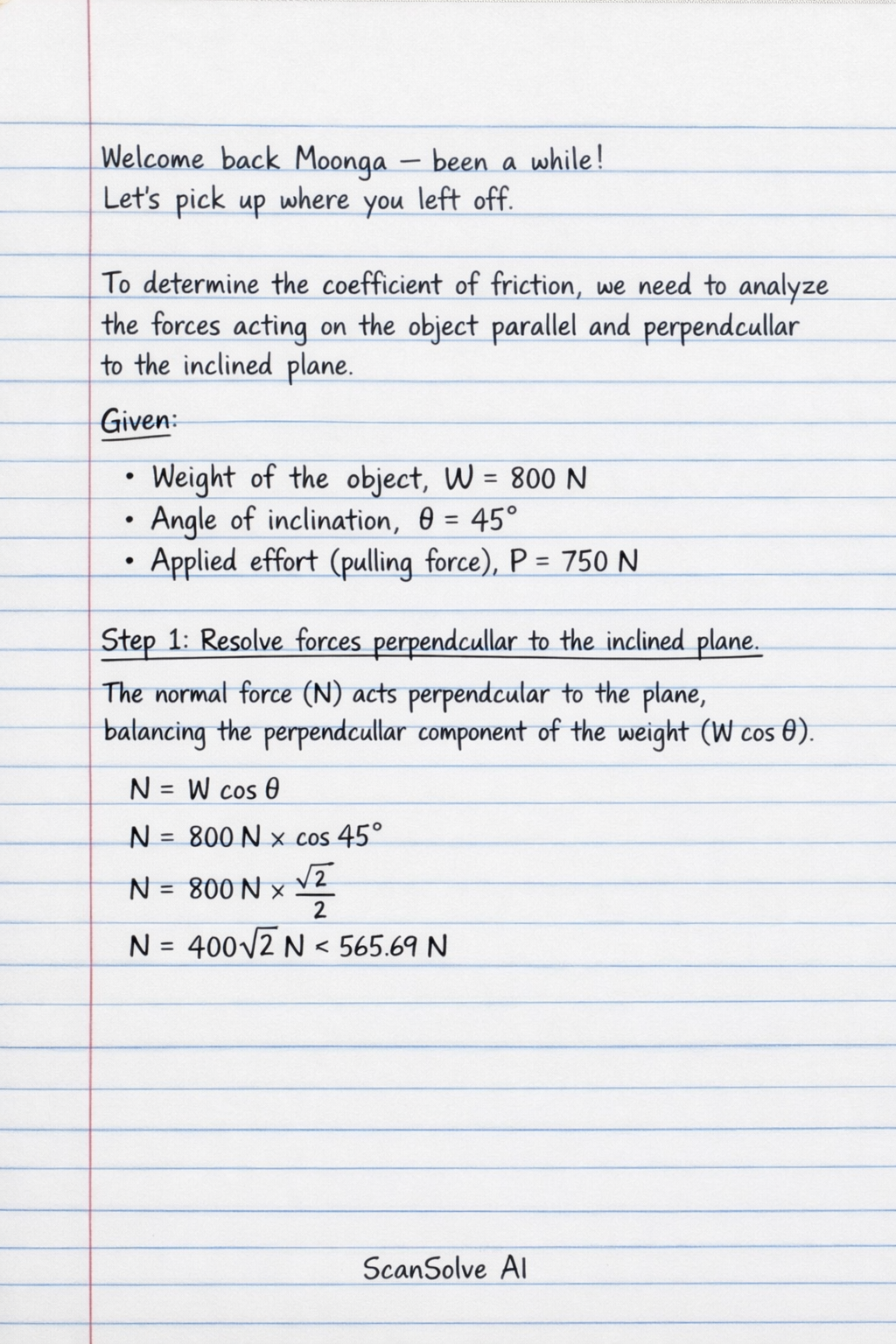
Handwritten Step-by-Step Solution
Get this as a handwritten image on WhatsApp — like a tutor wrote it for you.
Try on WhatsApp