
We read your photo as:
Analyze the pulley system shown in Figure 4, calculating its velocity ratio, the weight of the cement bag, its mechanical advantage, and its efficiency.
ScanSolve AI Answer
Answers
4 partsStep-by-step solution
7 stepsHere are the solutions for the questions from the image:
Figure 4: Pulley System
Part a· 1 step
What is the velocity ratio of the machine?
Count the number of ropes supporting the movable load.
In this pulley system, there are 4 ropes supporting the lower block (the load).
The velocity ratio (VR) is equal to the number of ropes supporting the movable load.The velocity ratio of the machine is .
Part b
Calculate the weight of the bag of cement.
Given: Mass () = 50 kg.
Assume acceleration due to gravity () = .
Use the formula for weight.
Substitute the values.
The weight of the bag of cement is .
Part c1.67
Calculate the mechanical advantage of the pulley system.
Given: Load = 500 N (from part b), Effort = 300 N.
Use the formula for mechanical advantage.
Substitute the values.
The mechanical advantage of the pulley system is .
Part d
Calculate the efficiency of the pulley system.
Given: Mechanical Advantage (MA) = 1.67, Velocity Ratio (VR) = 4.
Use the formula for efficiency.
Substitute the values.
The efficiency of the pulley system is .
7. (a)
Part d(i)
Define acceleration and state its units.
Acceleration is the rate of change of velocity of an object. Its SI unit is meters per second squared ().
Part d(ii)
What is the acceleration of a body moving with a constant velocity?
If a body is moving with a constant velocity, its velocity is not changing. Therefore, its acceleration is zero.
Part d(iii)
Describe an experiment to determine the acceleration of a moving body using a tape timer. Your description should include
To determine the acceleration of a moving body using a tape timer:
- Setup: Set up an inclined plane (runway) at a gentle slope. Attach a ticker tape to a trolley and feed the tape through a ticker tape timer. Connect the timer to a suitable power supply (e.g., 12 V AC).
- Procedure: Release the trolley from rest at the top of the inclined plane. As the trolley moves down, the ticker tape timer will make dots on the tape at regular time intervals (e.g., 50 dots per second, meaning each interval is ).
- Analysis:
- Collect the ticker tape. Cut the tape into strips of equal time intervals (e.g., 10 dots per strip, which represents ).
- Measure the length of each strip. The length of each strip is proportional to the average velocity of the trolley during that time interval.
- Calculate the average velocity for each strip ().
- Plot a graph of average velocity (y-axis) against the midpoint of the time interval for each strip (x-axis). The gradient of this velocity-time graph will give the acceleration of the trolley.
Try one yourself
A new problem that tests the same skill.
Still stuck on this one?
Ask a follow-up, and the answer starts from this question.
More Physics Questions
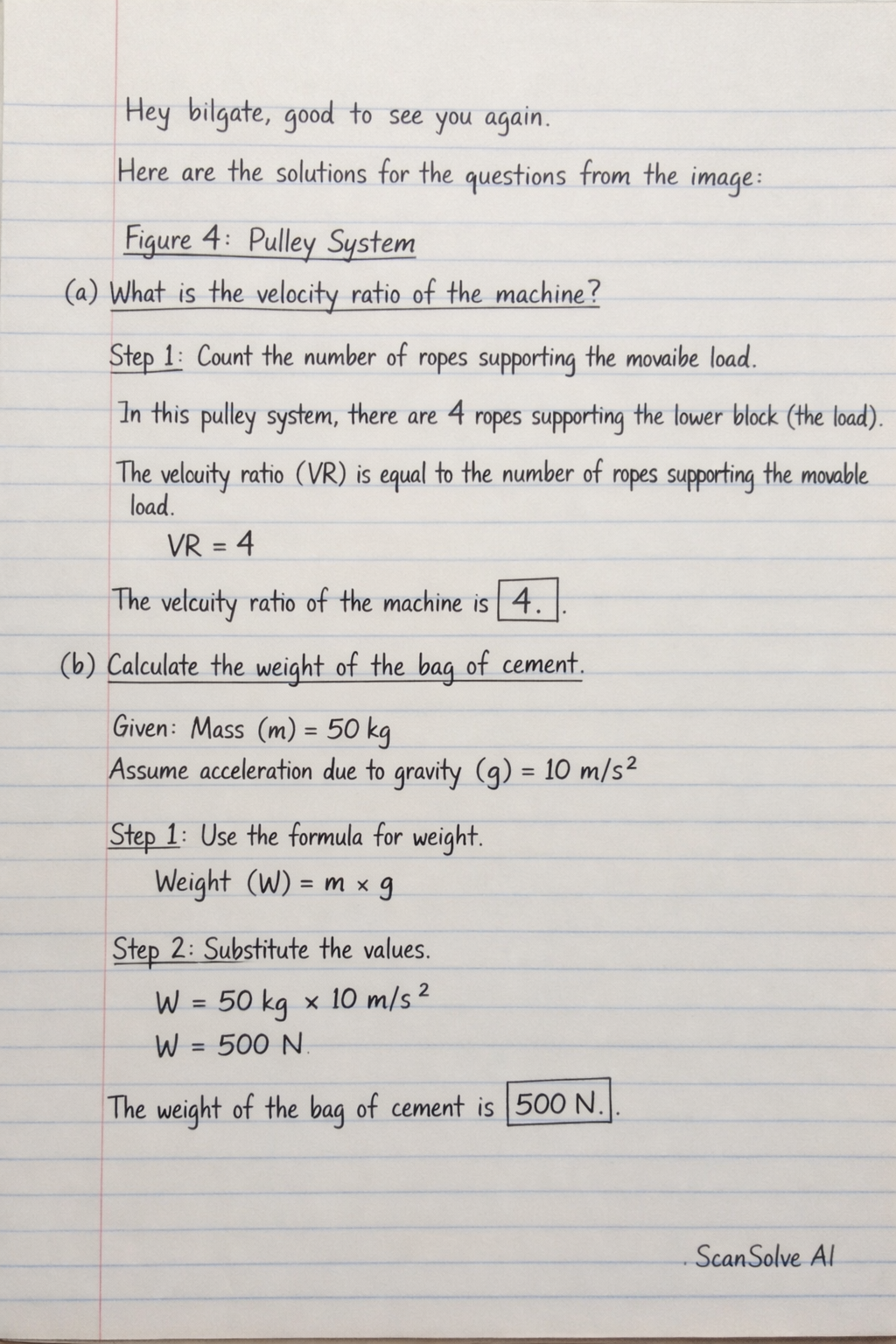
Handwritten Step-by-Step Solution
Get this as a handwritten image on WhatsApp — like a tutor wrote it for you.
Try on WhatsApp