
How can we find distance by using speed time graph? write three equation of motions what assumptions are made for equation of motions? define g? Q 2.7 of exercise Q-9 when will g is taken as positive or negative? Q -10 state revolutionary theory of special relativity? Q -11 Define universal speed limit? MCQS
ScanSolve AI Answer
here are the answers to your questions:
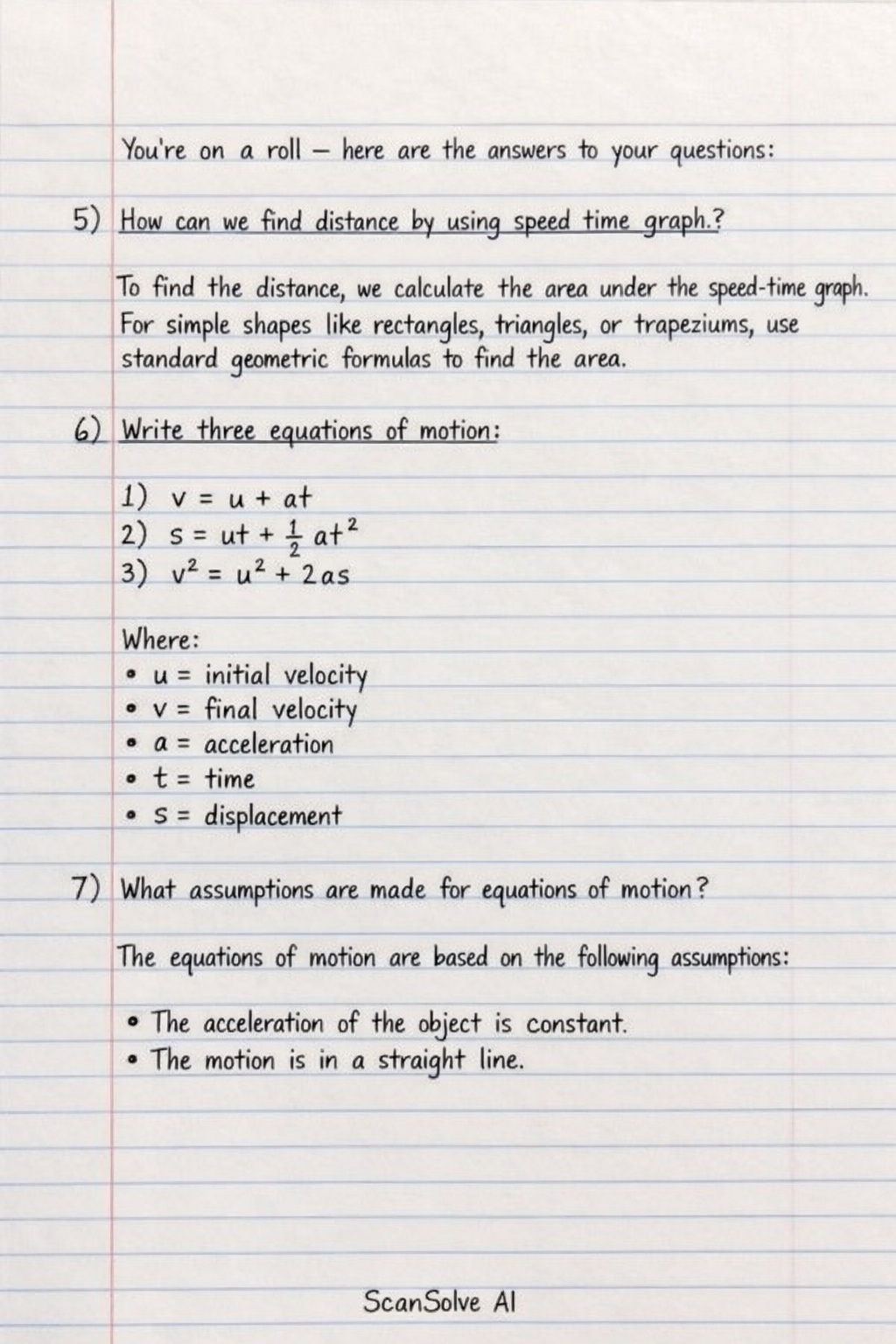
5- how can we find distance by using speed time graph?
The distance covered by an object can be found by calculating the area under the speed-time graph. For graphs with simple shapes (like rectangles, triangles, or trapeziums), you can use standard geometric formulas to find this area.
6-write three equation of motions
The three equations of motion for an object moving with constant acceleration are:
- Where:
- = initial velocity
- = final velocity
- = acceleration
- = time
- = displacement
7- what assumptions are made for equation of motions?
The equations of motion are derived based on the following key assumptions:
- The acceleration of the object is constant.
- The motion is in a straight line.
8-define g?
represents the acceleration due to gravity. It is the acceleration experienced by an object due to the gravitational pull of the Earth (or any celestial body) when air resistance is negligible. Its approximate value near the Earth's surface is or .
Q 2.7 of exercise
Please provide the text or an image of "Q 2.7 of exercise" so I can help you solve it.
Q-9 when will g is taken as positive or negative?
The sign of depends on the chosen direction of motion:
- is taken as positive when the object is moving downwards or accelerating in the downward direction (e.g., a ball falling).
- is taken as negative when the object is moving upwards or accelerating in the upward direction (e.g., a ball thrown upwards).
Q -10 state revolutionary theory of special relativity?
The revolutionary theory of special relativity, proposed by Albert Einstein, is based on two postulates:
- The laws of physics are the same for all observers in uniform motion (inertial frames of reference).
- The speed of light in a vacuum () is the same for all inertial observers, regardless of the motion of the light source. These postulates lead to profound consequences such as time dilation, length contraction, and the equivalence of mass and energy ().
Q -11 Define universal speed limit?
The universal speed limit is the speed of light in a vacuum, denoted by . It is approximately . According to the theory of special relativity, no information or object with mass can travel faster than this speed.
MCQS
Please send me the MCQs you'd like help with!
Still stuck on this one?
Ask a follow-up, and the answer starts from this question.
More Physics Questions
Handwritten Step-by-Step Solution
Get this as a handwritten image on WhatsApp — like a tutor wrote it for you.
Try on WhatsApp