
We read your photo as:
Create a Table of Household Numbers and Population Density
ScanSolve AI Answer
Step-by-step solution
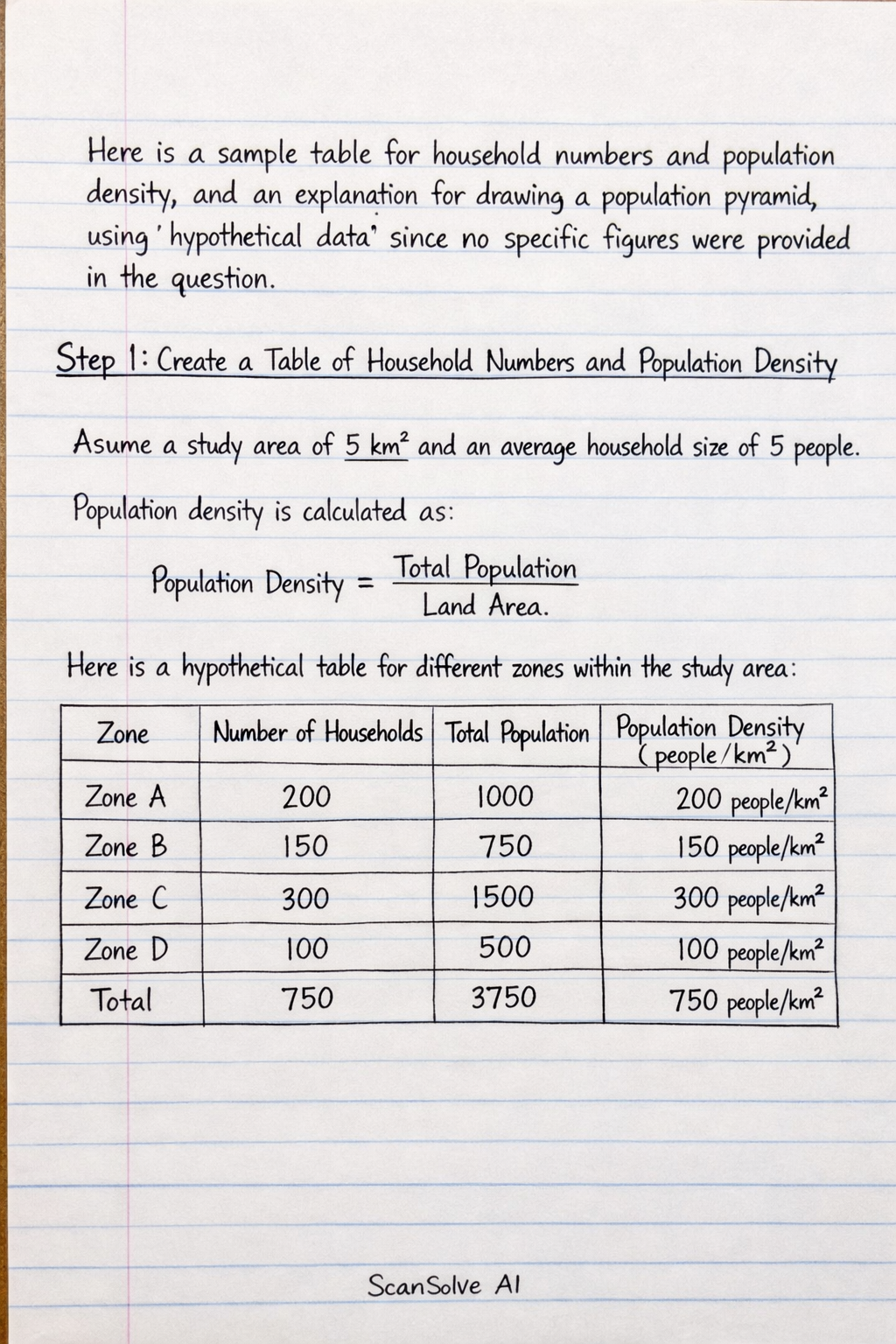
2 stepsHere is a sample table for household numbers and population density, and an explanation for drawing a population pyramid, using hypothetical data since no specific figures were provided in the question.
Create a Table of Household Numbers and Population Density
Assume a study area of and an average household size of 5 people. Population density is calculated as:
Here is a hypothetical table for different zones within the study area:
Zone/Area Number of Households Estimated Population (Households 5) Population Density (people/km) Zone A 150 750 Zone B 200 1000 Zone C 100 500 Total 450 2250 Explain How to Draw a Population Pyramid
A population pyramid graphically represents the age and sex distribution of a population. To draw one, you need data on the number or percentage of males and females in different age groups.
Hypothetical Data for Population Pyramid (Percentages):
Age Group Male (%) Female (%) 0-4 6.0 5.8 5-9 5.5 5.3 10-14 5.0 4.8 15-19 4.5 4.3 20-24 4.0 4.0 25-29 3.5 3.7 30-34 3.0 3.5 35-39 2.5 3.0 40-44 2.0 2.5 45-49 1.5 2.0 50-54 1.0 1.5 55-59 0.8 1.2 60-64 0.6 1.0 65-69 0.4 0.8 70-74 0.2 0.5 75+ 0.1 0.3 Instructions for Drawing the Population Pyramid:
- Draw a central vertical axis for age groups, typically in 5-year intervals (e.g., 0-4, 5-9, etc.), with the youngest at the bottom and oldest at the top.
- Draw a horizontal axis at the bottom for population numbers or percentages. The center of this axis is zero.
- On the left side of the vertical axis, plot the male population for each age group as horizontal bars.
- On the right side of the vertical axis, plot the female population for each age group as horizontal bars.
- Ensure the bars for each age group are aligned horizontally.
- Label the axes clearly: "Age Group" on the vertical axis, "Population (in % or numbers)" on the horizontal axis, and "Male" and "Female" on their respective sides.
- Give the pyramid a title, such as "Population Pyramid of [Your Local Area], [Year]".
Still stuck on this one?
Ask a follow-up, and the answer starts from this question.
More Physics Questions
Handwritten Step-by-Step Solution
Get this as a handwritten image on WhatsApp — like a tutor wrote it for you.
Try on WhatsApp