

This physics problem tests your understanding of fundamental physical laws and their applications. The step-by-step solution below breaks down the problem using relevant equations and physical reasoning.
ScanSolve AI Answer
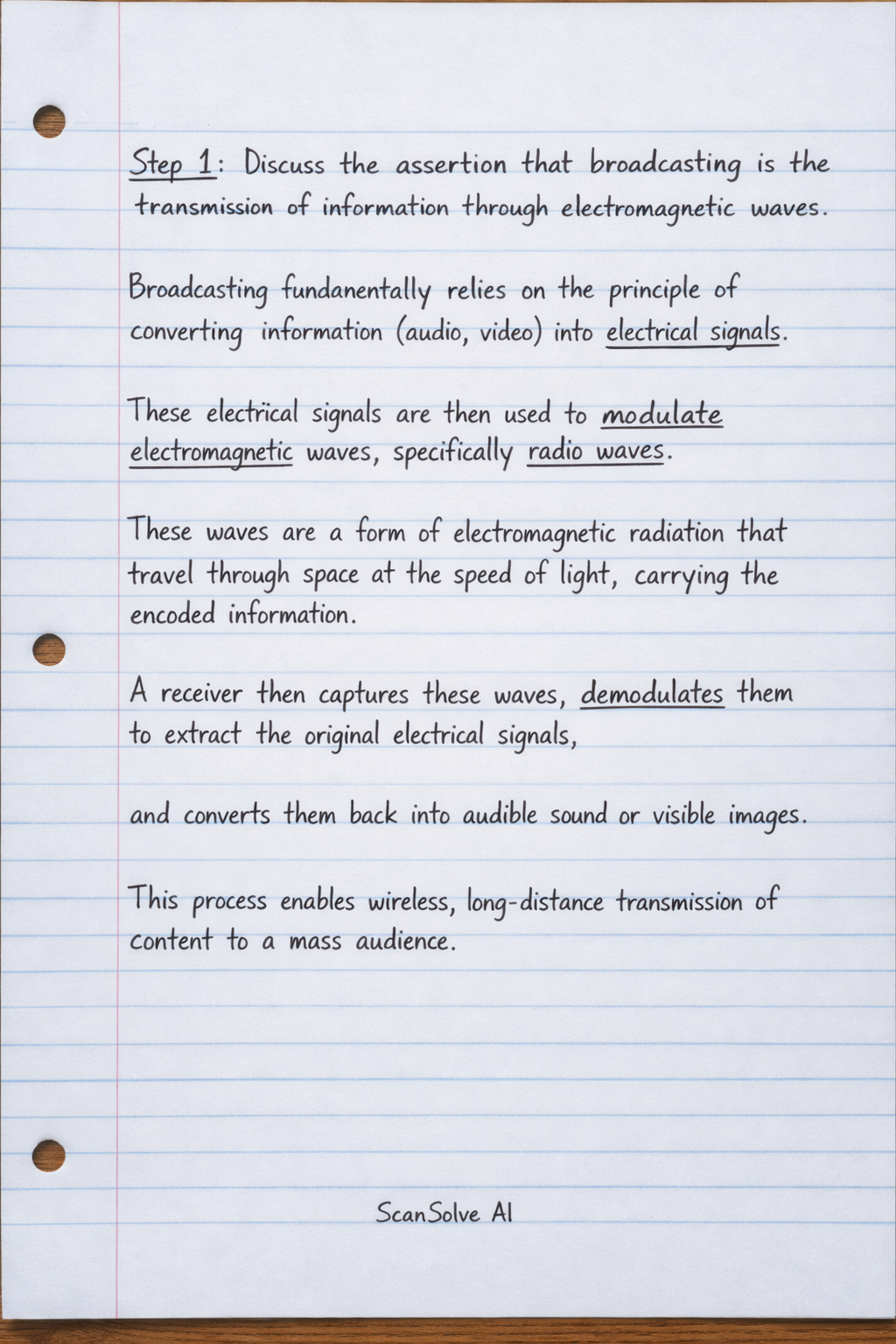
Step 1: Discuss the assertion that broadcasting is the transmission of information through electromagnetic waves. Broadcasting fundamentally relies on the principle of converting information (audio, video) into electrical signals. These electrical signals are then used to modulate electromagnetic waves, specifically radio waves. These waves are a form of electromagnetic radiation that travel through space at the speed of light, carrying the encoded information. A receiver then captures these waves, demodulates them to extract the original electrical signals, and converts them back into audible sound or visible images. This process enables wireless, long-distance transmission of content to a mass audience. Step 2: Explain the types of Radio broadcasting. There are several types of radio broadcasting, each utilizing different modulation techniques or transmission methods: • Amplitude Modulation (AM): In AM broadcasting, the amplitude (strength) of the carrier wave is varied in proportion to the amplitude of the modulating signal, while its frequency remains constant. AM signals can travel long distances, especially at night, but are more susceptible to atmospheric interference and offer lower audio fidelity. • Frequency Modulation (FM): FM broadcasting varies the frequency of the carrier wave in proportion to the amplitude of the modulating signal, while its amplitude remains constant. FM offers superior sound quality and is less prone to static and interference compared to AM, but typically has a shorter transmission range. • Digital Radio (DAB/HD Radio): Digital radio transmits audio as digital data rather than analog signals. This allows for higher sound quality, more programming choices on a single frequency (multicasting), and additional data services like song titles and artist information. It is also more robust against interference. • Satellite Radio: This type of broadcasting uses satellites orbiting Earth to transmit audio signals over vast geographical areas. Subscribers typically pay a fee to access a wide range of channels, often commercial-free, with consistent reception across large regions. • Internet Radio (Webcasting/Streaming Radio): Internet radio delivers audio content over the internet. It allows listeners to access a global array of stations and on-demand content through computers, smartphones, and other internet-connected devices, without the need for traditional radio waves for local transmission. Send me the next one 📸