during electrolysis 5g of a metal E was deposited by passing a current of 200Ampere for 30mins across the solution of E. find the ionic charge of E

Physics

ScanSolve AI Answer

Answer

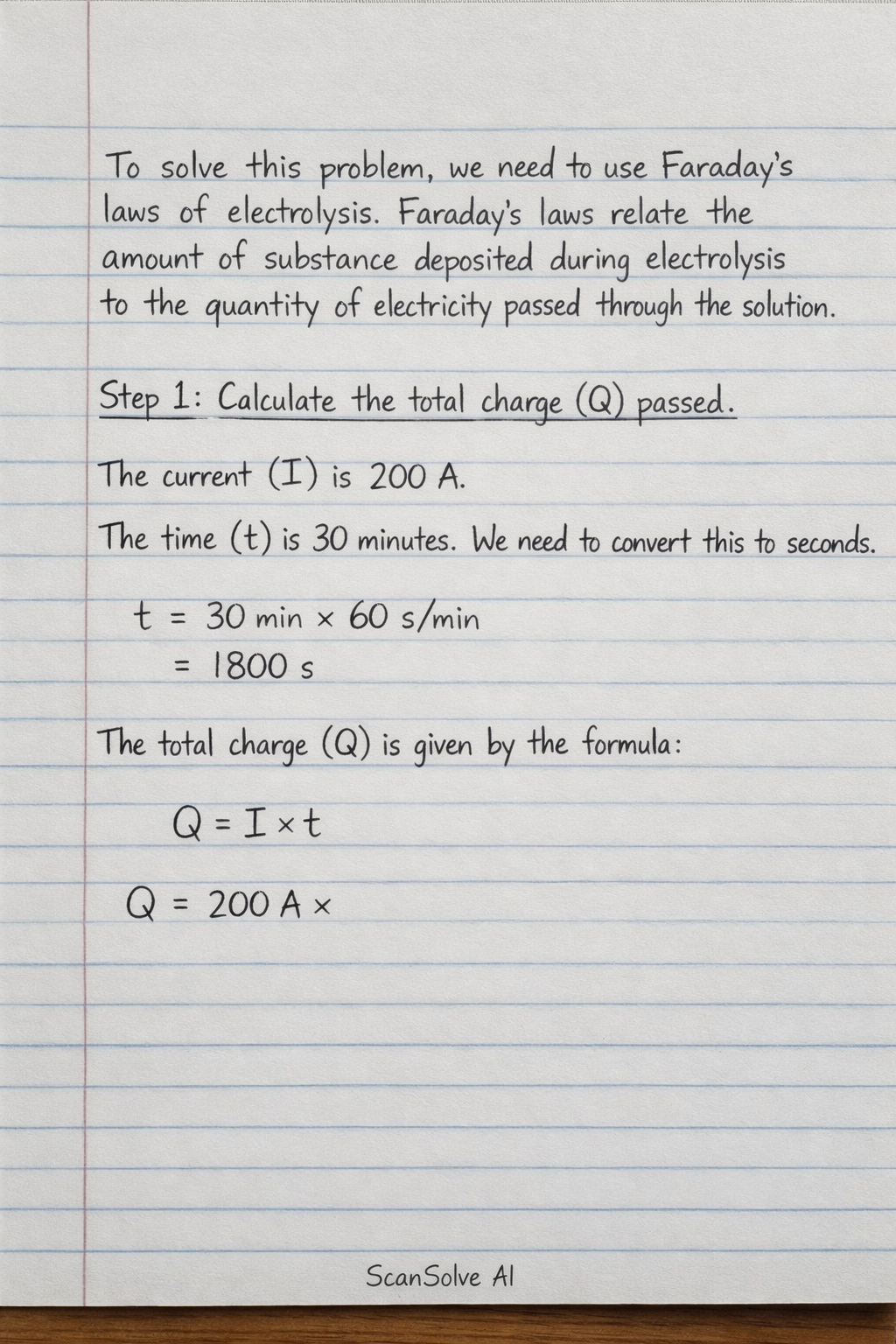
30 min \times 60 s/min = 1800 \text{ s}$$

To solve this problem, we need to use Faraday's laws of electrolysis. Faraday's laws relate the amount of substance deposited during electrolysis to the quantity of electricity passed through the solution.

Step 1: Calculate the total charge (QQ) passed. The current (II) is 200 A200 \text{ A}. The time (tt) is 30 minutes30 \text{ minutes}. We need to convert this to seconds. t=30min×60s/min=1800 st = 30 min \times 60 s/min = 1800 \text{ s} The total charge (QQ) is given by the formula: Q=I×tQ = I \times t

Was this helpful?

Need help with your own homework?

Get instant step-by-step solutions to any question. Free to start.

Ask Your Question
Handwritten step-by-step solution preview

Handwritten Step-by-Step Solution

Get this as a handwritten image on WhatsApp — like a tutor wrote it for you.

Try on WhatsApp

Still have questions?

Quick Answer

Faraday's laws relate the amount of substance deposited during electrolysis to the quantity of electricity passed through the solution.

during electrolysis 5g of a metal E was deposited by passing a current of 200Ampere for 30mins across the solution of E. find the ionic charge of E
Physics

This physics problem tests your understanding of fundamental physical laws and their applications. The step-by-step solution below breaks down the problem using relevant equations and physical reasoning.

ScanSolve AI Answer
To solve this problem, we need to use Faraday's laws of electrolysis. Faraday's laws relate the amount of substance deposited during electrolysis to the quantity of electricity passed through the solution. Step 1: Calculate the total charge (Q) passed. The current (I) is 200 A. The time (t) is 30 minutes. We need to convert this to seconds. t = 30 min × 60 s/min = 1800 s The total charge (Q) is given by the formula: Q = I × t Q = 200 A ×