
We read your photo as:
Derive the equation for kinetic energy, KE = 1/2mv2, using Newton's laws and kinematic equations.
ScanSolve AI Answer
Answer
Step-by-step solution
6 stepsTo derive the equation for kinetic energy, , we use the work-energy theorem and Newton's second law of motion.
Define work done.
Work done () by a constant force () over a displacement () is given by:
Apply Newton's second law.
According to Newton's second law, force () is the product of mass () and acceleration ():
Substitute into the work done equation.
Use a kinematic equation.
For an object accelerating from an initial velocity to a final velocity over a displacement with constant acceleration , the following kinematic equation applies:
Rearranging this equation to solve for :
Substitute the expression for into the work done equation from Step 3.
Relate work done to kinetic energy.
The work-energy theorem states that the net work done on an object is equal to the change in its kinetic energy. If an object starts from rest, its initial velocity . The work done to accelerate it to a velocity is its kinetic energy ().
Setting :Since this work done is stored as kinetic energy:
Try one yourself
A new problem that tests the same skill.
Still stuck on this one?
Ask a follow-up, and the answer starts from this question.
More Physics Questions
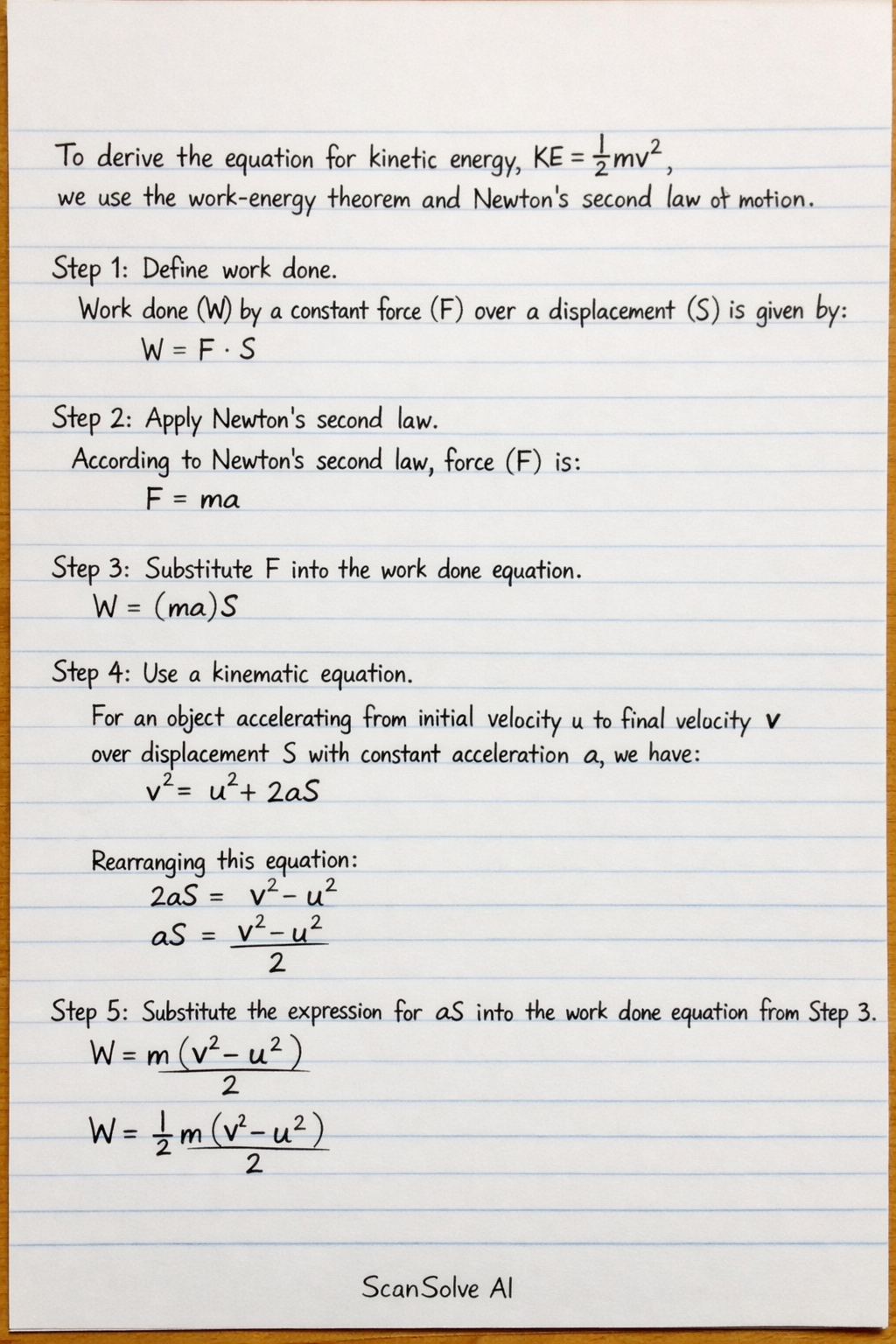
Handwritten Step-by-Step Solution
Get this as a handwritten image on WhatsApp — like a tutor wrote it for you.
Try on WhatsApp