
We read your photo as:
Solve the following kinematics problems involving displacement, initial velocity, acceleration, and time.
ScanSolve AI Answer
Answer
Step-by-step solution
16 stepsHere are the solutions to the questions:
Part 31· 3 steps
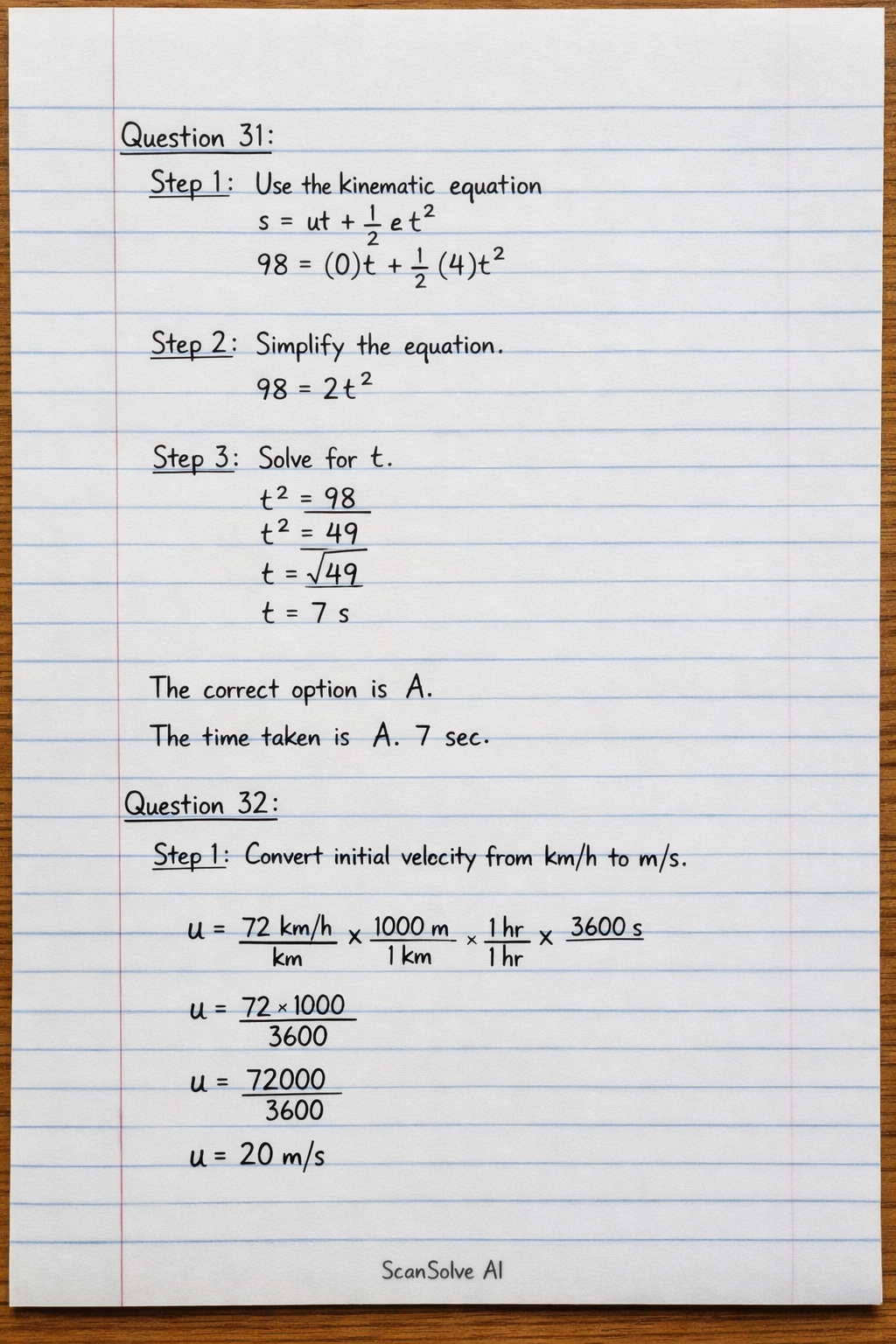
To find the time taken, we use the kinematic equation for displacement.
Given:
Initial velocity (starts from rest)
Displacement
Acceleration
Use the kinematic equation .
Simplify the equation.
Solve for .
The correct option is A.
The time taken is .
Part 32· 5 steps
To find the time taken, we use the kinematic equation for displacement.
Given:
Initial velocity
Deceleration
Displacement
Convert initial velocity from km/h to m/s.
Use the kinematic equation .
Rearrange into a quadratic equation .
Use the quadratic formula .
Here, , , .
Calculate the two possible values for .
Since the car is slowing down, both times are physically possible if the car hasn't stopped and reversed within 70m. However, usually, the smaller positive time is the one sought in such problems before it potentially stops or reverses. Let's check the final velocity for .
. This is a valid positive velocity.
The correct option is C.The time taken is .
Part 33
The phenomenon where a ball strikes the ground (action) and the ground pushes back with an equal and opposite force (reaction) is a direct application of Newton's Third Law of Motion.
The correct option is C.
The law of motion is .
Part 34
The statement "the vector sum of the forces F on an object is equal to the mass m of that object multiplied by the acceleration a of the object" is the definition of Newton's Second Law of Motion, often expressed as .
The correct option is B.
The name of this law of motion is .
Part 35
When you touch something, you exert a force on it, and in response, the object exerts an equal and opposite force back on you. It is this reaction force that you feel. This interaction is explained by Newton's Third Law of Motion.
The correct option is C.
The law is .
Part 36· 2 steps
Work done is calculated as the product of force and displacement in the direction of the force.
Given:
Force
Displacement
Use the formula for work done .
Calculate the work done.
The correct option is A.
The work done is .
Part 37· 2 steps
Work done to lift an object is equal to the force (weight) multiplied by the height lifted.
Given:
Work done
Force (weight)
Use the formula for work done .
Solve for .
The correct option is B.
The height the weight was lifted is .
Part 38· 2 steps
Power is the rate at which energy is transformed or transferred.
Given:
Energy
Time
Use the formula for power .
Calculate the power.
The correct option is B.
The power is .
Part 39· 2 steps
Energy transformed is the product of power and time.
Given:
Power
Time
Use the formula for energy .
Calculate the energy transformed.
The correct option is A.
The energy transformed is .
Part 40
Kinetic energy is the energy an object possesses due to its motion.
- A body at rest has zero kinetic energy.
- A body in motion possesses kinetic energy.
- Being placed on a platform does not inherently mean motion.
- Zero gravity does not prevent motion or kinetic energy.
The correct option is B.
A body possesses kinetic energy in the state of .
Try one yourself
A new problem that tests the same skill.
Still stuck on this one?
Ask a follow-up, and the answer starts from this question.
More Physics Questions
Handwritten Step-by-Step Solution
Get this as a handwritten image on WhatsApp — like a tutor wrote it for you.
Try on WhatsApp