We read your photo as:

In Figure 4, a plastic rod having a uniformly distributed charge, Q = 25.6 pC has been bent into a circular arc of radius, R=3.71 cm and central angle, = 120°. With V=0 at infinity, what is the electric potential at P, the center of curvature of the rod?

Physics

ScanSolve AI Answer

Answer

0 V0 \text{ V}

0.805 N/C0.805 \text{ N/C}

Here's how to solve the problem:

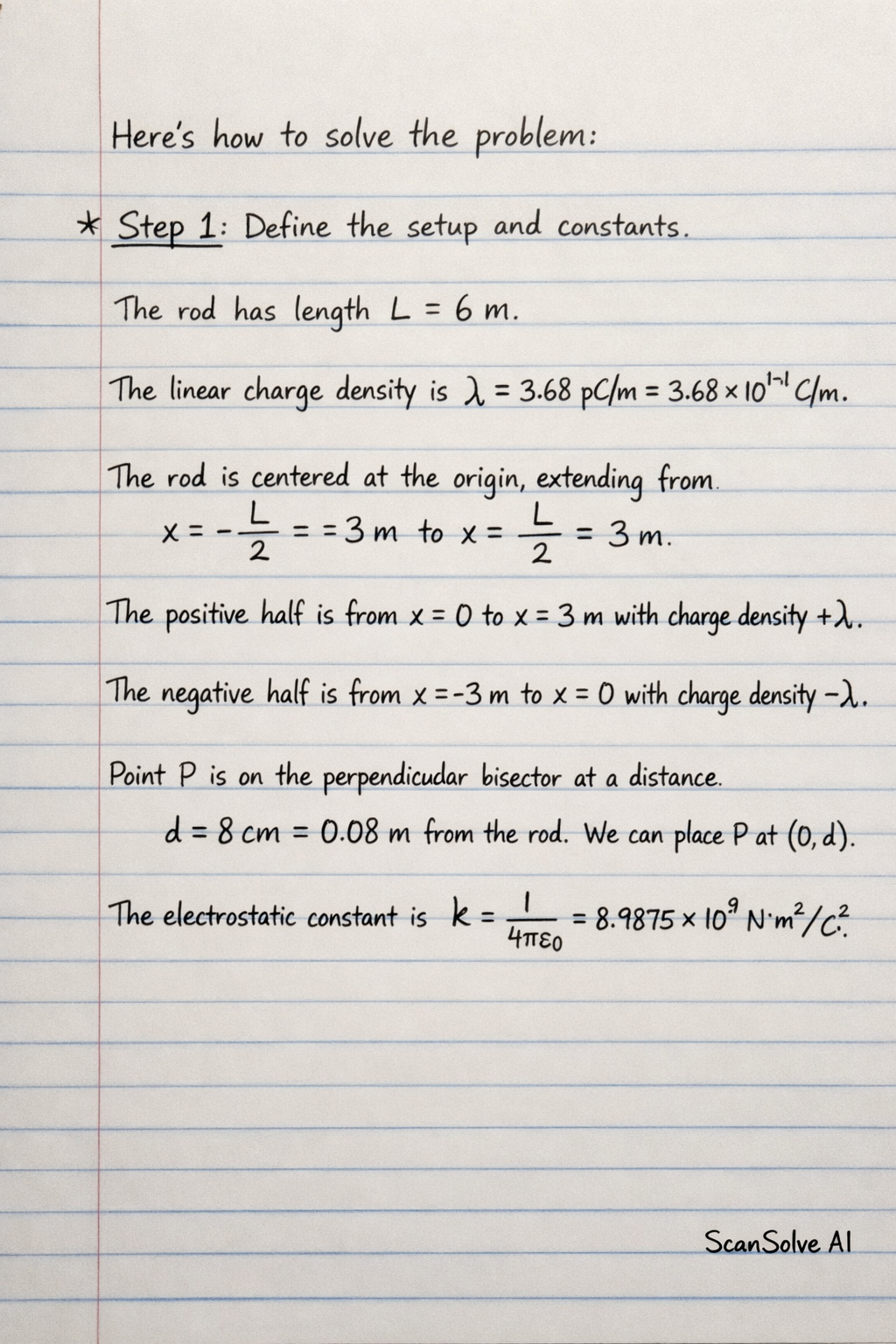
  • Step 1: Define the setup and constants. The rod has length L=6 mL = 6 \text{ m}. The linear charge density is λ=3.68 pC/m=3.68×10−12 C/m\lambda = 3.68 \text{ pC/m} = 3.68 \times 10^{-12} \text{ C/m}. The rod is centered at the origin, extending from x=−L/2=−3 mx = -L/2 = -3 \text{ m} to x=L/2=3 mx = L/2 = 3 \text{ m}. The positive half is from x=0x=0 to x=3 mx=3 \text{ m} with charge density +λ+\lambda. The negative half is from x=−3 mx=-3 \text{ m} to x=0x=0 with charge density −λ-\lambda. Point P is on the perpendicular bisector at a distance d=8 cm=0.08 md = 8 \text{ cm} = 0.08 \text{ m} from the rod. We can place P at (0,d)(0, d). The electrostatic constant is k=14πϵ0=8.9875×10⁹ N⋅m2/C2k = \frac{1}{4\pi\epsilon_0} = 8.9875 \times 10^9 \text{ N} \cdot \text{m}^2/\text{C}^2.

  • Step 2: Calculate the electric potential VV at point P (part a). The electric potential VV at point P due to a continuous charge distribution is given by V=∫k dqrV = \int \frac{k \, dq}{r}. For a linear charge distribution, dq=λ′ dxdq = \lambda' \, dx, where λ′\lambda' is the charge density of the element. The distance from a charge element dqdq at (x,0)(x, 0) to point P at (0,d)(0, d) is r=x2+d2r = \sqrt{x^2 + d^2}.

    The total potential VV is the sum of potentials from the positive and negative halves:

    V=V++V−V = V_+ + V_- V+=∫0L/2kλ dxx2+d2V_+ = \int_{0}^{L/2} \frac{k \lambda \, dx}{\sqrt{x^2 + d^2}} V−=∫−L/20k(−λ) dxx2+d2V_- = \int_{-L/2}^{0} \frac{k (-\lambda) \, dx}{\sqrt{x^2 + d^2}}

    Let's change the variable in V−V_- by setting x′=−xx' = -x, so dx′=−dxdx' = -dx. When x=−L/2x=-L/2, x′=L/2x'=L/2. When x=0x=0, x′=0x'=0.

    V−=∫L/20k(−λ)(−dx′)(−x′)2+d2=∫L/20kλ dx′(x′)2+d2V_- = \int_{L/2}^{0} \frac{k (-\lambda) (-dx')}{\sqrt{(-x')^2 + d^2}} = \int_{L/2}^{0} \frac{k \lambda \, dx'}{\sqrt{(x')^2 + d^2}} V−=−∫0L/2kλ dx′(x′)2+d2V_- = - \int_{0}^{L/2} \frac{k \lambda \, dx'}{\sqrt{(x')^2 + d^2}}

    Notice that V−=−V+V_- = -V_+.
    Therefore, the total electric potential at point P is:

    V=V++(−V+)=0V = V_+ + (-V_+) = 0

    This result is expected due to the symmetry of the charge distribution and the position of point P on the perpendicular bisector. For every positive charge element at xx, there is a corresponding negative charge element at −x-x, both equidistant from P, causing their potential contributions to cancel out.

    The electric potential at point P is 0 V\boxed{0 \text{ V}}.

  • Step 3: Calculate the electric field EE at point P (part b). The electric field E⃗\vec{E} is a vector quantity. We need to calculate its components ExE_x and EyE_y. An infinitesimal electric field dE⃗d\vec{E} due to a charge element dqdq at (x,0)(x,0) at point P (0,d)(0,d) has components:

    dEx=k dqr2cos⁡αdE_x = \frac{k \, dq}{r^2} \cos \alpha dEy=k dqr2sin⁡αdE_y = \frac{k \, dq}{r^2} \sin \alpha

    where r=x2+d2r = \sqrt{x^2+d^2}, cos⁡α=−xr\cos \alpha = \frac{-x}{r}, and sin⁡α=dr\sin \alpha = \frac{d}{r}.

    For the x-component (ExE_x):
    For the positive half (0≤x≤L/20 \le x \le L/2, dq=+λdxdq = +\lambda dx):

    dEx=k(λdx)x2+d2(−xx2+d2)=−kλx dx(x2+d2)3/2dE_x = \frac{k (\lambda dx)}{x^2+d^2} \left(\frac{-x}{\sqrt{x^2+d^2}}\right) = \frac{-k\lambda x \, dx}{(x^2+d^2)^{3/2}}

    For the negative half (−L/2≤x≤0-L/2 \le x \le 0, dq=−λdxdq = -\lambda dx):

    dEx=k(−λdx)x2+d2(−xx2+d2)=kλx dx(x2+d2)3/2dE_x = \frac{k (-\lambda dx)}{x^2+d^2} \left(\frac{-x}{\sqrt{x^2+d^2}}\right) = \frac{k\lambda x \, dx}{(x^2+d^2)^{3/2}}

    The total ExE_x is the sum of the integrals over both halves:

    Ex=∫0L/2−kλx dx(x2+d2)3/2+∫−L/20kλx dx(x2+d2)3/2E_x = \int_{0}^{L/2} \frac{-k\lambda x \, dx}{(x^2+d^2)^{3/2}} + \int_{-L/2}^{0} \frac{k\lambda x \, dx}{(x^2+d^2)^{3/2}}

    The integral ∫x dx(x2+d2)3/2=−1x2+d2\int \frac{x \, dx}{(x^2+d^2)^{3/2}} = -\frac{1}{\sqrt{x^2+d^2}}.

    Ex=[−kλ(−1x2+d2)]0L/2+[kλ(−1x2+d2)]−L/20E_x = [-k\lambda \left(-\frac{1}{\sqrt{x^2+d^2}}\right)]_{0}^{L/2} + [k\lambda \left(-\frac{1}{\sqrt{x^2+d^2}}\right)]_{-L/2}^{0} Ex=kλ[1x2+d2]0L/2−kλ[1x2+d2]−L/20E_x = k\lambda \left[\frac{1}{\sqrt{x^2+d^2}}\right]_{0}^{L/2} - k\lambda \left[\frac{1}{\sqrt{x^2+d^2}}\right]_{-L/2}^{0} Ex=kλ(1(L/2)2+d2−1d)−kλ(1d−1(−L/2)2+d2)E_x = k\lambda \left(\frac{1}{\sqrt{(L/2)^2+d^2}} - \frac{1}{d}\right) - k\lambda \left(\frac{1}{d} - \frac{1}{\sqrt{(-L/2)^2+d^2}}\right)

    Since (−L/2)2=(L/2)2(-L/2)^2 = (L/2)^2:

    Ex=kλ(1(L/2)2+d2−1d)−kλ(1d−1(L/2)2+d2)E_x = k\lambda \left(\frac{1}{\sqrt{(L/2)^2+d^2}} - \frac{1}{d}\right) - k\lambda \left(\frac{1}{d} - \frac{1}{\sqrt{(L/2)^2+d^2}}\right) Ex=kλ(1(L/2)2+d2−1d−1d+1(L/2)2+d2)E_x = k\lambda \left(\frac{1}{\sqrt{(L/2)^2+d^2}} - \frac{1}{d} - \frac{1}{d} + \frac{1}{\sqrt{(L/2)^2+d^2}}\right) Ex=2kλ(1(L/2)2+d2−1d)E_x = 2k\lambda \left(\frac{1}{\sqrt{(L/2)^2+d^2}} - \frac{1}{d}\right)

    For the y-component (EyE_y):
    For the positive half (0≤x≤L/20 \le x \le L/2, dq=+λdxdq = +\lambda dx):

    dEy=k(λdx)x2+d2(dx2+d2)=kλd dx(x2+d2)3/2dE_y = \frac{k (\lambda dx)}{x^2+d^2} \left(\frac{d}{\sqrt{x^2+d^2}}\right) = \frac{k\lambda d \, dx}{(x^2+d^2)^{3/2}}

    For the negative half (−L/2≤x≤0-L/2 \le x \le 0, dq=−λdxdq = -\lambda dx):

    dEy=k(−λdx)x2+d2(dx2+d2)=−kλd dx(x2+d2)3/2dE_y = \frac{k (-\lambda dx)}{x^2+d^2} \left(\frac{d}{\sqrt{x^2+d^2}}\right) = \frac{-k\lambda d \, dx}{(x^2+d^2)^{3/2}}

    The total EyE_y is:

    Ey=∫0L/2kλd dx(x2+d2)3/2+∫−L/20−kλd dx(x2+d2)3/2E_y = \int_{0}^{L/2} \frac{k\lambda d \, dx}{(x^2+d^2)^{3/2}} + \int_{-L/2}^{0} \frac{-k\lambda d \, dx}{(x^2+d^2)^{3/2}}

    The integral ∫dx(x2+d2)3/2=1d2xx2+d2\int \frac{dx}{(x^2+d^2)^{3/2}} = \frac{1}{d^2} \frac{x}{\sqrt{x^2+d^2}}.

    Ey=[kλdd2xx2+d2]0L/2−[kλdd2xx2+d2]−L/20E_y = \left[\frac{k\lambda d}{d^2} \frac{x}{\sqrt{x^2+d^2}}\right]_{0}^{L/2} - \left[\frac{k\lambda d}{d^2} \frac{x}{\sqrt{x^2+d^2}}\right]_{-L/2}^{0} Ey=kλd(L/2(L/2)2+d2−0)−kλd(0−−L/2(−L/2)2+d2)E_y = \frac{k\lambda}{d} \left(\frac{L/2}{\sqrt{(L/2)^2+d^2}} - 0\right) - \frac{k\lambda}{d} \left(0 - \frac{-L/2}{\sqrt{(-L/2)^2+d^2}}\right) Ey=kλdL/2(L/2)2+d2−kλdL/2(L/2)2+d2=0E_y = \frac{k\lambda}{d} \frac{L/2}{\sqrt{(L/2)^2+d^2}} - \frac{k\lambda}{d} \frac{L/2}{\sqrt{(L/2)^2+d^2}} = 0

    This is also expected due to symmetry. The y-components of the electric field from corresponding positive and negative charge elements cancel out.

  • Step 4: Substitute values and calculate ExE_x. We have L/2=3 mL/2 = 3 \text{ m} and d=0.08 md = 0.08 \text{ m}. (L/2)2+d2=(3 m)2+(0.08 m)2=9+0.0064=9.0064≈3.001066 m\sqrt{(L/2)^2+d^2} = \sqrt{(3 \text{ m})^2 + (0.08 \text{ m})^2} = \sqrt{9 + 0.0064} = \sqrt{9.0064} \approx 3.001066 \text{ m}.

    Ex=2×(8.9875×109 N⋅m2/C2)×(3.68×10−12 C/m)×(13.001066 m−10.08 m)E_x = 2 \times (8.9875 \times 10^9 \text{ N} \cdot \text{m}^2/\text{C}^2) \times (3.68 \times 10^{-12} \text{ C/m}) \times \left(\frac{1}{3.001066 \text{ m}} - \frac{1}{0.08 \text{ m}}\right) Ex=(66.149×10⁻³ N/C)×(0.333214−12.5)E_x = (66.149 \times 10^{-3} \text{ N/C}) \times (0.333214 - 12.5) Ex=(66.149×10⁻³)×(−12.166786)E_x = (66.149 \times 10^{-3}) \times (-12.166786) Ex≈−0.8049 N/CE_x \approx -0.8049 \text{ N/C}

    The magnitude of the electric field is ∣Ex∣|E_x|. Rounding to three significant figures:

    ∣Ex∣≈0.805 N/C|E_x| \approx 0.805 \text{ N/C}

    The electric field points in the negative x-direction (towards the negative half of the rod).

The electric field at point P is 0.805 N/C\boxed{0.805 \text{ N/C}} (pointing towards the negative half of the rod).
3 zimekamilika, zimebaki 2 leo. Unapiga hatua.

Was this helpful?

Try one yourself

A new problem that tests the same skill.

Still stuck on this one?

Ask a follow-up, and the answer starts from this question.

Got a different question?Ask your own question
Handwritten step-by-step solution preview

Handwritten Step-by-Step Solution

Get this as a handwritten image on WhatsApp — like a tutor wrote it for you.

Try on WhatsApp