

This physics problem tests your understanding of fundamental physical laws and their applications. The step-by-step solution below breaks down the problem using relevant equations and physical reasoning.
ScanSolve AI Answer
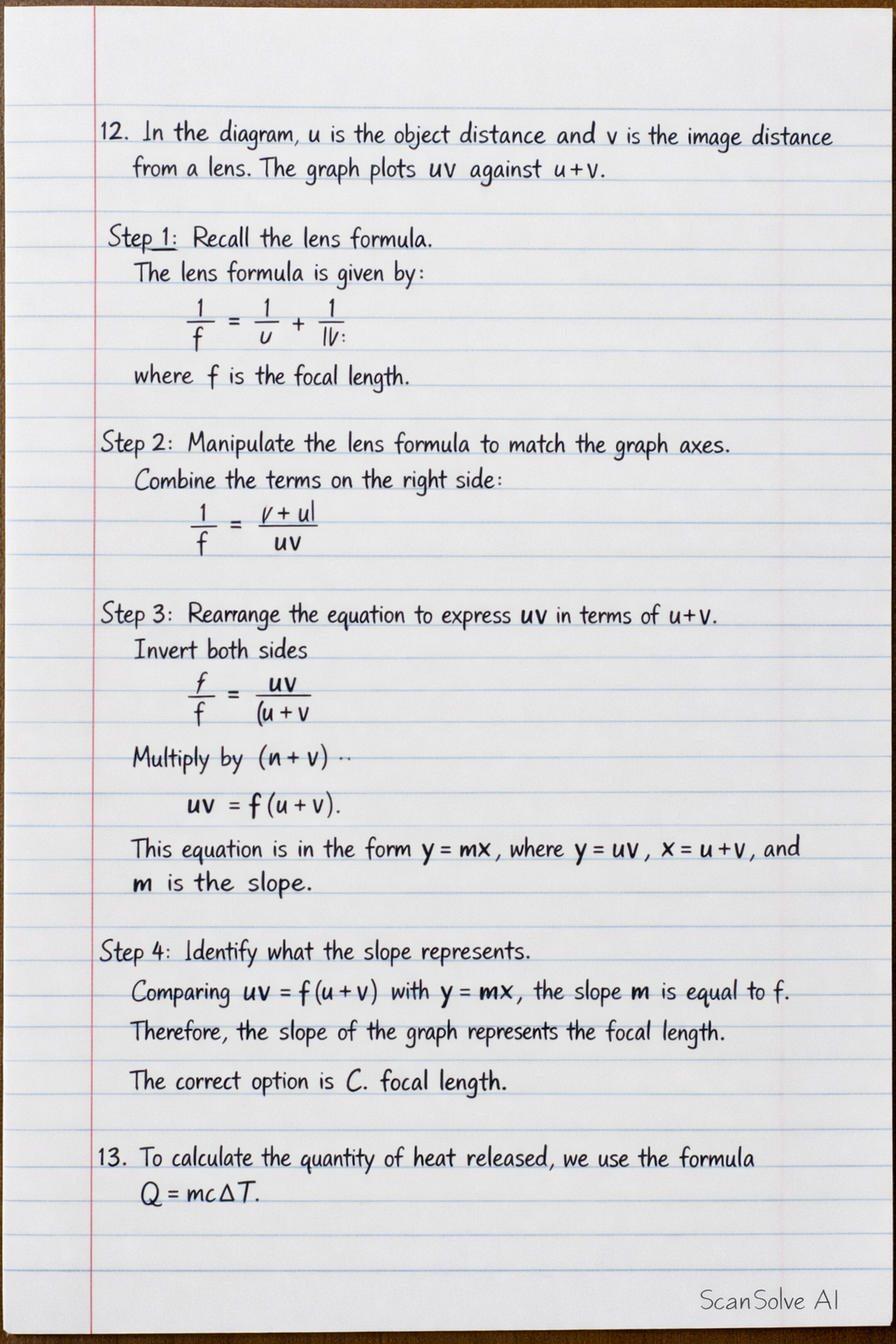
Here are the solutions to the questions: 12. In the diagram, u is the object distance and v is the image distance from a lens. The graph plots UV against U+V. Step 1: Recall the lens formula. The lens formula is given by: (1)/(f) = (1)/(u) + (1)/(v) where f is the focal length. Step 2: Manipulate the lens formula to match the graph axes. Combine the terms on the right side: (1)/(f) = (v+u)/(uv) Step 3: Rearrange the equation to express uv in terms of u+v. Invert both sides: f = (uv)/(u+v) Multiply by (u+v): uv = f(u+v) This equation is in the form y = mx, where y = uv, x = u+v, and m is the slope. Step 4: Identify what the slope represents. Comparing uv = f(u+v) with y = mx, the slope m is equal to f. Therefore, the slope of the graph represents the focal length. The correct option is C. focal length. 13. To calculate the quantity of heat released, we use the formula Q = mc T. Step 1: Identify the given values and convert units to S.I. units where necessary. Mass (m) = 100 g = 0.1 kg Specific heat capacity (c) = 460 Jkg^-1K^-1 Initial temperature (T_1) = 70 °C Final temperature (T_2) = 20 °C Step 2: Calculate the change in temperature ( T). T = T_1 - T_2 = 70 °C - 20 °C = 50 °C Since a change of 1 °C is equivalent to a change of 1 K, T = 50 K. Step 3: Substitute the values into the heat released formula. Q = mc T Q = (0.1 kg) × (460 Jkg^-1K^-1) × (50 K) Step 4: Calculate the quantity of heat released. Q = 0.1 × 460 × 50 J Q = 46 × 50 J Q = 2300 J Step 5: Express the answer in scientific notation and compare with the options. Q = 2.3 × 10^3 J The correct option is A. 2.3 × 10^3 J. 3 done, 2 left today. You're making progress.