

This physics problem tests your understanding of fundamental physical laws and their applications. The step-by-step solution below breaks down the problem using relevant equations and physical reasoning.
ScanSolve AI Answer
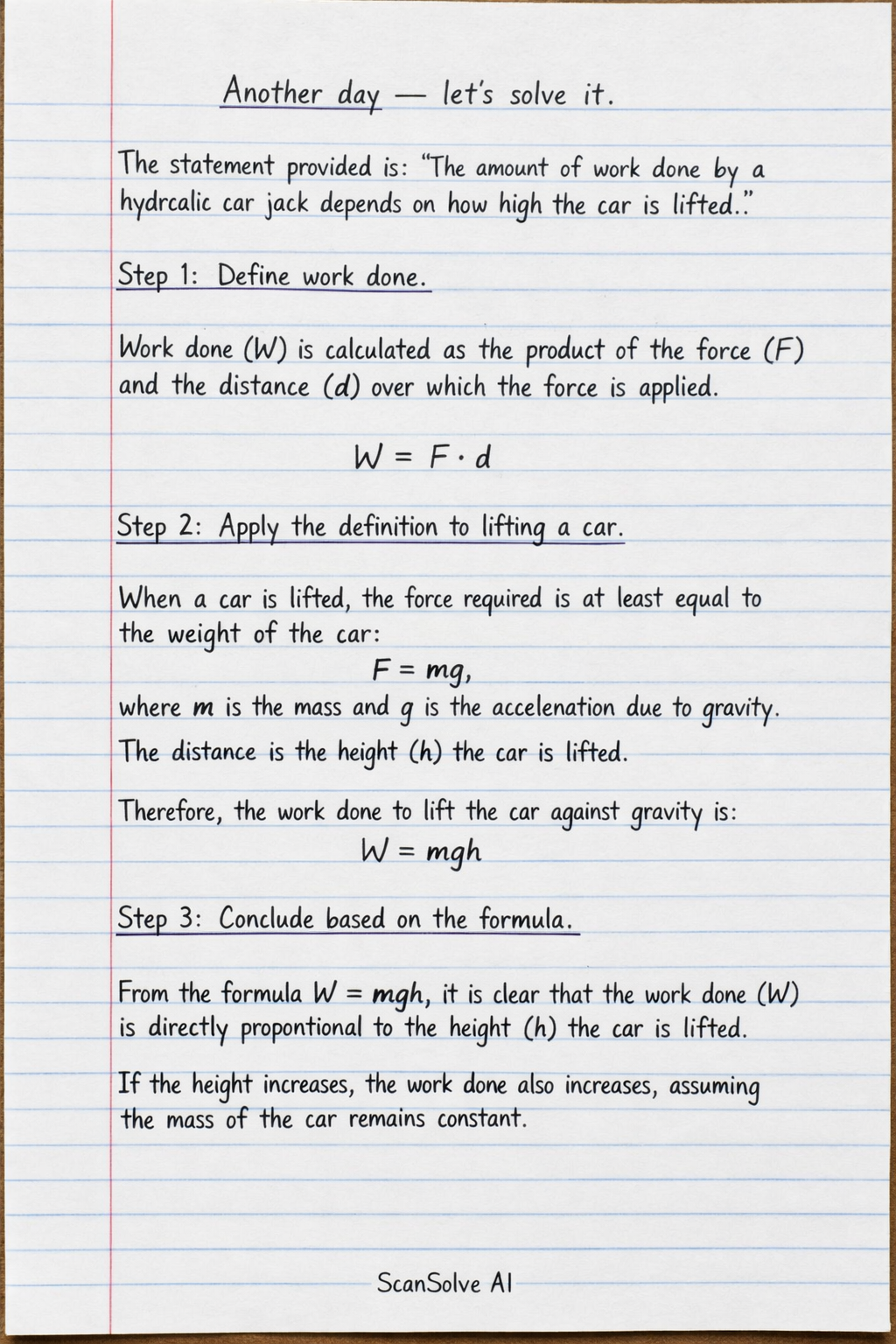
Another day — let's solve it. The statement provided is: "The amount of work done by a hydraulic car jack depends on how high the car is lifted." Step 1: Define work done. Work done (W) is calculated as the product of the force applied (F) and the distance (d) over which the force is applied in the direction of the force. W = F · d Step 2: Apply the definition to lifting a car. When a car is lifted, the force required is at least equal to the weight of the car (F = mg, where m is the mass and g is the acceleration due to gravity). The distance over which this force is applied is the height (h) the car is lifted. Therefore, the work done to lift the car against gravity is: W = mg h Step 3: Conclude based on the formula. From the formula W = mgh, it is clear that the work done (W) is directly proportional to the height (h) the car is lifted. If the height increases, the work done also increases, assuming the mass of the car remains constant. The statement is correct. The amount of work done by a hydraulic car jack to lift a car indeed depends on how high the car is lifted. The statement is correct. Send me the next one 📸