
We read your photo as:
Keats presents his fears primarily through the lens of unfulfilled artistic potential and the brevity of life.
ScanSolve AI Answer
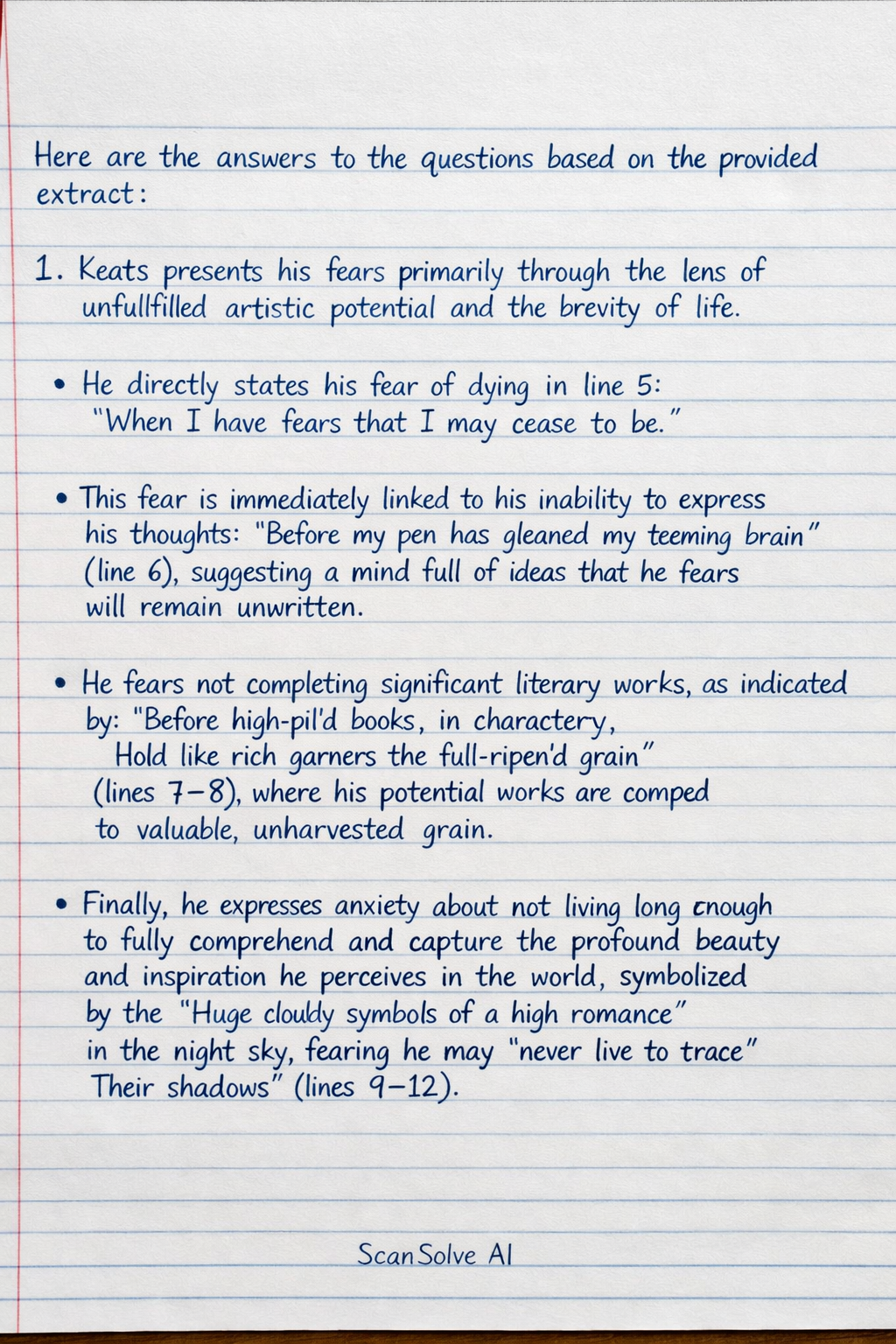
Here are the answers to the questions based on the provided extract:
-
Keats presents his fears primarily through the lens of unfulfilled artistic potential and the brevity of life.
- He directly states his fear of dying in line 5: "When I have fears that I may cease to be."
- This fear is immediately linked to his inability to express his thoughts: "Before my pen has gleaned my teeming brain" (line 6), suggesting a mind full of ideas that he fears will remain unwritten.
- He fears not completing significant literary works, as indicated by "Before high-pil'd books, in charactery, / Hold like rich garners the full-ripen'd grain" (lines 7-8), where his potential works are compared to valuable, unharvested grain.
- Finally, he expresses anxiety about not living long enough to fully comprehend and capture the profound beauty and inspiration he perceives in the world, symbolized by the "Huge cloudy symbols of a high romance" in the night sky, fearing he may "never live to trace / Their shadows" (lines 9-12).
-
The phrase "teeming brain" (line 6) suggests that the speaker's mind is full of ideas, thoughts, and creative potential. It implies a fertile and highly active intellect.
-
The figure of speech in "Hold like rich garners the full-ripen'd grain" (line 7) is a simile.
- It compares the speaker's unwritten thoughts or potential literary works to "full-ripen'd grain" stored in "rich garners" (storehouses). The use of "like" explicitly draws a parallel, suggesting that his ideas are valuable and ready to be harvested and preserved in books.
-
The imagery of the night sky in lines 9-12 ("night's starred face," "Huge cloudy symbols of a high romance") contributes to the poem's meaning by representing the vastness of inspiration, profound beauty, and the sublime themes of love and romance that Keats yearns to capture in his poetry. This imagery highlights the grand scale of his artistic ambition and, by extension, the tragic nature of his fear that he may die before he can fully explore and express these deep, romantic inspirations. It underscores his anxiety about the transient nature of life preventing the fulfillment of his artistic purpose.
-
In my opinion, Keats is more afraid of leaving his work unfinished.
- While line 5 directly mentions the fear of death ("When I have fears that I may cease to be"), the subsequent lines elaborate on why death is feared. The poem immediately shifts to the consequences of death: "Before my pen has gleaned my teeming brain," "Before high-pil'd books... Hold like rich garners the full-ripen'd grain," and "I may never live to trace / Their shadows" (referring to the "high romance" of the night sky). These phrases consistently emphasize the unfulfilled potential and unwritten works, indicating that death is primarily a source of fear because it would prevent him from achieving his artistic goals and leaving a lasting legacy.
Still stuck on this one?
Ask a follow-up, and the answer starts from this question.
More Physics Questions
Handwritten Step-by-Step Solution
Get this as a handwritten image on WhatsApp — like a tutor wrote it for you.
Try on WhatsApp