
This physics problem tests your understanding of fundamental physical laws and their applications. The step-by-step solution below breaks down the problem using relevant equations and physical reasoning.
ScanSolve AI Answer
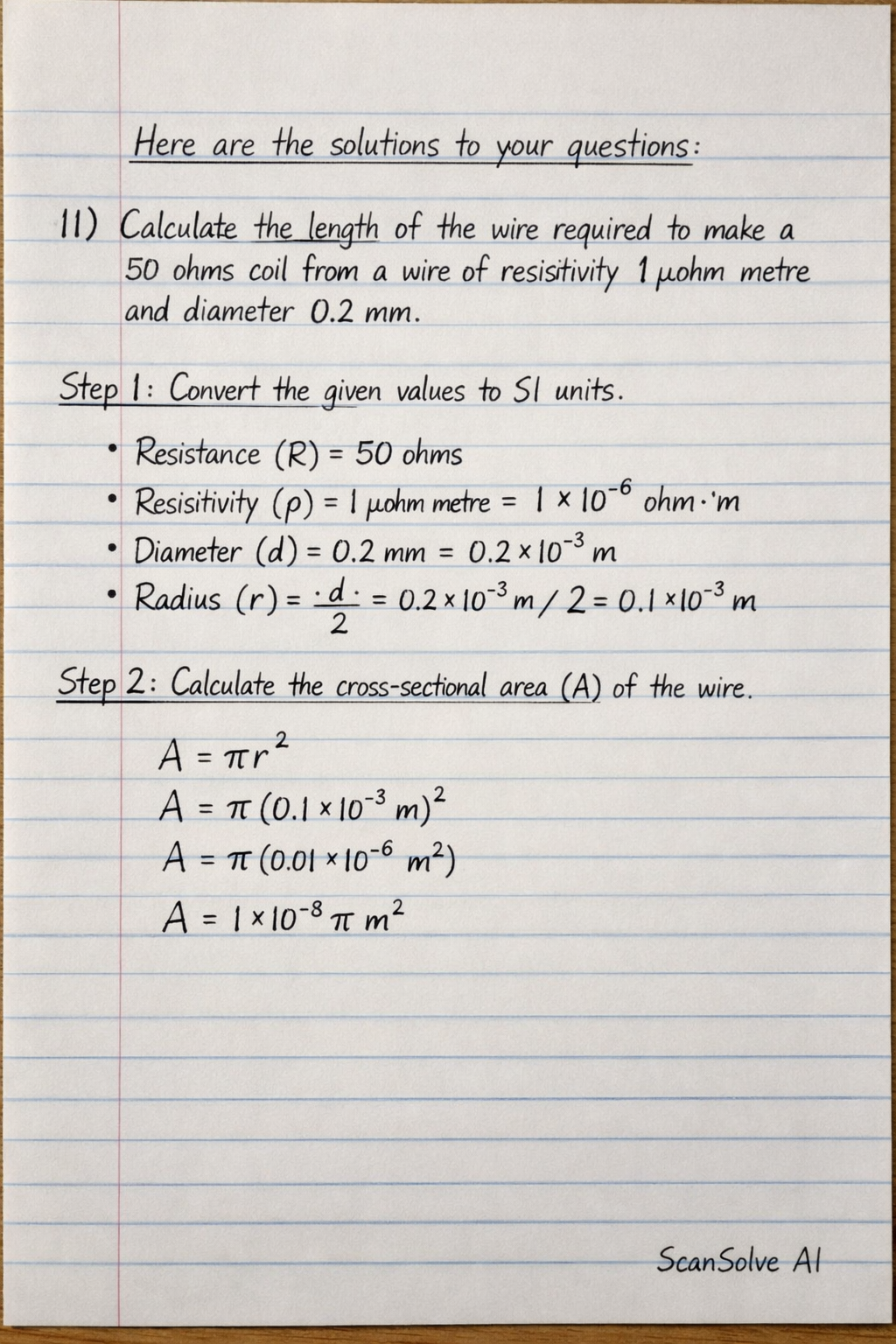
Here are the solutions to your questions: 11) Calculate the length of the wire required to make a 50ohms coil from a wire of resistivity 1uohm metre and diameter 0.2mm. Step 1: Convert the given values to SI units. Resistance (R) = 50 ohms Resistivity () = 1 uohm metre = 1 × 10^-6 ohm · m Diameter (d) = 0.2 mm = 0.2 × 10^-3 m Radius (r) = (d)/(2) = 0.2 × 10^-3 m2 = 0.1 × 10^-3 m Step 2: Calculate the cross-sectional area (A) of the wire. A = r^2 A = (0.1 × 10^-3 m)^2 A = (0.01 × 10^-6 m^2) A = 1 × 10^-8 m^2 Step 3: Use the formula for resistance to find the length (L). The formula for resistance is R = (L)/(A). Rearranging for L: L = (R · A)/() L = 50 ohms × (1 × 10^-8 m^2)1 × 10^-6 ohm · m L = 50 × 10^-81 × 10^-6 m L = 50 × 10^-2 m L = 0.50 m Using ≈ 3.14159: L ≈ 0.50 × 3.14159 m L ≈ 1.5708 m The length of the wire required is 1.57 m. 12) An electron occupies a certain energy level before to ground state. If the Uncertainty in determining the time is 6.3×10^-3 secs, Calculate the Uncertainty in determining it's energy level at that level. (h=1.055×10^-34Js) Step 1: Identify the given values and the relevant principle. Uncertainty in time ( t) = 6.3 × 10^-3 s The given value h = 1.055 × 10^-34 J · s is the reduced Planck's constant (). Heisenberg's Uncertainty Principle for energy and time states: E t ()/(2) However, in many contexts, especially for multiple-choice questions, a simplified form E t is used when is provided directly. We will use this form to match the options. Step 2: Calculate the minimum uncertainty in energy ( E). E ()/( t) E 1.055 × 10^-34 J · s6.3 × 10^-3 s E (1.055)/(6.3) × 10^-34 - (-3) J E 0.16746 × 10^-31 J E 1.6746 × 10^-32 J This value is approximately 1.68 × 10^-32 J. The correct option is (C). C) E≥1.68×10^-32 13) In gas experiment, pressure is plotted against reciprocal of volume at constant pressure. Calculate the unit of slope of the resulting curve. Step 1: Identify the relationship between pressure and volume at constant temperature. According to Boyle's Law, for a fixed amount of gas at constant temperature, the pressure (P) is inversely proportional to the volume (V). P (1)/(V) This can be written as: P = k ((1)/(V)) where k is a constant. Step 2: Determine the slope of the curve. If pressure (P) is plotted on the y-axis and reciprocal of volume (1/V) is plotted on the x-axis, the equation is in the form y = mx, where m is the slope. Thus, the slope (m) is equal to the constant k. From Boyle's Law, PV = k. Therefore, the slope is PV. Step 3: Calculate the unit of the slope. The unit of pressure (P) is Pascal (Pa) or Newton per square meter (N/m^2). The unit of volume (V) is cubic meter (m^3). The unit of the slope is the unit of P × V: Unit of slope = Unit of P × Unit of V Unit of slope = Pa · m^3 Unit of slope = (Nm^2) · m^3 Unit of slope = N · m A Newton-meter (N · m) is the unit of work or energy, which is the Joule (J). The unit of the slope of the resulting curve is Joule (J). 14) The force that causes the steering wheel of a car to rotate is... The rotation of a steering wheel is caused by a couple. A couple consists of two forces of equal magnitude, acting in opposite directions, and separated by a perpendicular distance. This arrangement produces a pure rotational effect (torque) without causing any translational motion. The correct option is (D). D) Couple 15) Gauge pressure for a manometer is described as... Gauge pressure is the pressure measured relative to the ambient atmospheric pressure. It is defined as the difference between the absolute pressure of a fluid and the local atmospheric pressure. P_gauge = P_absolute - P_atmospheric Let's analyze the given options: A) Difference between atmospheric pressure and absolute pressure. This option describes P_atmospheric - P_absolute, which is the negative of the standard gauge pressure. However, it is the only option that correctly identifies gauge pressure as a difference* between atmospheric and absolute pressure. The other options are fundamentally incorrect descriptions of gauge pressure. The correct option is (A). A) Difference between atmospheric pressure and absolute pressure. 16) Oxygen gas is heated at constant volume to a temperature of 27°C. If mass is 16g, what is the heat needed by the gas. (Molar Heat capacity=0.85mol-¹K-¹) Step 1: Identify the given values and make necessary assumptions. Gas: Oxygen (O_2) Process: Heated at constant volume. Mass (m) = 16 g Molar heat capacity at constant volume (C_v) = 0.85 J · mol^-1K^-1 Temperature: "to a temperature of 27^". Since no initial temperature is given, we assume this refers to the change* in temperature, T = 27 K. (A change of 27^ is equivalent to a change of 27 K). Step 2: Calculate the number of moles (n) of oxygen gas. Molar mass of O_2 = 2 × 16.00 g/mol = 32.00 g/mol n = massmolar mass = 16 g32 g/mol = 0.5 mol Step 3: Calculate the heat needed (Q) using the formula for heat transfer at constant volume. Q = n C_v T Q = 0.5 mol × 0.85 J · mol^-1K^-1 × 27 K Q = 0.5 × 0.85 × 27 J Q = 0.425 × 27 J Q = 11.475 J Step 4: Compare the calculated value to the given options. The calculated value 11.475 J is closest to 12 J. The correct option is (B). B) 12