This physics problem tests your understanding of fundamental physical laws and their applications. The step-by-step solution below breaks down the problem using relevant equations and physical reasoning.
What method of making magnets is illustrated in set-ups A and B? Give the names of the parts of the current labelled I, II, and III in set-up B. How will you know the steel bar and iron nail are magnetized? Name any other method of making magnets. What will happen when the north pole of the bar magnet and the north pole of the steel bar are brought together?
Physics

ScanSolve AI Answer
Here are the answers to the questions in SECTION B:
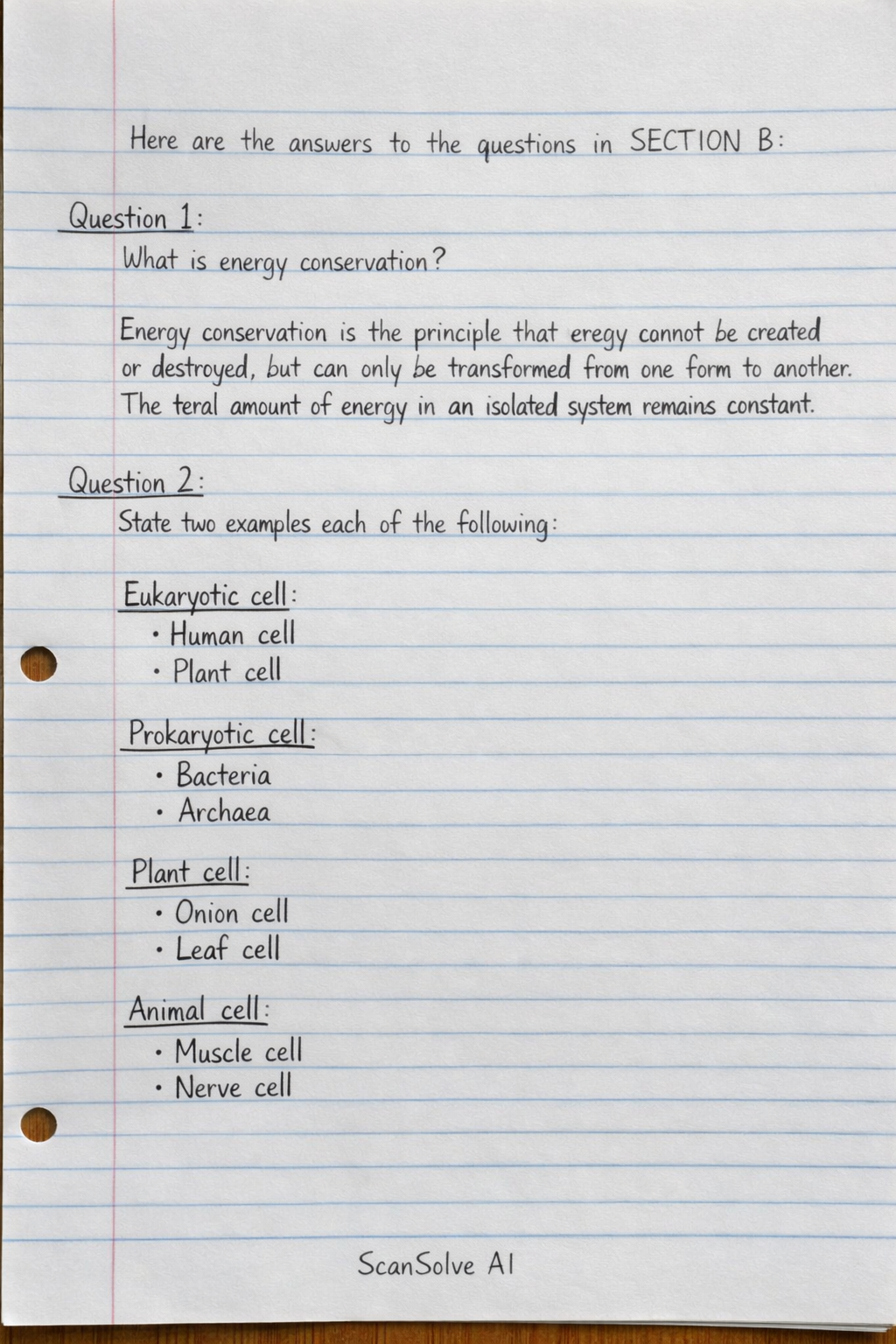
Question 1: What is energy conservation? Energy conservation is the principle that energy cannot be created or destroyed, but can only be transformed from one form to another. The total amount of energy in an isolated system remains constant.
Question 2: State two examples each of the following:
- Eukaryotic cell:
- Human cell
- Plant cell
- Prokaryotic cell:
- Bacteria
- Archaea
- Plant cell:
- Onion cell
- Leaf cell
- Animal cell:
- Muscle cell
- Nerve cell
Was this helpful?
Still stuck on this one?
Ask a follow-up, and the answer starts from this question.
Got a different question?Ask your own question
More Physics Questions
QThe diagrams below are of two methods used in making magnets. Study them and use them to answer the…QDescribe how to identify wood, steel, and another bar magnet from three given objects using a known…Qa) Explain how the plotting compasses show that bar AB is a magnet. b) Draw the magnetic field lines…QA bar magnet is freely suspended by a thread at its midpoint. A small piece of iron is brought near…QWhich of the poles of the magnet, labelled (c) and (d) in Figure 1, are North and South poles? Brief…

Handwritten Step-by-Step Solution
Get this as a handwritten image on WhatsApp — like a tutor wrote it for you.
Try on WhatsAppScanSolve AI Answer
Here are the answers to the questions in SECTION B: Question 1: What is energy conservation? Energy conservation is the principle that energy cannot be created or destroyed, but can only be transformed from one form to another. The total amount of energy in an isolated system remains constant. Question 2: State two examples each of the following: Eukaryotic cell: Human cell* Plant cell* Prokaryotic cell: Bacteria* Archaea* Plant cell: Onion cell* Leaf cell* Animal cell: Muscle cell* Nerve cell*