
We read your photo as:
Describe the motion of the bus using a speed-time graph and calculate its average speed.
Physics
ScanSolve AI Answer
Step-by-step solution
3 stepsHere's the solution for Item 3:
Part a· 2 steps
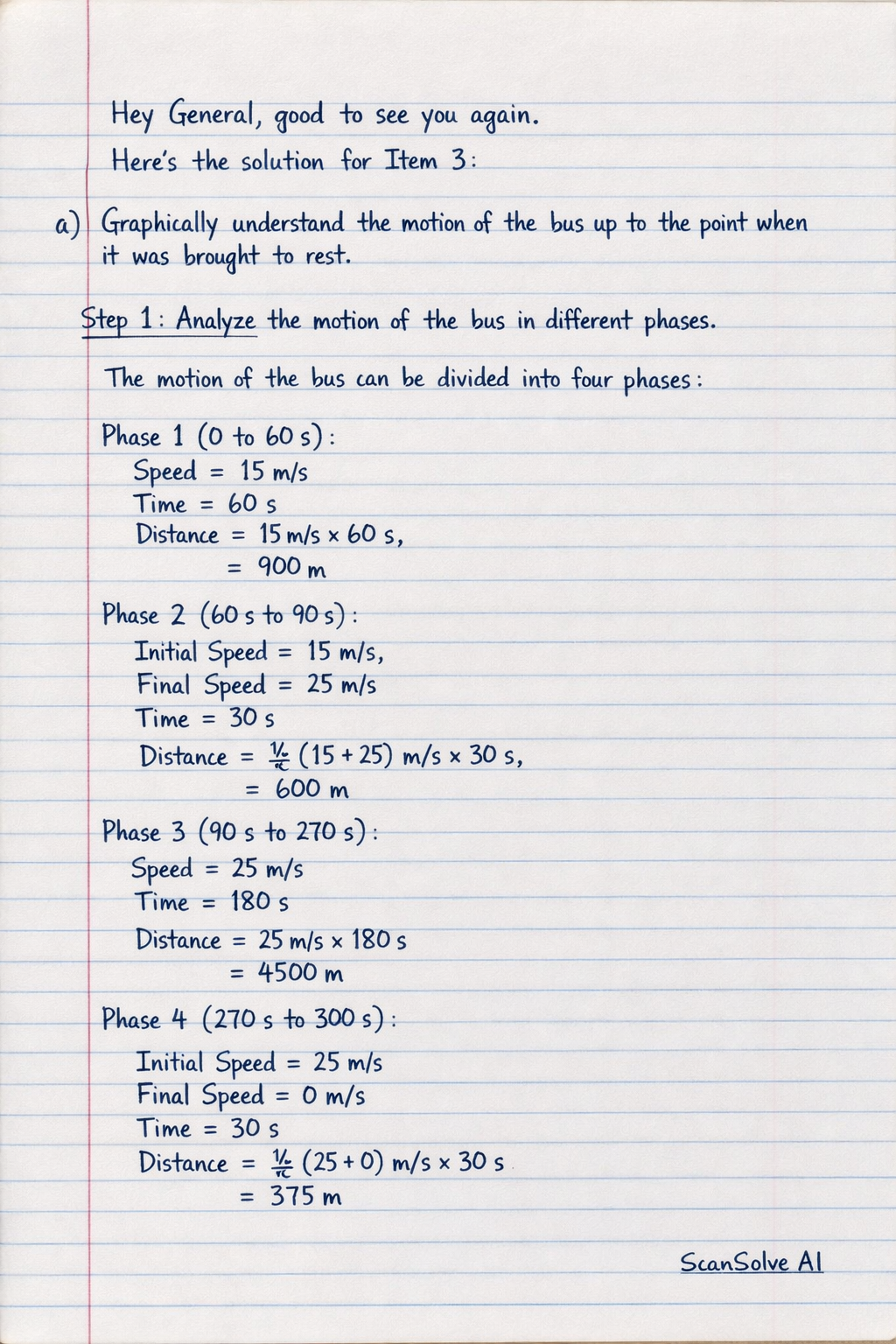
Graphically understand the motion of the bus up to the point when it was brought to rest.
Analyze the motion of the bus in different phases.
The motion of the bus can be divided into four phases:
- Phase 1 (0 to 60 s): The bus moves at a constant speed of for ().
- Phase 2 (60 s to 90 s): The speed increases linearly from to over .
- Phase 3 (90 s to 270 s): The bus maintains a constant speed of for ().
- Phase 4 (270 s to 300 s): The bus decelerates linearly from to (rest) over .
Describe the speed-time graph.
A speed-time graph for this motion would show:
- A horizontal line from $(0, 15)$ to $(60, 15)$, representing constant speed.
- A straight line sloping upwards from $(60, 15)$ to $(90, 25)$, representing constant acceleration.
- A horizontal line from $(90, 25)$ to $(270, 25)$, representing constant speed.
- A straight line sloping downwards from $(270, 25)$ to $(300, 0)$, representing constant deceleration.
Part b· 1 step
Estimate the average speed of the bus for the motion.
Calculate the distance traveled in each phase.
- Phase 1:
- Phase 2:
- Phase 3:
- Phase 4: $d_4 = \frac{(initial speed + final speed)}{2} \times
Was this helpful?
Still stuck on this one?
Ask a follow-up, and the answer starts from this question.
Got a different question?Ask your own question
More Physics Questions
QA car's motion is represented by a distance-time graph. Describe the motion in segments OA, AB, and…QAs a student of Physics, help the students in the bus (a) Graphically understand the motion of the…QF hours after the departure of the bus from P. (a) Express the average speed of the trailer in terms…QWork out the average speed of the bus for the whole journey. The median of four consecutive counting…QA car's motion is represented by a speed-time graph. Analyze the motion at points R, S, and T, find…
Browse by topic:Mechanics
Handwritten Step-by-Step Solution
Get this as a handwritten image on WhatsApp — like a tutor wrote it for you.
Try on WhatsApp