This physics problem tests your understanding of fundamental physical laws and their applications. The step-by-step solution below breaks down the problem using relevant equations and physical reasoning.
दो संधारित्रों को समानांतर क्रम में जोड़ने पर उभयनिष्ठ विभव की गणना करें।
Physics

ScanSolve AI Answer
Answer
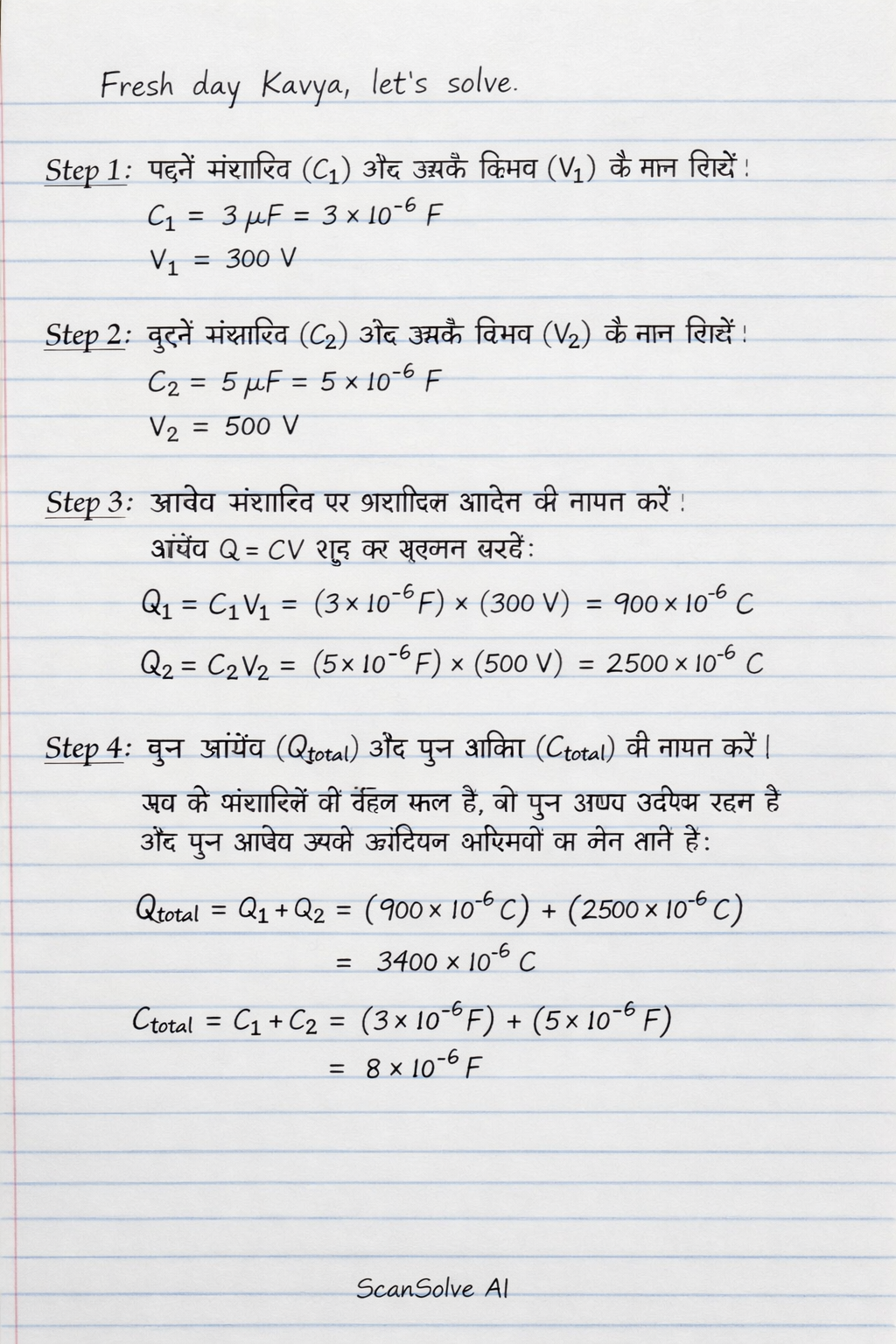
Step 1: पहले संधारित्र () और उसके विभव () के मान लिखें।
Step 2: दूसरे संधारित्र () और उसके विभव () के मान लिखें।
Step 3: प्रत्येक संधारित्र पर प्रारंभिक आवेश की गणना करें। आवेश सूत्र का उपयोग करके:
Step 4: कुल आवेश () और कुल धारिता () की गणना करें। जब दो संधारित्रों को जोड़ा जाता है, तो कुल आवेश संरक्षित रहता है और कुल धारिता उनकी व्यक्तिगत धारिताओं का योग होती है।
Step 5: उभयनिष्ठ विभव () की गणना करें। उभयनिष्ठ विभव का सूत्र है:
सही विकल्प है: [C]
Was this helpful?
Still stuck on this one?
Ask a follow-up, and the answer starts from this question.
Got a different question?Ask your own question
More Physics Questions
QComplete the table with data collected of person A and person B. Draw line graphs on the same system…QPlease write me a note and teaching material from the Module: Engine Fuels and Fuel Performance expl…QA light bulb is connected to a 9 V battery. Predict what will happen to the brightness of the bulb i…Q3 Will the motor car stop before reaching the wreck of the truck? Show all working in your answer.QLP Grade 10 Physical Sciences...

Handwritten Step-by-Step Solution
Get this as a handwritten image on WhatsApp — like a tutor wrote it for you.
Try on WhatsAppScanSolve AI Answer
Step 1: पहले संधारित्र (C_1) और उसके विभव (V_1) के मान लिखें। C_1 = 3 F = 3 × 10^-6 F V_1 = 300 V Step 2: दूसरे संधारित्र (C_2) और उसके विभव (V_2) के मान लिखें। C_2 = 5 F = 5 × 10^-6 F V_2 = 500 V Step 3: प्रत्येक संधारित्र पर प्रारंभिक आवेश की गणना करें। आवेश Q = CV सूत्र का उपयोग करके: Q_1 = C_1 V_1 = (3 × 10^-6 F) × (300 V) = 900 × 10^-6 C Q_2 = C_2 V_2 = (5 × 10^-6 F) × (500 V) = 2500 × 10^-6 C Step 4: कुल आवेश (Q_total) और कुल धारिता (C_total) की गणना करें। जब दो संधारित्रों को जोड़ा जाता है, तो कुल आवेश संरक्षित रहता है और कुल धारिता उनकी व्यक्तिगत धारिताओं का योग होती है। Q_total = Q_1 + Q_2 = (900 × 10^-6 C) + (2500 × 10^-6 C) = 3400 × 10^-6 C C_total = C_1 + C_2 = (3 × 10^-6 F) + (5 × 10^-6 F) = 8 × 10^-6 F Step 5: उभयनिष्ठ विभव (V_common) की गणना करें। उभयनिष्ठ विभव का सूत्र है: V_common = Q_totalC_total V_common = 3400 × 10^-6 C8 × 10^-6 F V_common = (3400)/(8) V V_common = 425 V सही विकल्प है: [C] 425 V