
We read your photo as:
Two balls, A and B, move towards each other. Ball A has a change in momentum of 2.4 kg·m·s⁻¹ to the left. Ball B has a mass of 0.3 kg and an initial velocity of 15 m·s⁻¹ to the left. What is the initi
ScanSolve AI Answer
Answer
Step-by-step solution
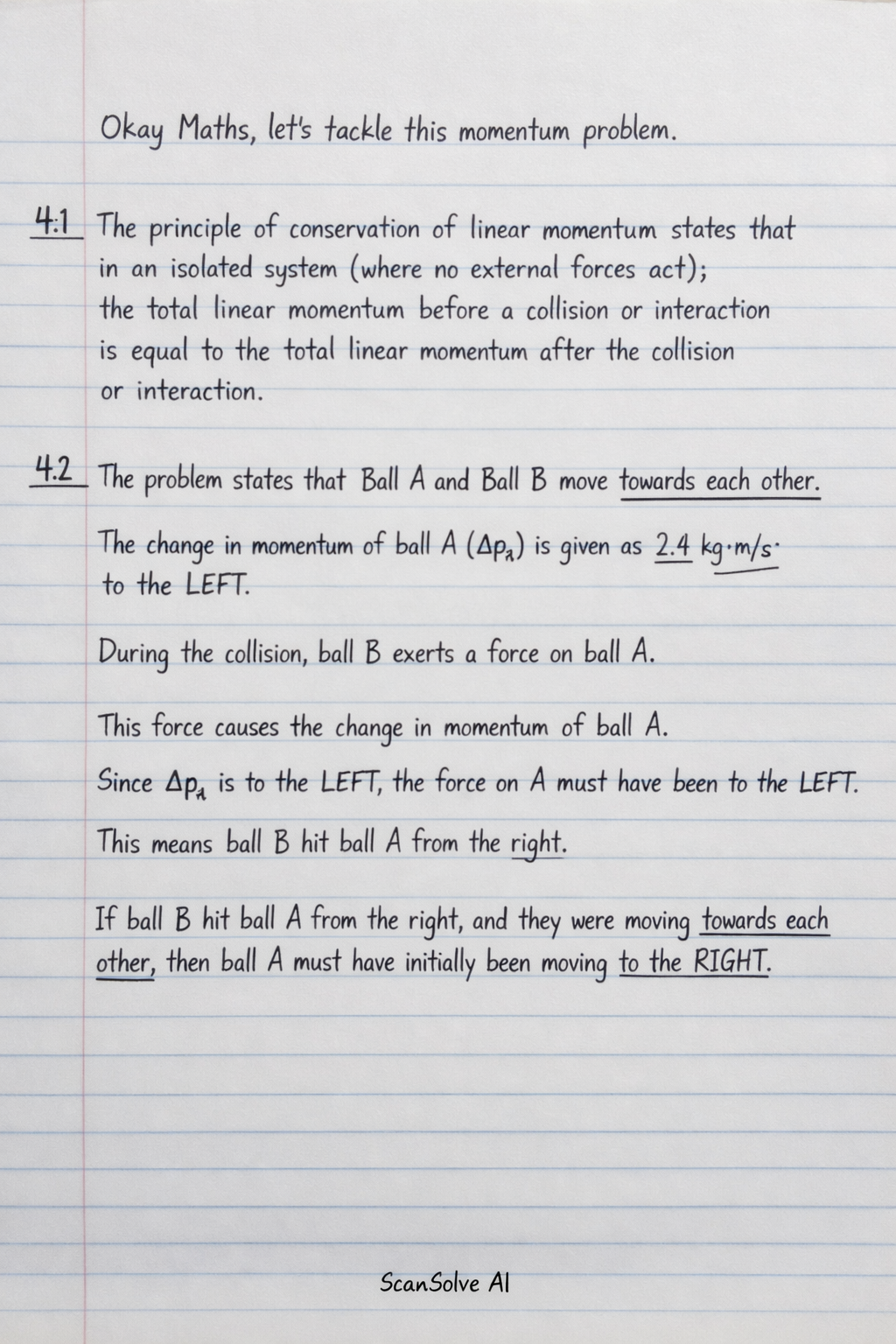
4 stepsOkay Maths, let's tackle this momentum problem.
Part 4.1
The principle of conservation of linear momentum states that in an isolated system (where no external forces act), the total linear momentum before a collision or interaction is equal to the total linear momentum after the collision or interaction.
Part 4.2
The problem states that Ball A and Ball B move towards each other.
The change in momentum of ball A () is given as to the LEFT.
During the collision, ball B exerts a force on ball A. This force causes the change in momentum of ball A. Since is to the LEFT, the force on A must have been to the LEFT. This means ball B hit ball A from the right.
If ball B hit ball A from the right, and they were moving towards each other, then ball A must have initially been moving to the RIGHT.
Part 4.3
Define a positive direction and identify given values.
Let's choose RIGHT as the positive direction.
- Mass of ball B,
- Initial speed of ball B, . Since ball B moves towards ball A (which is initially moving right), ball B's initial velocity is to the LEFT. So, .
- Change in momentum of ball A, to the LEFT. So, .
Apply the impulse-momentum theorem relationship between the two balls.
According to Newton's Third Law, the impulse exerted by ball A on ball B is equal in magnitude and opposite in direction to the impulse exerted by ball B on ball A. Therefore, the change in momentum of ball B () is equal in magnitude and opposite in direction to the change in momentum of ball A ().
This means the change in momentum of ball B is to the RIGHT.
Calculate the final velocity of ball B using the change in momentum formula.
The change in momentum for ball B is given by:
Substitute the known values:
Solve for .
The negative sign indicates that the final velocity of ball B is to the LEFT.
The velocity of ball B after the collision is .
Try one yourself
A new problem that tests the same skill.
Still stuck on this one?
Ask a follow-up, and the answer starts from this question.
More Physics Questions
Handwritten Step-by-Step Solution
Get this as a handwritten image on WhatsApp — like a tutor wrote it for you.
Try on WhatsApp