
We read your photo as:
Two balls, A and B, are suspended from the ceiling by a spring and a string, respectively. Both balls have the same mass. The string holding Ball B is cut. What happens to Ball A and Ball B, and which
ScanSolve AI Answer
Answer
Ball B will hit the ground first.
Here's why:
-
Ball B (String): When the string holding Ball B is cut, the tension in the string immediately drops to zero. The only force acting on Ball B is gravity, which pulls it downwards. Therefore, Ball B begins to accelerate downwards instantly with an acceleration equal to the acceleration due to gravity ().
-
Ball A (Spring): Before the cut, the spring is stretched by the weight of Ball A, exerting an upward force equal to (where is the mass of the ball and is the acceleration due to gravity) to keep it in equilibrium. When the suspension point of the spring is cut, the spring is still attached to Ball A and is still stretched by the same amount at that instant. This means the spring continues to exert an upward force of on Ball A. The forces acting on Ball A immediately after the cut are gravity ( downwards) and the spring force ( upwards). The net force on Ball A is . Therefore, Ball A's initial acceleration is zero.
Since Ball B starts accelerating downwards immediately at , while Ball A has an initial acceleration of 0, Ball B will begin to fall first and reach the ground before Ball A.
Try one yourself
A new problem that tests the same skill.
Still stuck on this one?
Ask a follow-up, and the answer starts from this question.
More Physics Questions
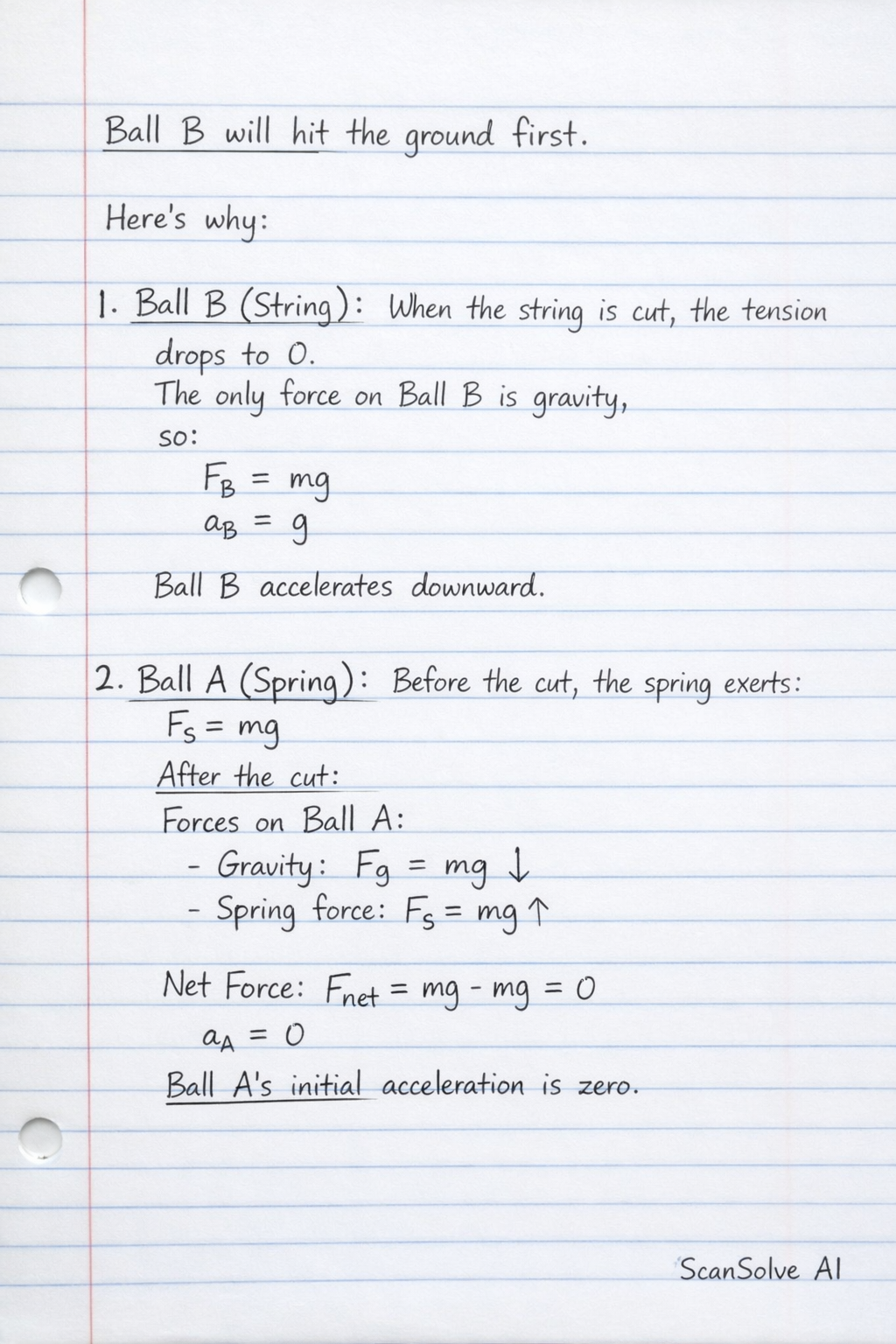
Handwritten Step-by-Step Solution
Get this as a handwritten image on WhatsApp — like a tutor wrote it for you.
Try on WhatsApp