
We read your photo as:
Understand the relationship between power, voltage, current, and losses.
ScanSolve AI Answer
Step-by-step solution
7 stepsPart 8· 4 steps
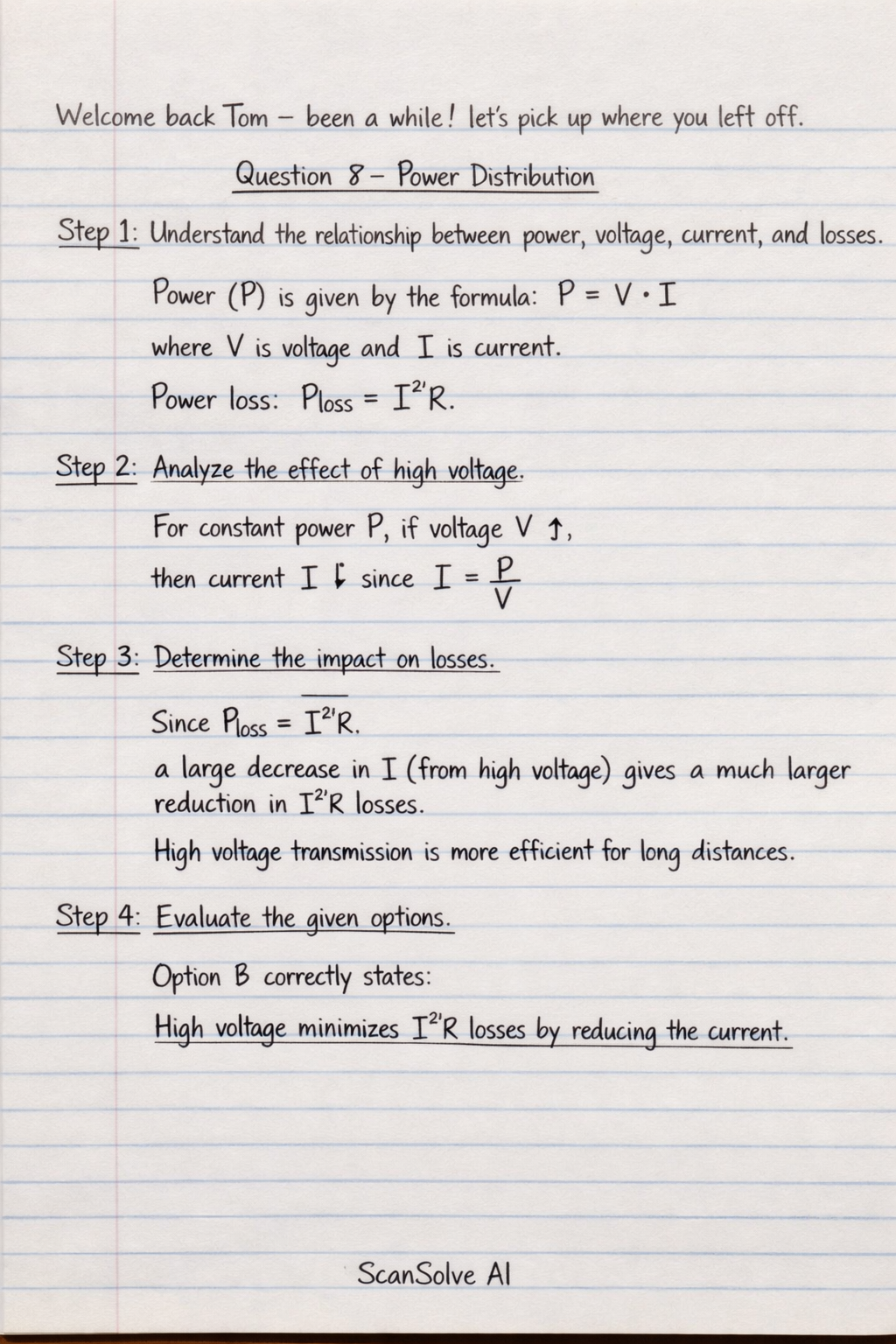
Power Distribution
Understand the relationship between power, voltage, current, and losses.
The power () transmitted is given by the formula , where is voltage and is current. The power loss () in transmission lines due to resistance () is given by .
Analyze the effect of high voltage.
For a constant amount of power to be transmitted, if the voltage is increased, the current must decrease ().
Determine the impact on losses.
Since power loss is proportional to the square of the current (), a significant reduction in current (due to high voltage) leads to a much larger reduction in losses. This makes high voltage transmission more efficient for long distances.
Evaluate the given options.
Option B correctly states that high voltage minimizes losses by reducing the current.
The final answer is
Part 9· 3 steps
Mechanical and Hand Power Tools
Understand the risks of welding near precision components.
Arc welding involves high electrical currents. If this current passes through sensitive components like antifriction bearings, it can cause localized heating, arcing, and pitting on the bearing surfaces. This damage can lead to premature failure of the bearing.
Identify the appropriate precaution.
To prevent damage, the welding current must be directed only through the work piece and back to the welding machine, avoiding any unintended paths through precision mechanical components.
Evaluate the given options.
Option C directly addresses this concern by stating that one should avoid allowing welding current to pass through the bearing. Options A and B are either incorrect or would increase the risk of damage.
The final answer is
Still stuck on this one?
Ask a follow-up, and the answer starts from this question.
More Physics Questions
Handwritten Step-by-Step Solution
Get this as a handwritten image on WhatsApp — like a tutor wrote it for you.
Try on WhatsApp