
With good sketch, derive the equation of motion of a compound pendulum. What is the difference between a simple pendulum and a compound pendulum? State the equation(s) for calculating natural frequency in both pendulums.
ScanSolve AI Answer
Answer
Step-by-step solution
4 stepsHere are the explanations and derivations for pendulums:
- Derivation of the Equation of Motion of a Compound Pendulum
-
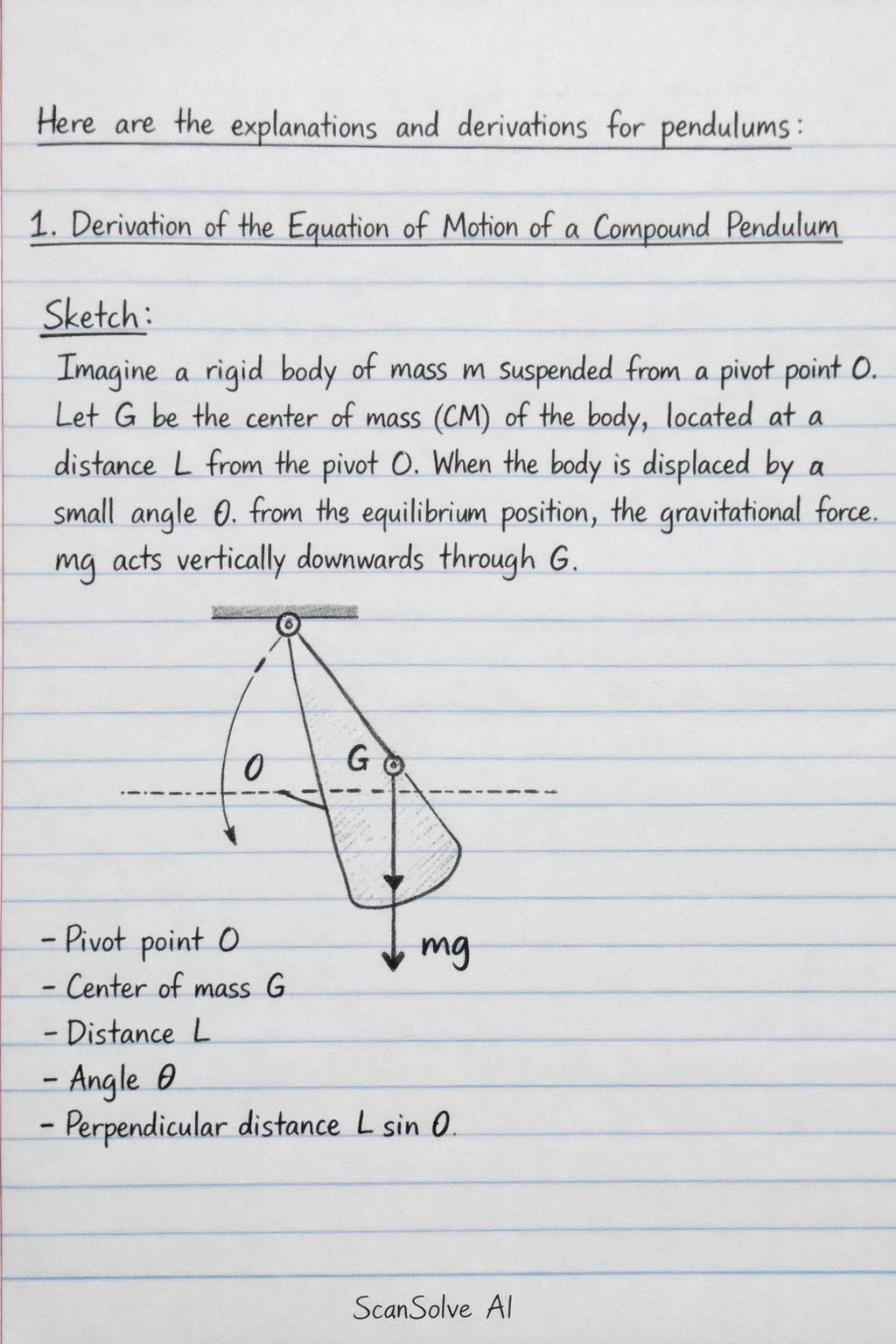
Sketch: Imagine a rigid body of mass suspended from a pivot point O. Let G be the center of mass (CM) of the body, located at a distance from the pivot O. When the body is displaced by a small angle from its equilibrium position, the gravitational force acts vertically downwards through G.
- Draw a pivot point O.
- Draw a rigid body hanging from O.
- Mark the center of mass G, a distance below O when at equilibrium.
- Show the body displaced by an angle from the vertical.
- Draw the gravitational force acting downwards through G.
- Indicate the perpendicular distance from O to the line of action of , which is .
-
Derivation:
-
Identify the forces and torques.
The only force creating a torque about the pivot O is gravity, , acting at the center of mass G.
The torque due to gravity about the pivot O is given by: The negative sign indicates that the torque acts to restore the pendulum to its equilibrium position (opposite to the direction of increasing ).Apply Newton's second law for rotational motion.
The rotational equivalent of Newton's second law is $\tau = I\alpha$, where $I$ is the moment of inertia of the compound pendulum about the pivot O, and $\alpha$ is the angular acceleration ($\ddot{\theta}$). $$ -mgL \sin\theta = I\ddot{\theta} $$Rearrange the equation.
$$ I\ddot{\theta} + mgL \sin\theta = 0 $$For small angles of oscillation, .
Substituting this approximation into the equation: $$ I\ddot{\theta} + mgL\theta = 0 $$ This is the equation of motion for a compound pendulum under small oscillations. $$ \boxed{I\ddot{\theta} + mgL\theta = 0} $$2. Difference between a Simple Pendulum and a Compound Pendulum * A simple pendulum consists of a point mass (bob) suspended by a massless, inextensible string from a fixed pivot. All its mass is concentrated at a single point. * A compound pendulum (or physical pendulum) is any rigid body that oscillates about a fixed pivot point under the influence of gravity. Its mass is distributed throughout its volume, and its moment of inertia about the pivot is a significant factor in its motion.
- Equations for Calculating Natural Frequency
-
Simple Pendulum: The natural angular frequency for a simple pendulum of length is:
where is the acceleration due to gravity.
-
Compound Pendulum: The natural angular frequency for a compound pendulum is:
where is the total mass of the pendulum, is the acceleration due to gravity, is the distance from the pivot to the center of mass, and is the moment of inertia of the pendulum about the pivot point.
-
- Equations for Calculating Natural Frequency
Try one yourself
A new problem that tests the same skill.
Still stuck on this one?
Ask a follow-up, and the answer starts from this question.
More Physics Questions
Handwritten Step-by-Step Solution
Get this as a handwritten image on WhatsApp — like a tutor wrote it for you.
Try on WhatsApp