
We read your photo as:
A student burns 60.5 g of charcoal (carbon) in excess oxygen. a) Identify the product and explain why it is a covalent compound. b) Explain if the product is suitable for cooking. c) Calculate the vol
ScanSolve AI Answer
Answer
Step-by-step solution
4 stepsPart a
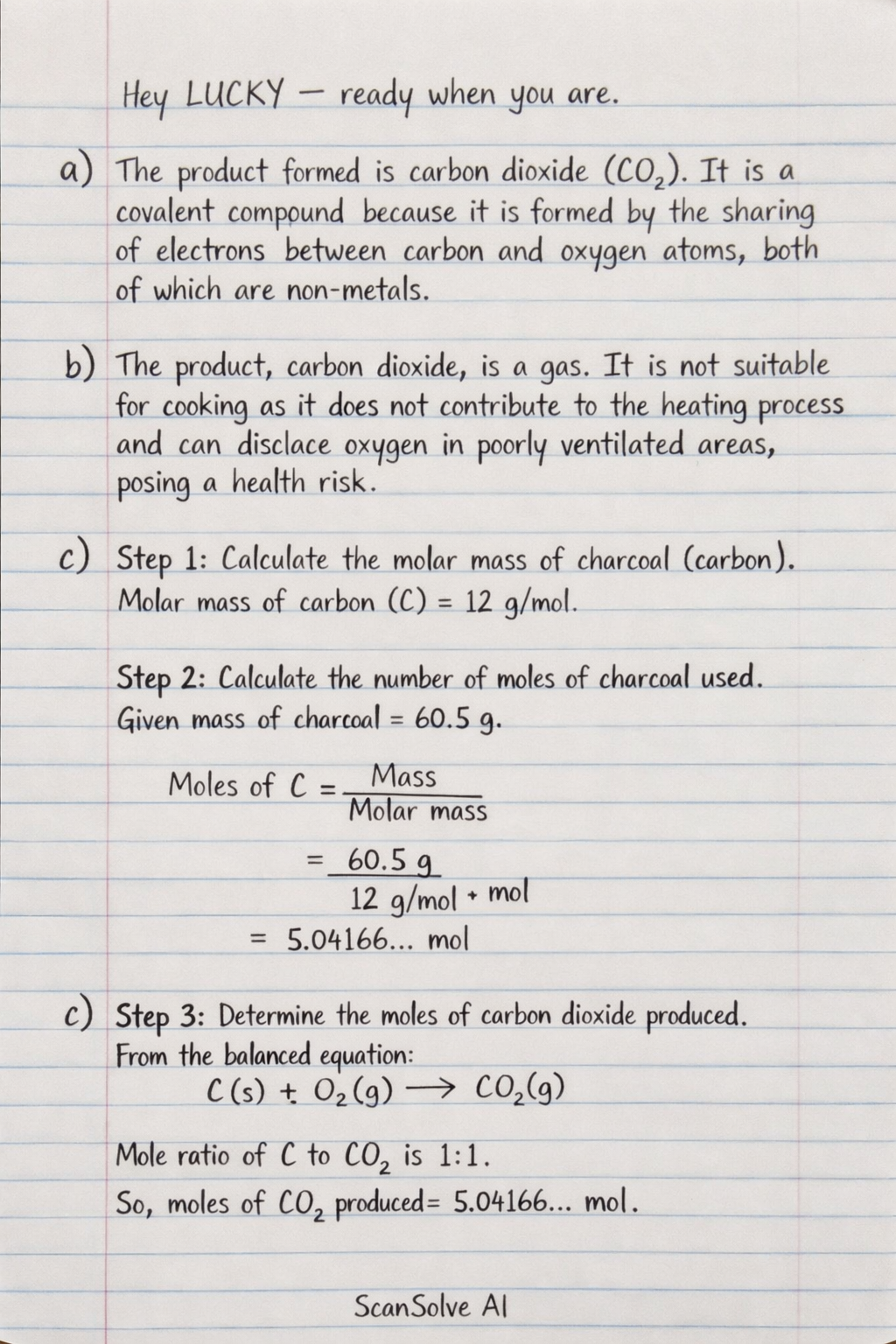
The product formed is carbon dioxide (). It is a covalent compound because it is formed by the sharing of electrons between carbon and oxygen atoms, both of which are non-metals.
Part b
The product, carbon dioxide, is a gas. It is not suitable for cooking as it does not contribute to the heating process and can displace oxygen in poorly ventilated areas, posing a health risk.
Part c
Calculate the molar mass of charcoal (carbon).
The molar mass of carbon (C) is .
Calculate the number of moles of charcoal used.
Given mass of charcoal = .
Determine the moles of carbon dioxide produced.
From the balanced equation , the mole ratio of C to is .
So, moles of produced = .Calculate the volume of carbon dioxide produced at s.t.p.
At s.t.p., 1 mole of any gas occupies .
Rounding to two decimal places:
d) Yes, carbon dioxide has several environmental impacts. It is a greenhouse gas that contributes to global warming and climate change. It also dissolves in water to form carbonic acid, leading to ocean acidification, which harms marine life.
Still stuck on this one?
Ask a follow-up, and the answer starts from this question.
More Chemistry Questions
Handwritten Step-by-Step Solution
Get this as a handwritten image on WhatsApp — like a tutor wrote it for you.
Try on WhatsApp