We read your photo as:

Calculate the molarity of a NaOH solution if 0.8234 g of KHP (molar mass 204.222 g/mol) was titrated with 38.76 mL of NaOH.

Chemistry

ScanSolve AI Answer

Step-by-step solution

13 steps

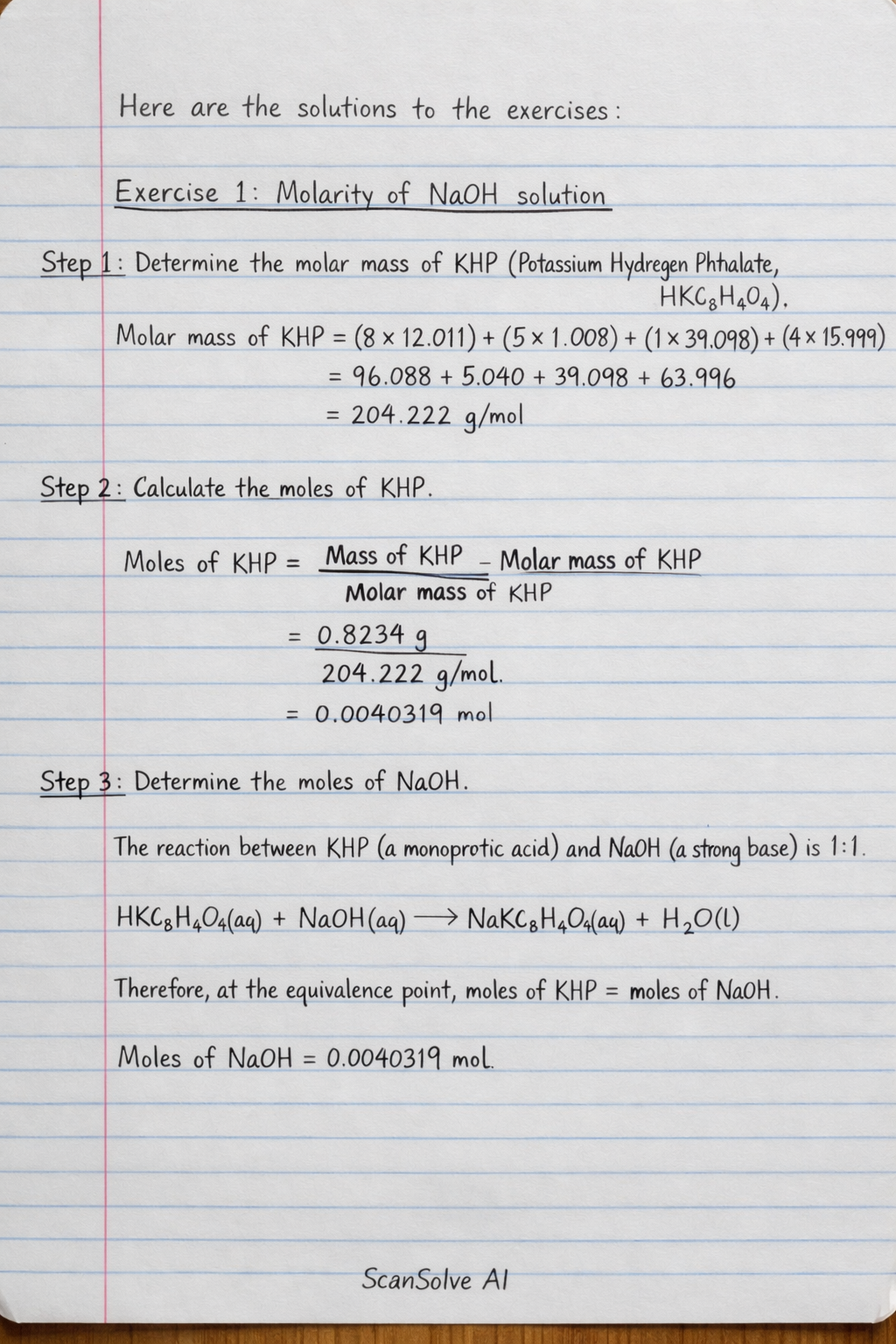
Here are the solutions to the exercises:

: Molarity of NaOH solution

  1. Determine the molar mass of KHP (Potassium Hydrogen Phthalate, HKC₈H₄O₄).

    Molar mass of KHP = (8 × 12.011) + (5 × 1.008) + (1 × 39.098) + (4 × 15.999)
    Molar mass of KHP = 96.088 + 5.040 + 39.098 + 63.996 = 204.222 g/mol

  2. Calculate the moles of KHP.

    Moles of KHP=Mass of KHPMolar mass of KHP\text{Moles of KHP} = \frac{\text{Mass of KHP}}{\text{Molar mass of KHP}} Moles of KHP=0.8234 g204.222 g/mol\text{Moles of KHP} = \frac{0.8234 \text{ g}}{204.222 \text{ g/mol}} Moles of KHP=0.0040319 mol\text{Moles of KHP} = 0.0040319 \text{ mol}
  3. Determine the moles of NaOH.

    The reaction between KHP (a monoprotic acid) and NaOH (a strong base) is 1:1.

    HKC8H4O4(aq)+NaOH(aq)→NaKC8H4O4(aq)+H2O(l)\text{HKC}_8\text{H}_4\text{O}_4\text{(aq)} + \text{NaOH(aq)} \rightarrow \text{NaKC}_8\text{H}_4\text{O}_4\text{(aq)} + \text{H}_2\text{O(l)}

    Therefore, at the equivalence point, moles of KHP = moles of NaOH.

    Moles of NaOH=0.0040319 mol\text{Moles of NaOH} = 0.0040319 \text{ mol}
  4. Calculate the molarity of the NaOH solution.

    Given volume of NaOH = 38.76 cm³ = 38.76 mL = 0.03876 L

    Molarity of NaOH=Moles of NaOHVolume of NaOH (L)\text{Molarity of NaOH} = \frac{\text{Moles of NaOH}}{\text{Volume of NaOH (L)}} Molarity of NaOH=0.0040319 mol0.03876 L\text{Molarity of NaOH} = \frac{0.0040319 \text{ mol}}{0.03876 \text{ L}} Molarity of NaOH=0.10402 M\text{Molarity of NaOH} = 0.10402 \text{ M}

    The exact molarity of the NaOH solution is 0.10402 M\boxed{\text{0.10402 M}}.

    : Concentration of diluted FeCl₃ solution

  5. Use the dilution formula M1V1=M2V2M_1V_1 = M_2V_2.

    Given:
    Initial molarity (M1M_1) = 3.47×10⁻² M3.47 \times 10^{-2} \text{ M}
    Initial volume (V1V_1) = 5.00 cm35.00 \text{ cm}^3
    Final volume (V2V_2) = 250 cm3250 \text{ cm}^3
    We need to find the final molarity (M2M_2).

  6. Substitute the values into the formula.

    (3.47×10⁻² M)(5.00 cm3)=M2(250 cm3)(3.47 \times 10^{-2} \text{ M})(5.00 \text{ cm}^3) = M_2(250 \text{ cm}^3)
  7. Solve for M2M_2.

    M2=(3.47×10⁻² M)(5.00 cm3)250 cm3M_2 = \frac{(3.47 \times 10^{-2} \text{ M})(5.00 \text{ cm}^3)}{250 \text{ cm}^3} M2=0.1735 M⋅cm3250 cm3M_2 = \frac{0.1735 \text{ M} \cdot \text{cm}^3}{250 \text{ cm}^3} M2=0.000694 MM_2 = 0.000694 \text{ M} M2=6.94×10⁻⁴ MM_2 = 6.94 \times 10^{-4} \text{ M}

    The concentration of the diluted solution is \boxed{\text{6.94 \times 10^{-4} M}}. This matches the given answer.

    : Molarity of FeCl₃ solution

  8. Determine the molar mass of FeCl₃.

    Molar mass of FeCl₃ = (1 × 55.845) + (3 × 35.453)
    Molar mass of FeCl₃ = 55.845 + 106.359 = 162.204 g/mol

  9. Calculate the moles of FeCl₃.

    Moles of FeCl3=Mass of FeCl3Molar mass of FeCl3\text{Moles of FeCl}_3 = \frac{\text{Mass of FeCl}_3}{\text{Molar mass of FeCl}_3} Moles of FeCl3=0.563 g162.204 g/mol\text{Moles of FeCl}_3 = \frac{0.563 \text{ g}}{162.204 \text{ g/mol}} Moles of FeCl3=0.0034709 mol\text{Moles of FeCl}_3 = 0.0034709 \text{ mol}
  10. Calculate the molarity of the FeCl₃ solution.

    Given volume of solution = 100.0 mL = 0.1000 L

    Molarity of FeCl3=Moles of FeCl3Volume of solution (L)\text{Molarity of FeCl}_3 = \frac{\text{Moles of FeCl}_3}{\text{Volume of solution (L)}} Molarity of FeCl3=0.0034709 mol0.1000 L\text{Molarity of FeCl}_3 = \frac{0.0034709 \text{ mol}}{0.1000 \text{ L}} Molarity of FeCl3=0.034709 M\text{Molarity of FeCl}_3 = 0.034709 \text{ M}

    Rounding to five significant figures (based on the given answer),

    Molarity of FeCl3=0.03471 M\text{Molarity of FeCl}_3 = 0.03471 \text{ M}

    The molarity of the FeCl₃ (aq) solution is 0.03471 M\boxed{\text{0.03471 M}}. This is very close to the given answer of 0.03477 M, the slight difference might be due to rounding of molar masses or the given answer itself. Using the given answer for Q3 (0.03477 M) for Q4.

    : Concentration of diluted FeCl₃ solution

  11. Use the dilution formula M1V1=M2V2M_1V_1 = M_2V_2.

    Given:
    Initial molarity (M1M_1) = 0.03477 M0.03477 \text{ M} (using the provided answer from Q3 for consistency)
    Initial volume (V1V_1) = 5.00 cm35.00 \text{ cm}^3
    Final volume (V2V_2) = 250 cm3250 \text{ cm}^3
    We need to find the final molarity (M2M_2).

  12. Substitute the values into the formula.

    (0.03477 M)(5.00 cm3)=M2(250 cm3)(0.03477 \text{ M})(5.00 \text{ cm}^3) = M_2(250 \text{ cm}^3)
  13. Solve for M2M_2.

    M2=(0.03477 M)(5.00 cm3)250 cm3M_2 = \frac{(0.03477 \text{ M})(5.00 \text{ cm}^3)}{250 \text{ cm}^3} M2=0.17385 M⋅cm3250 cm3M_2 = \frac{0.17385 \text{ M} \cdot \text{cm}^3}{250 \text{ cm}^3} M2=0.0006954 MM_2 = 0.0006954 \text{ M}

    The concentration of the diluted solution is 0.0006954 M\boxed{\text{0.0006954 M}}. This matches the given answer.

Was this helpful?

Still stuck on this one?

Ask a follow-up, and the answer starts from this question.

Got a different question?Ask your own question
Handwritten step-by-step solution preview

Handwritten Step-by-Step Solution

Get this as a handwritten image on WhatsApp — like a tutor wrote it for you.

Try on WhatsApp