
We read your photo as:
Which of the following pairs of enthalpy changes is always negative?
Chemistry
ScanSolve AI Answer
Answer
D
6.
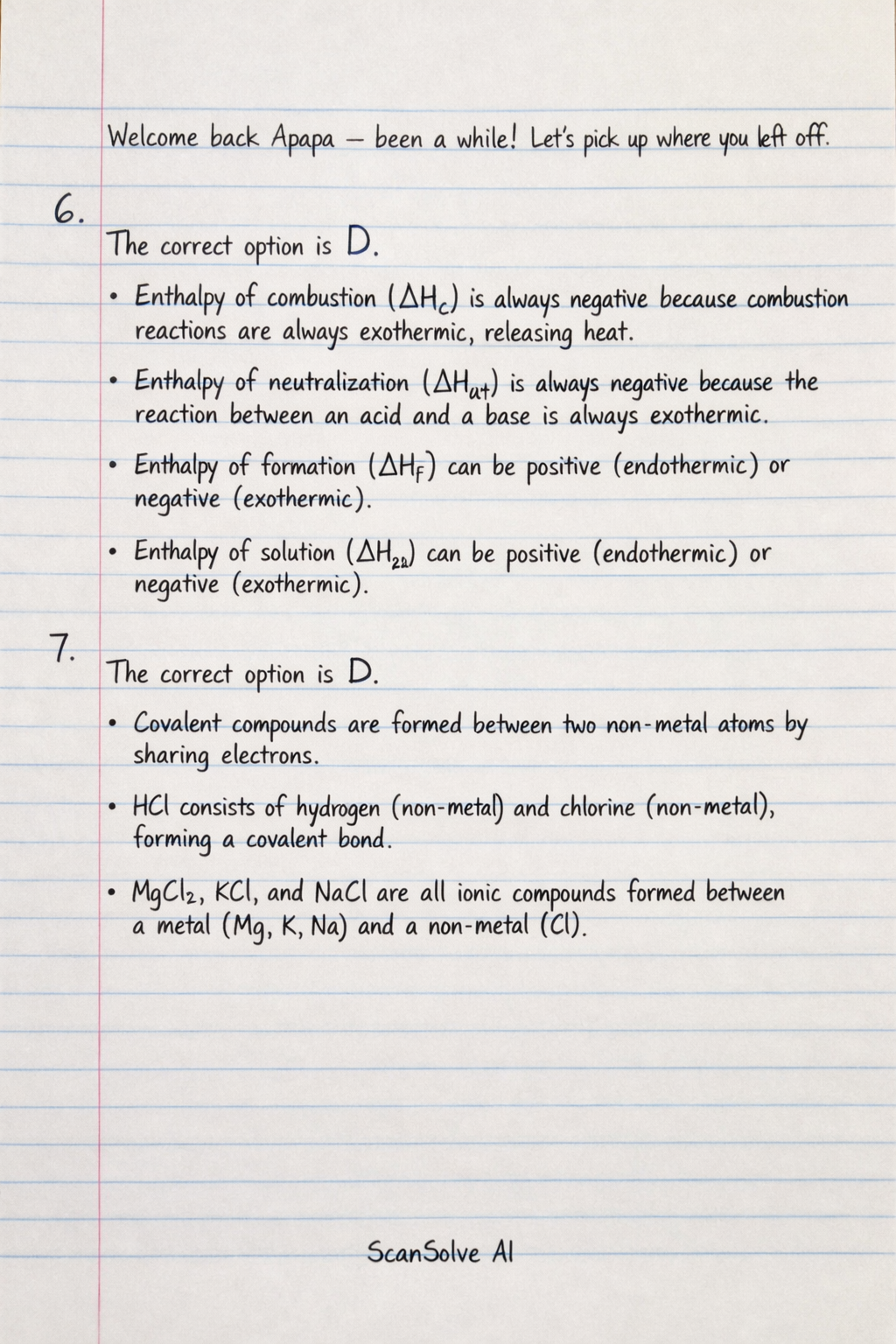
The correct option is D.
- Enthalpy of combustion () is always negative because combustion reactions are always exothermic, releasing heat.
- Enthalpy of neutralization () is always negative because the reaction between an acid and a base is always exothermic.
- Enthalpy of formation () can be positive (endothermic) or negative (exothermic).
- Enthalpy of solution () can be positive (endothermic) or negative (exothermic).
7.
The correct option is D.
- Covalent compounds are formed between two non-metal atoms by sharing electrons.
- HCl consists of hydrogen (non-metal) and chlorine (non-metal), forming a covalent bond.
- MgCl, KCl, and NaCl are all ionic compounds formed between a metal (Mg, K, Na) and a non-metal (Cl).
8.
The correct option is A.
- A soapy touch is a characteristic property of basic solutions.
- Basic solutions have a pH greater than 7. Among the given options, 12 is the only pH value that indicates a strongly basic solution.
9.
The correct option is C.
- Element X has a valency of +3, meaning it forms an ion X.
- Chlorine (Cl) has a valency of -1, meaning it forms an ion Cl.
- To form a neutral compound, one X ion will combine with three Cl ions.
- Therefore, the formula is XCl.
10.
The correct option is B.
- According to Avogadro's Law, equal volumes of all gases at the same temperature and pressure contain the same number of molecules.
- CH and NH are both gases, and if they have equal volumes at the same temperature and pressure, they must contain the same number of molecules.
- They would not have the same number of atoms because CH has 5 atoms per molecule, and NH has 4 atoms per molecule.
- Their rates of diffusion would be different due to their different molar masses (CH = 16 g/mol, NH = 17 g/mol).
Was this helpful?
Try one yourself
A new problem that tests the same skill.
Still stuck on this one?
Ask a follow-up, and the answer starts from this question.
Got a different question?Ask your own question
More Chemistry Questions
QWhich of the following reactions is accompanied by a decrease in entropy?QThe figure below shows an energy cycle. a) Give the name of the enthalpy change H1. b) Determine the…QDetermine the change in enthalpy ( H) from Diagram A.QThe enthalpy changes H1, H2, and H₃ cannot be identified without a reaction diagram or further…QTo determine the enthalpy change for the reaction using bond energies, we use the formula:
Handwritten Step-by-Step Solution
Get this as a handwritten image on WhatsApp — like a tutor wrote it for you.
Try on WhatsApp