

This physics problem tests your understanding of fundamental physical laws and their applications. The step-by-step solution below breaks down the problem using relevant equations and physical reasoning.
ScanSolve AI Answer
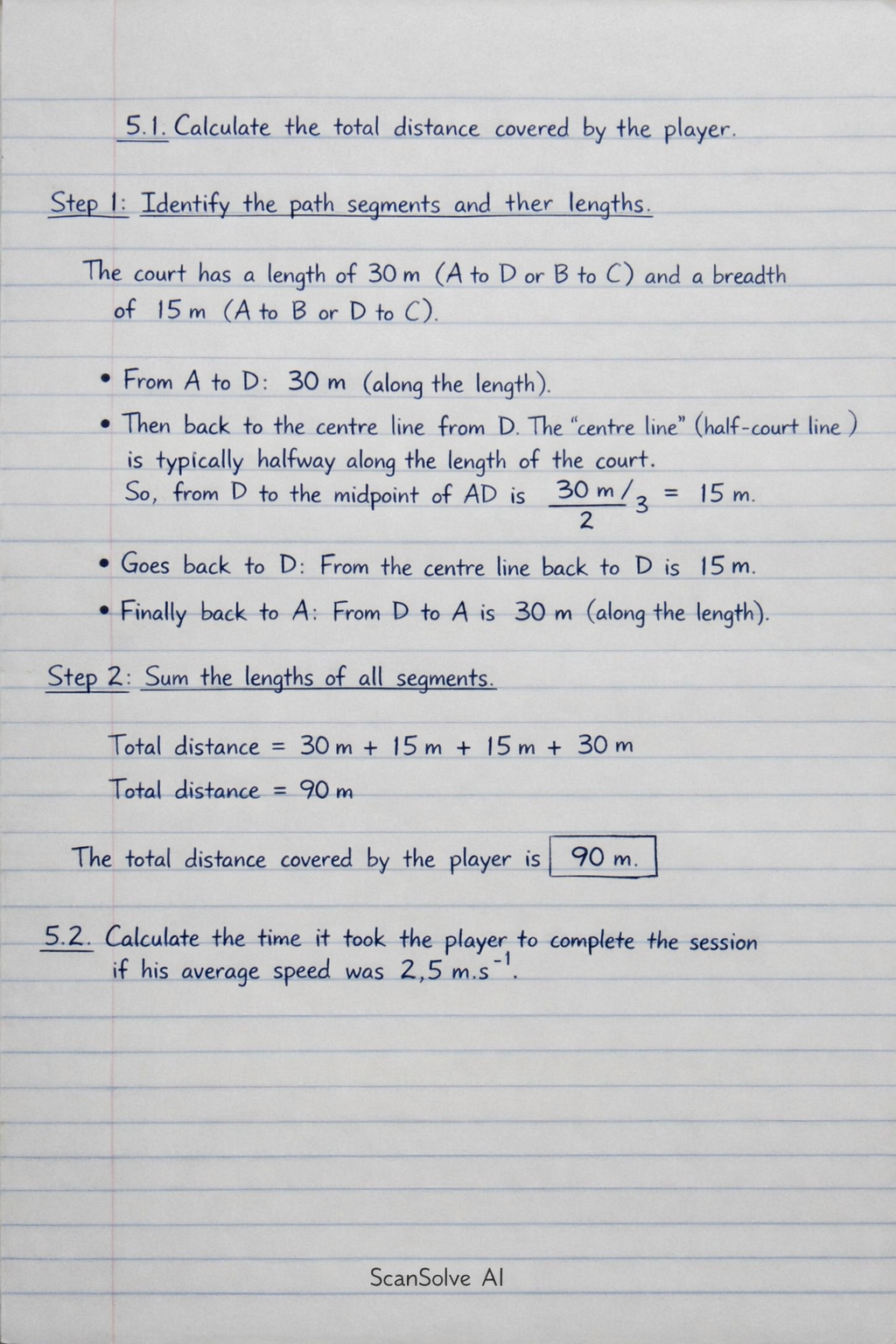
💍🫀Thakgiey, let's knock this out. 5.1 Calculate the total distance covered by the player. Step 1: Identify the path segments and their lengths. The court has a length of 30 m (A to D or B to C) and a breadth of 15 m (A to B or D to C). The player's path is: • From A to D: 30 m (along the length). • Then back to the centre line from D. The "centre line" (half-court line) is typically halfway along the length of the court. So, from D to the midpoint of AD is 30 m / 2 = 15 m. • Goes back to D: From the centre line back to D is 15 m. • Finally back to A: From D to A is 30 m (along the length). Step 2: Sum the lengths of all segments. Total distance = 30 m + 15 m + 15 m + 30 m Total distance = 90 m The total distance covered by the player is 90 m. 5.2 Calculate the time it took the player to complete the session if his average speed was 2,5 m.s⁻¹. Step 1: Use the formula for average speed. Average speed is defined as total distance divided by total time. Average speed = Total distanceTotal time Step 2: Rearrange the formula to solve for total time and substitute the values. Total time = Total distanceAverage speed Total time = 90 m2.5 m/s Total time = 36 s The time it took the player to complete the session is 36 s. 5.3 Define the term average velocity. Average velocity is the total displacement of an object divided by the total time taken for that displacement. It is a vector quantity, meaning it has both magnitude and direction. 5.4 Determine the average velocity of the athlete. Step 1: Determine the total displacement. The player starts at point A and finishes at point A. Total displacement = Final position - Initial position Since the initial and final positions are the same, the total displacement is 0 m. Step 2: Calculate the average velocity. Average velocity = Total displacementTotal time Average velocity = 0 m36 s Average velocity = 0 m/s The average velocity of the athlete is 0 m/s. --- QUESTION 3 3.1 Convert 135 km.h⁻¹ to m.s⁻¹. Step 1: Convert kilometers to meters and hours to seconds. 1 km = 1000 m 1 h = 3600 s Step 2: Apply the conversion factors. 135 km/h = 135 × 1000 m3600 s 135 km/h = 135 × (10)/(36) m/s 135 km/h = 37.5 m/s The speed of car A is 37.5 m/s. 3.2 Determine the velocity of car B while trying to avoid car A. Step 1: Identify the given values for car B. Initial velocity u = 0 m/s (starts from rest). Acceleration a = 1.5 m/s^2. Time t = 11.5 s. Step 2: Use the kinematic equation v = u + at to find the final velocity v. v = 0 m/s + (1.5 m/s^2)(11.5 s) v = 17.25 m/s The velocity of car B is 17.25 m/s. 3.3 How far has car B driven after 11,5 seconds? Step 1: Identify the given values for car B. Initial velocity u = 0 m/s. Acceleration a = 1.5 m/s^2. Time t = 11.5 s. Step 2: Use the kinematic equation s = ut + (1)/(2)at^2 to find the distance s. s = (0 m/s)(11.5 s) + (1)/(2)(1.5 m/s^2)(11.5 s)^2 s = 0 + (1)/(2)(1.5)(132.25) s = 0.75 × 132.25 s = 99.1875 m Car B has driven 99.19 m (rounded to two decimal places). 3.4 The driver of car A suddenly hit the brakes and managed to stop after 40 m. What acceleration does car A experience to come to a standstill after 4 seconds? Step 1: Identify the given values for car A during braking. Final velocity v = 0 m/s (comes to a standstill). Distance s = 40 m. Time t = 4 s. Step 2: Calculate the initial velocity u for this braking event using the equation s = (u+v)/(2)t. 40 m = u + 0 m/s2(4 s) 40 = 2u u = 20 m/s Step 3: Calculate the acceleration a using the equation v = u + at. 0 m/s = 20 m/s + a(4 s) -20 m/s = a(4 s) a = -20 m/s4 s a = -5 m/s^2 The acceleration car A experiences is -5 m/s^2. The negative sign indicates deceleration. Send me the next one 📸