
We read your photo as:
A copper can of mass 0.2 kg contains 0.2kg of water at 10C. The can and its contents are placed in a refrigerator. Calculate the quantity of heat given out if the temperature of the can and its contents falls to -2C.
ScanSolve AI Answer
Answer
Step-by-step solution
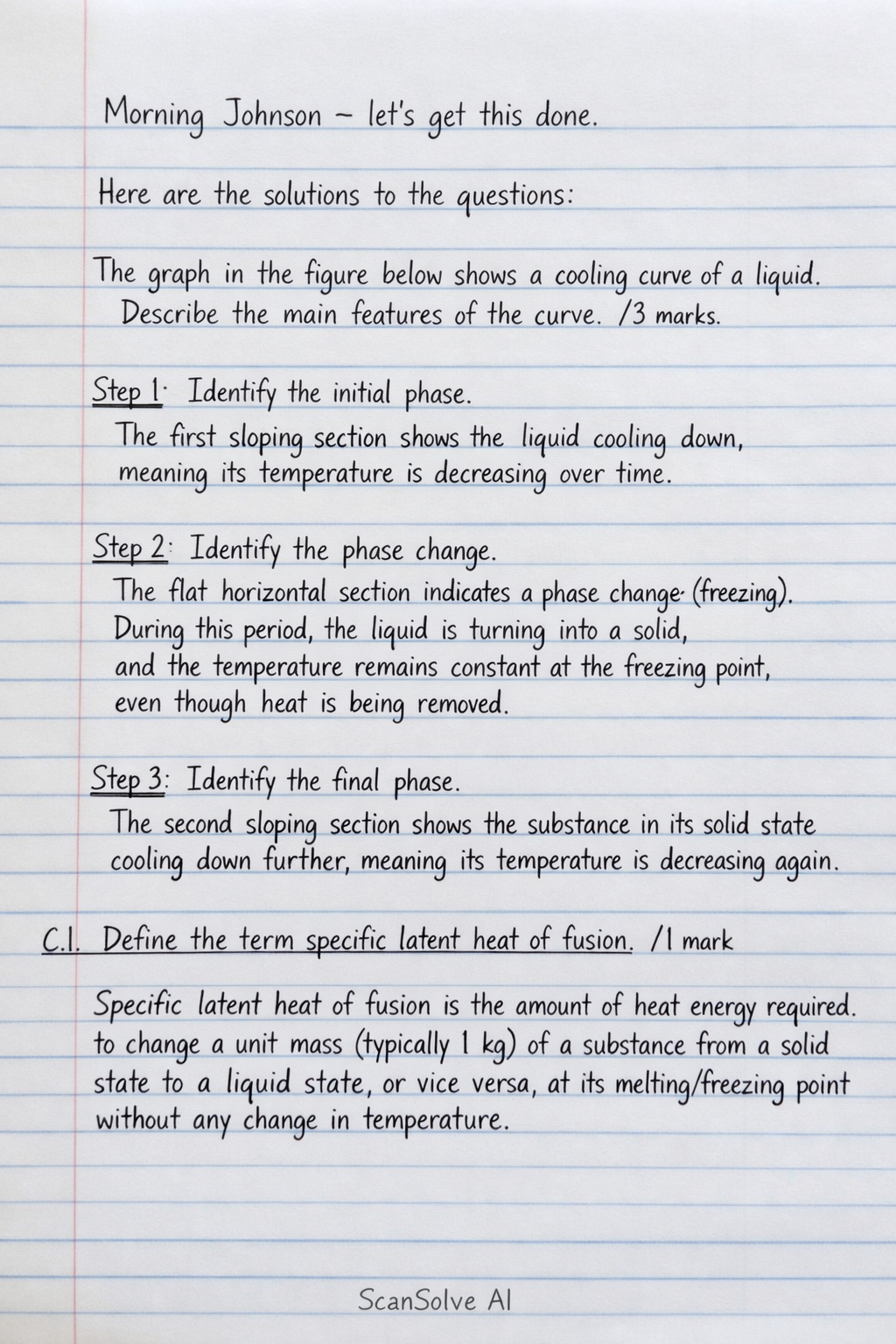
5 stepsHere are the solutions to the questions:
The graph in the figure below shows a cooling curve of a liquid. Describe the main features of the curve. /3 marks
Step 1: Identify the initial phase.
The first sloping section shows the liquid cooling down, meaning its temperature is decreasing over time.
Step 2: Identify the phase change.
The flat horizontal section indicates a phase change (freezing). During this period, the liquid is turning into a solid, and the temperature remains constant at the freezing point, even though heat is being removed.
Step 3: Identify the final phase.
The second sloping section shows the substance in its solid state cooling down further, meaning its temperature is decreasing again.
C.I. Define the term specific latent heat of fusion. /1 mark
Specific latent heat of fusion is the amount of heat energy required to change a unit mass (typically 1 kg) of a substance from a solid state to a liquid state, or vice versa, at its melting/freezing point without any change in temperature.
II. A copper can of mass 0.2 kg contains 0.2 kg of water at 10°C. The can and its contents are placed in a refrigerator. Calculate the quantity of heat given out if the temperature of the can and its contents falls to -2°C. /3 marks
Given:
Mass of copper can () =
Mass of water () =
Initial temperature () =
Final temperature () =
Specific heat capacity of copper () =
Specific heat capacity of water () =
Specific heat capacity of ice () =
Specific latent heat of fusion of water () =
Step 1: Calculate the heat lost by the copper can as it cools from to .
Step 2: Calculate the heat lost by water as it cools from to .
Step 3: Calculate the heat lost by water as it freezes at .
Step 4: Calculate the heat lost by the ice as it cools from to .
Step 5: Calculate the total quantity of heat given out.
The total quantity of heat given out is .
Part d
Name two main features of a vacuum flask which enable it to keep a liquid warm. /1 mark
- The vacuum between the double walls prevents heat transfer by conduction and convection.
- The silvered surfaces on the inner and outer walls reduce heat transfer by radiation.
104. State the Coulomb's law. /2 marks
Coulomb's law states that the electrostatic force between two point charges is directly proportional to the product of the magnitudes of the charges and inversely proportional to the square of the distance between them. The force acts along the line joining the two charges.
Part b
A helium nucleus has charge +2e and a neon nucleus +10e, where C. With what force do they repel each other when separated by m? /5 marks
Given:
Charge of helium nucleus () =
Charge of neon nucleus () =
Distance () =
Coulomb's constant () =
State Coulomb's Law formula.
Substitute the given values into the formula.
Calculate the product of the charges.
Calculate the square of the distance.
Calculate the force.
The force of repulsion between the nuclei is .
Try one yourself
A new problem that tests the same skill.
Still stuck on this one?
Ask a follow-up, and the answer starts from this question.
More Physics Questions
Handwritten Step-by-Step Solution
Get this as a handwritten image on WhatsApp — like a tutor wrote it for you.
Try on WhatsApp