

This physics problem tests your understanding of fundamental physical laws and their applications. The step-by-step solution below breaks down the problem using relevant equations and physical reasoning.
ScanSolve AI Answer
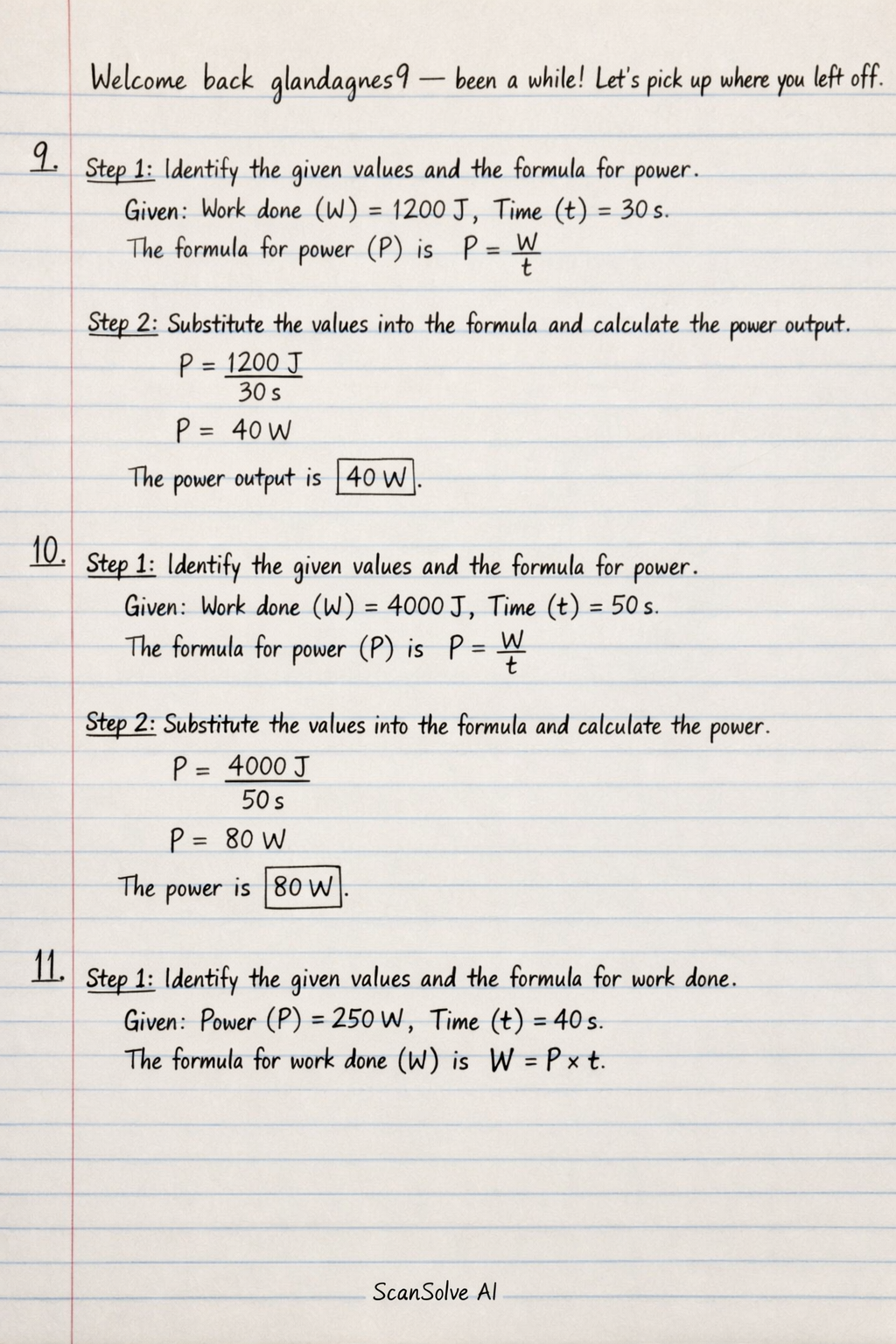
9. Step 1: Identify the given values and the formula for power. Given: Work done (W) = 1200\,J, Time (t) = 30\,s. The formula for power (P) is P = (W)/(t). Step 2: Substitute the values into the formula and calculate the power output. P = 1200\,J30\,s P = 40\,W The power output is 40 W. 10. Step 1: Identify the given values and the formula for power. Given: Work done (W) = 4000\,J, Time (t) = 50\,s. The formula for power (P) is P = (W)/(t). Step 2: Substitute the values into the formula and calculate the power. P = 4000\,J50\,s P = 80\,W The power is 80 W. 11. Step 1: Identify the given values and the formula for work done. Given: Power (P) = 250\,W, Time (t) = 40\,s. The formula for work done (W) is W = P × t. Step 2: Substitute the values into the formula and calculate the work done. W = 250\,W × 40\,s W = 10000\,J The work done is 10000 J. 12. Step 1: Identify the given values and the formula for time taken. Given: Work done (W) = 900\,J, Power (P) = 45\,W. The formula for time (t) is t = (W)/(P). Step 2: Substitute the values into the formula and calculate the time taken. t = 900\,J45\,W t = 20\,s The time taken is 20 s. 13. a) What is energy? Energy is the capacity to do work. It exists in various forms such as kinetic, potential, thermal, electrical, chemical, and nuclear energy. b) Name the energy changes that take place in each of the following: i) When an electric bell rings. Electrical energy is converted into sound energy and kinetic energy. ii) Someone speaks into a microphone. Sound energy is converted into electrical energy. iii) A solid metallic ball is thrown upwards. Kinetic energy is converted into gravitational potential energy. iv) A torch is on to give light. Chemical energy (from the battery) is converted into electrical energy, which then converts into light energy and heat energy. v) In green plants. Light energy is converted into chemical energy through photosynthesis. 14. Step 1: Identify the given values and the formula for gravitational potential energy. Given: Mass (m) = 4\,kg, Height (h) = 6\,m, Acceleration due to gravity (g) = 10\,m/s^2. The formula for gravitational potential energy (GPE) is GPE = mgh. Step 2: Substitute the values into the formula and calculate the gravitational potential energy. GPE = 4\,kg × 10\,m/s^2 × 6\,m GPE = 240\,J The gravitational potential energy is 240 J. 15. Step 1: Identify the given values and the formula for kinetic energy. Given: Mass (m) = 2\,kg, Speed (v) = 5\,m/s. The formula for kinetic energy (KE) is KE = (1)/(2)mv^2. Step 2: Substitute the values into the formula and calculate the kinetic energy. KE = (1)/(2) × 2\,kg × (5\,m/s)^2 KE = 1\,kg × 25\,m^2/s^2 KE = 25\,J The kinetic energy is 25 J. 16. Step 1: Identify the given values and the formula for kinetic energy. Given: Mass (m) = 10\,kg, Speed (v) = 8\,m/s. The formula for kinetic energy (KE) is KE = (1)/(2)mv^2. Step 2: Substitute the values into the formula and calculate the kinetic energy. KE = (1)/(2) × 10\,kg × (8\,m/s)^2 KE = 5\,kg × 64\,m^2/s^2 KE = 320\,J The kinetic energy is 320 J. 17. Step 1: Identify the given values and the formula for mass from potential energy. Given: Potential energy (PE) = 500\,J, Height (h) = 5\,m, Acceleration due to gravity (g) = 10\,m/s^2. The formula for potential energy is PE = mgh. Rearranging for mass (m): m = (PE)/(gh). Step 2: Substitute the values into the formula and calculate the mass. m = 500\,J10\,m/s^2 × 5\,m m = 500\,J50\,J/kg m = 10\,kg The mass is 10 kg. 18. Step 1: Identify the given values and the formula for potential energy. Given: Mass (m) = 3\,kg, Height (h) = 10\,m, Acceleration due to gravity (g) = 10\,m/s^2. The formula for potential energy (PE) is PE = mgh. Step 2: Substitute the values into the formula and calculate the potential energy. PE = 3\,kg × 10\,m/s^2 × 10\,m PE = 300\,J The potential energy before it falls is 300 J. 19. a) The work done Step 1: Identify the given values and the formula for work done. Given: Force (F) = 80\,N, Distance (d) = 12\,m. The formula for work done (W) is W = F × d. Step 2: Substitute the values into the formula and calculate the work done. W = 80\,N × 12\,m W = 960\,J The work done is 960 J. b) The power developed. Step 1: Identify the given values and the formula for power. Given: Work done (W) = 960\,J (from part a), Time (t) = 6\,s. The formula for power (P) is P = (W)/(t). Step 2: Substitute the values into the formula and calculate the power developed. P = 960\,J6\,s P = 160\,W The power developed is 160 W. 20. Step 1: Identify the given values and the formula for power. Given: Work done (W) = 3000\,J, Time (t) = 25\,s. The formula for power (P) is P = (W)/(t). Step 2: Substitute the values into the formula and calculate the power. P = 3000\,J25\,s P = 120\,W The power is 120 W. 21. a) The work done. Step 1: Identify the given values and the formula for work done against gravity. Given: Mass (m) = 15\,kg, Height (h) = 4\,m, Acceleration due to gravity (g) = 10\,m/s^2. The work done (W) against gravity is equal to the change in gravitational potential energy, W = mgh. Step 2: Substitute the values into the formula and calculate the work done. W = 15\,kg × 10\,m/s^2 × 4\,m W = 600\,J The work done is 600 J. b) The power output. Step 1: Identify the given values and the formula for power. Given: Work done (W) = 600\,J (from part a), Time (t) = 12\,s. The formula for power (P) is P = (W)/(t). Step 2: Substitute the values into the formula and calculate the power output. P = 600\,J12\,s P = 50\,W The power output is 50 W. 22. Step 1: Identify the given values and the formula for kinetic energy. Given: Mass (m) = 1000\,kg, Speed (v) = 20\,m/s. The formula for kinetic energy (KE) is KE = (1)/(2)mv^2. Step 2: Substitute the values into the formula and calculate the kinetic energy. KE = (1)/(2) × 1000\,kg × (20\,m/s)^2 KE = 500\,kg × 400\,m^2/s^2 KE = 200000\,J The kinetic energy is 200000 J. 23. a) The work done. Step 1: Identify the given values and the formula for work done against gravity. Given: Mass (m) = 200\,kg, Height (h) = 10\,m, Acceleration due to gravity (g) = 10\,m/s^2. The work done (W) against gravity is equal to the change in gravitational potential energy, W = mgh. Step 2: Substitute the values into the formula and calculate the work done. W = 200\,kg × 10\,m/s^2 × 10\,m W = 20000\,J The work done is 20000 J. b) The power of the pump. Step 1: Identify the given values and the formula for power. Given: Work done (W) = 20000\,J (from part a), Time (t) = 50\,s. The formula for power (P) is P = (W)/(t). Step 2: Substitute the values into the formula and calculate the power of the pump. P = 20000\,J50\,s P = 400\,W The power of the pump is 400 W. 24. i) State Hooke's law. Hooke's Law states that the extension of a spring is directly proportional to the force applied to it, provided the elastic limit is not exceeded. ii) State the principle of conservation of energy. The principle of conservation of energy states that energy cannot be created or destroyed, but it can be transformed from one form to another. The total energy in an isolated system remains constant. iii) Explain how a simple pendulum can be used to illustrate the Principle of conservation of energy. When a simple pendulum is pulled to one side and released, its energy continuously transforms. At its highest point, it has maximum gravitational potential energy and zero kinetic energy. As it swings downwards, potential energy converts to kinetic energy, reaching maximum kinetic energy and minimum potential energy at the lowest point. As it swings upwards again, kinetic energy converts back to potential energy. Ignoring air resistance and friction, the total mechanical energy (potential + kinetic) remains constant, illustrating the conservation of energy. Send me the next one 📸