
We read your photo as:
Calculate the cross-sectional area of a conductor and the total resistance of resistors in series.
ScanSolve AI Answer
Step-by-step solution
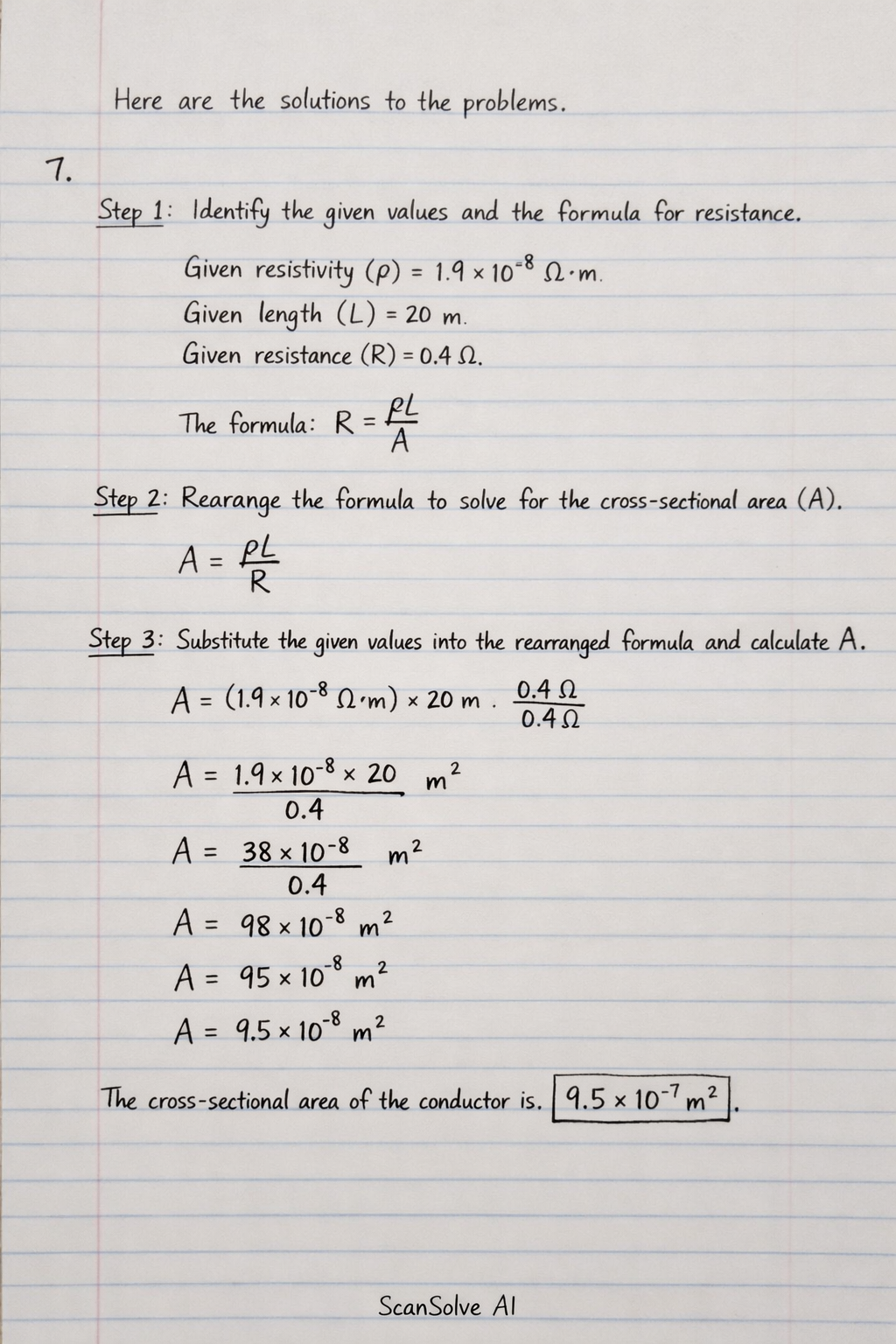
7 stepsHere are the solutions to the problems.
7.
Identify the given values and the formula for resistance.
Given resistivity () = .
Given length () = .
Given resistance () = .
The formula relating resistance, resistivity, length, and cross-sectional area () is:Rearrange the formula to solve for the cross-sectional area ().
Substitute the given values into the rearranged formula and calculate .
The cross-sectional area of the conductor is .
** (Circuit with three resistors):**
Calculate the total resistance for resistors in series.
Given resistors: , , .
For resistors in series, the total resistance () is the sum of individual resistances:Use Ohm's Law to find the total current.
Given total voltage () = .
According to Ohm's Law, , where is the total current.The current flowing through the circuit is .
** (Circuit with two resistors in parallel):**
Calculate the equivalent resistance for resistors in parallel.
Given resistors: , .
For resistors in parallel, the reciprocal of the equivalent resistance () is the sum of the reciprocals of individual resistances:Use Ohm's Law to find the total voltage applied to the circuit.
Given total current () = .
According to Ohm's Law, , where is the total voltage.The voltage applied to the circuit is .
Still stuck on this one?
Ask a follow-up, and the answer starts from this question.
More Physics Questions
Handwritten Step-by-Step Solution
Get this as a handwritten image on WhatsApp — like a tutor wrote it for you.
Try on WhatsApp