
We read your photo as:
Explain image formation in a pinhole camera and calculate the height of the image given the object height and distances.
ScanSolve AI Answer
Answers
2 partsStep-by-step solution
13 stepshere are the direct calculations and answers for the physics questions:
Item 1
Part a· 2 steps
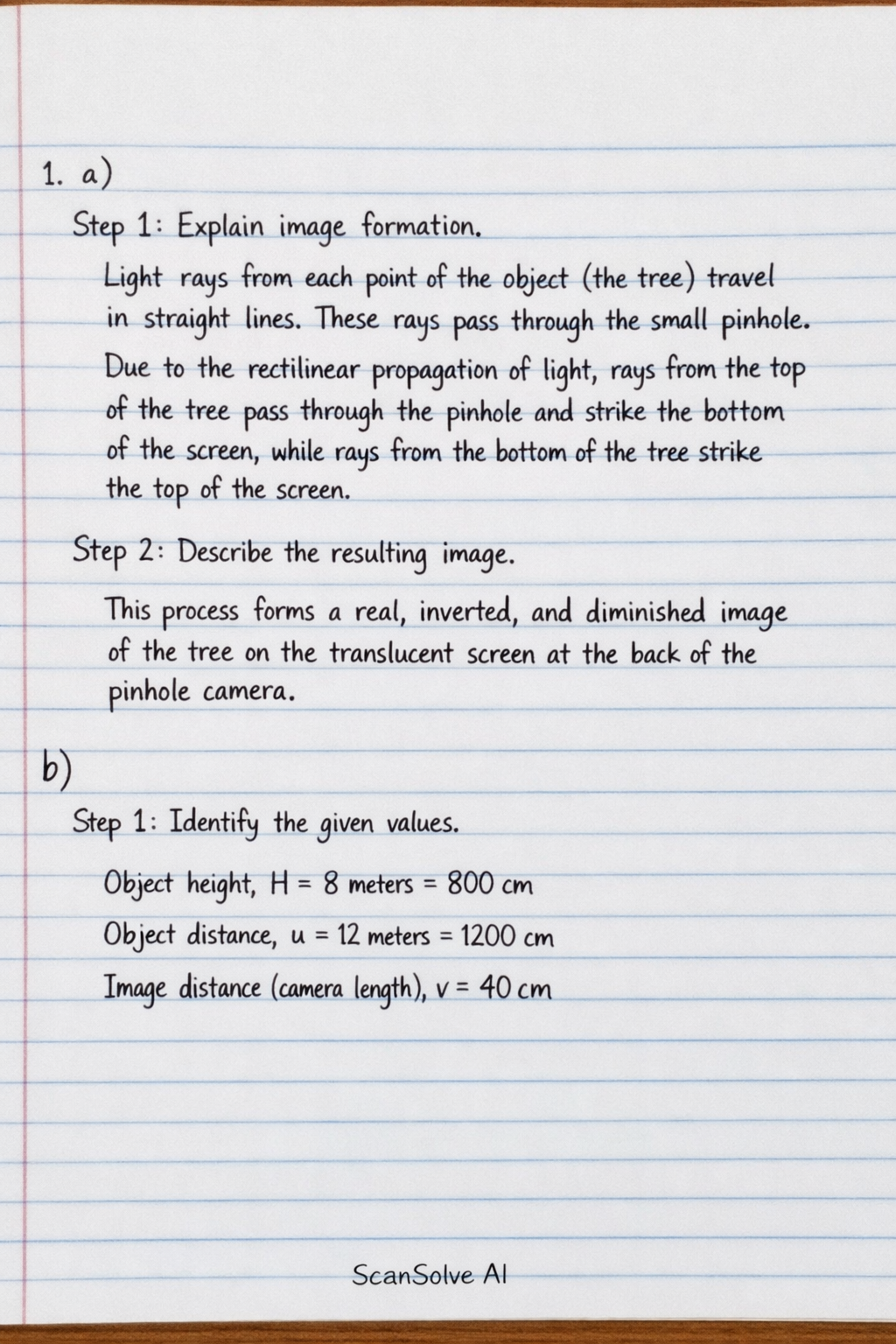
Explain image formation.
Light rays from each point of the object (the tree) travel in straight lines. These rays pass through the small pinhole. Due to the rectilinear propagation of light, rays from the top of the tree pass through the pinhole and strike the bottom of the screen, while rays from the bottom of the tree strike the top of the screen.
Describe the resulting image.
This process forms a real, inverted, and diminished image of the tree on the translucent screen at the back of the pinhole camera.
Part b
Identify the given values.
Object height,
Object distance,
Image distance (camera length),Apply the magnification formula.
The magnification () of a pinhole camera is given by the ratio of image height () to object height (), which is also equal to the ratio of image distance () to object distance ():
Calculate the image height.
Rearrange the formula to solve for :
Substitute the values:
The size of the formed image is .
Part c· 2 steps
Describe the effect of an enlarged pinhole.
If the pinhole is enlarged, more light rays from each point on the object will pass through it. Instead of a single, distinct set of rays forming a sharp image, multiple overlapping images will be formed.
Explain the consequences for the image.
This overlapping of images will cause the final image to appear blurred or less sharp. However, because more light is entering the camera, the image will also be brighter.
Part d· 3 steps
Analyze the change in object distance.
Moving the box (pinhole camera) closer to the tree means decreasing the object distance (). The image distance (, camera length) remains constant.
Apply the magnification principle.
The magnification of a pinhole camera is inversely proportional to the object distance (). If decreases while is constant, the magnification will increase.
Conclude the effect on image size.
Therefore, the size of the image formed on the screen will increase. The image will still be real and inverted.
Item 2
Part d(i)
Determine the temperature scale.
The lower fixed point () corresponds to a liquid column length of .
The upper fixed point () corresponds to a liquid column length of .
The length of the liquid column in the bathing water is .Calculate the temperature of the bathing water.
The temperature can be calculated using the formula:
Substitute the given values:
Compare the calculated temperature with the recommended range.
The calculated temperature of the bathing water is . The hint states that water meant for bathing should be between and .
Since is higher than , the water is not warm enough for bathing; it is too hot.
The water is .
Part d(ii)
Mercury is preferred over water in liquid-in-glass thermometers for several reasons:
- Mercury expands uniformly with temperature, providing more accurate readings, unlike water which has anomalous expansion between and .
- Mercury has a wide temperature range (low freezing point of and high boiling point of ), allowing it to measure a broader spectrum of temperatures compared to water ( to ).
- Mercury is opaque and silvery, making it easily visible against the glass tube for clear readings, whereas water is transparent.
- Mercury does not wet glass, ensuring it rises and falls cleanly without sticking to the tube, unlike water.
Try one yourself
A new problem that tests the same skill.
Still stuck on this one?
Ask a follow-up, and the answer starts from this question.
More Physics Questions
Handwritten Step-by-Step Solution
Get this as a handwritten image on WhatsApp — like a tutor wrote it for you.
Try on WhatsApp