

This physics problem tests your understanding of fundamental physical laws and their applications. The step-by-step solution below breaks down the problem using relevant equations and physical reasoning.
ScanSolve AI Answer
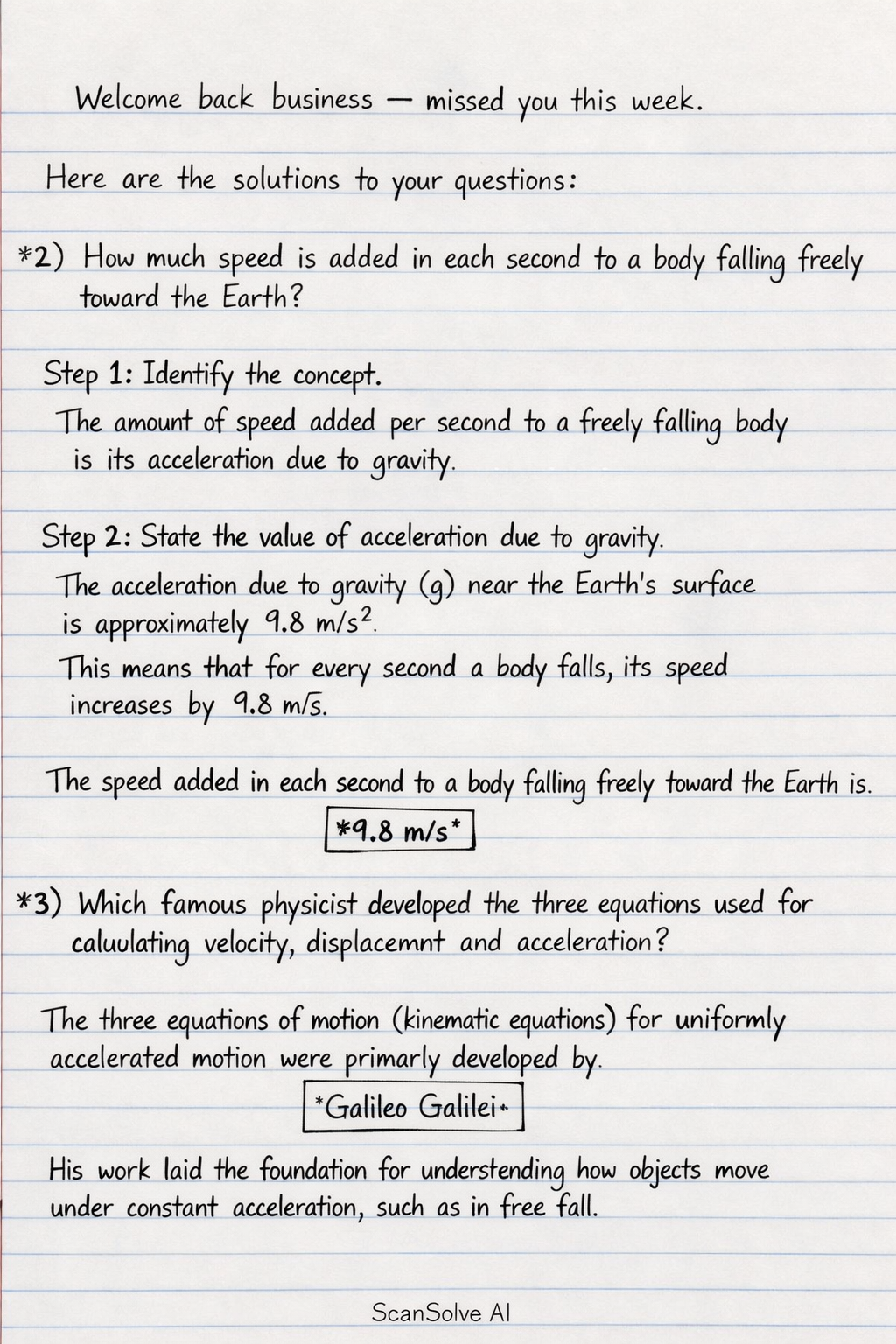
Here are the solutions to your questions: 2) How much speed is added in each second to a body falling freely toward the Earth? Step 1: Identify the concept. The amount of speed added per second to a freely falling body is its acceleration due to gravity. Step 2: State the value of acceleration due to gravity. The acceleration due to gravity (g) near the Earth's surface is approximately 9.8 \, m/s^2. This means that for every second a body falls, its speed increases by 9.8 \, m/s. The speed added in each second to a body falling freely toward the Earth is 9.8 m/s. 3) Which famous physicist developed the three equations used for calculating velocity, displacement and acceleration? The three equations of motion (kinematic equations) for uniformly accelerated motion were primarily developed by Galileo Galilei. His work laid the foundation for understanding how objects move under constant acceleration, such as in free fall. The famous physicist who developed the three equations of motion is Galileo Galilei. 4) Disregarding air resistance, how far does a body move during the first second? Step 1: Identify the given values and the formula. Assuming the body starts from rest, the initial velocity is u = 0 \, m/s. The time is t = 1 \, s. The acceleration due to gravity is a = g = 9.8 \, m/s^2. The formula for displacement (s) under constant acceleration is: s = ut + (1)/(2)at^2 Step 2: Substitute the values into the formula. s = (0 \, m/s)(1 \, s) + (1)/(2)(9.8 \, m/s^2)(1 \, s)^2 Step 3: Calculate the displacement. s = 0 + (1)/(2)(9.8 \, m/s^2)(1 \, s^2) s = (1)/(2)(9.8 \, m) s = 4.9 \, m Disregarding air resistance, a body moves 4.9 m during the first second. Send me the next one 📸