
We read your photo as:
Question 2: A parallel plate capacitor has a capacitance of 10 mu F. If the distance between the plates is halved, what will happen to the capacitance?
ScanSolve AI Answer
Answers
2 partsHere are the solutions to the remaining questions:
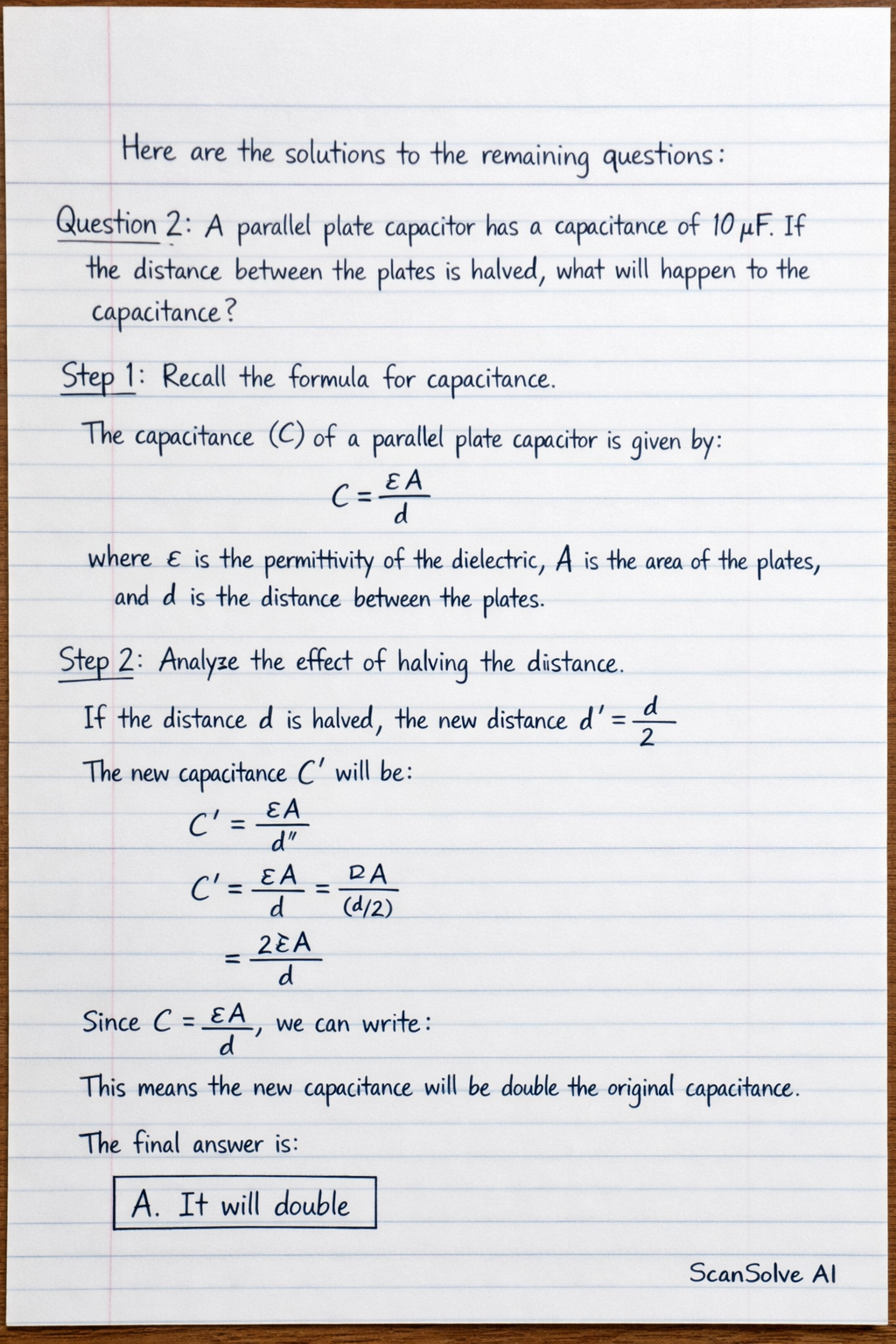
Question 2: A parallel plate capacitor has a capacitance of . If the distance between the plates is halved, what will happen to the capacitance?
-
Step 1: Recall the formula for capacitance. The capacitance () of a parallel plate capacitor is given by:
where is the permittivity of the dielectric, is the area of the plates, and is the distance between the plates.
-
Step 2: Analyze the effect of halving the distance. If the distance is halved, the new distance becomes . The new capacitance will be:
Since , we can write:
This means the new capacitance will be double the original capacitance.
The final answer is .
Question 3: The graphical representation of pressure law is always a straight line passing through the origin only if the temperature scale is
- Concept: The pressure law (also known as Gay-Lussac's Law or Amontons's Law) states that for a fixed mass of gas at constant volume, the pressure is directly proportional to its absolute temperature.
- Explanation: A graph of pressure versus temperature will be a straight line passing through the origin only when the temperature is measured on an absolute scale, where zero corresponds to absolute zero. The Kelvin scale is the absolute thermodynamic temperature scale.
The final answer is .
Question 4: The density of water is , while the density of ice is . Calculate the change in volume when of ice is completely melted.
-
Step 1: Calculate the volume of ice. The formula for volume is . Given mass of ice () = Given density of ice () =
-
Step 2: Calculate the volume of water. When ice melts, its mass remains the same. So, mass of water () = . Given density of water () =
-
**Step 3:
Try one yourself
A new problem that tests the same skill.
Still stuck on this one?
Ask a follow-up, and the answer starts from this question.
More Physics Questions
Handwritten Step-by-Step Solution
Get this as a handwritten image on WhatsApp — like a tutor wrote it for you.
Try on WhatsApp