

This physics problem tests your understanding of fundamental physical laws and their applications. The step-by-step solution below breaks down the problem using relevant equations and physical reasoning.
ScanSolve AI Answer
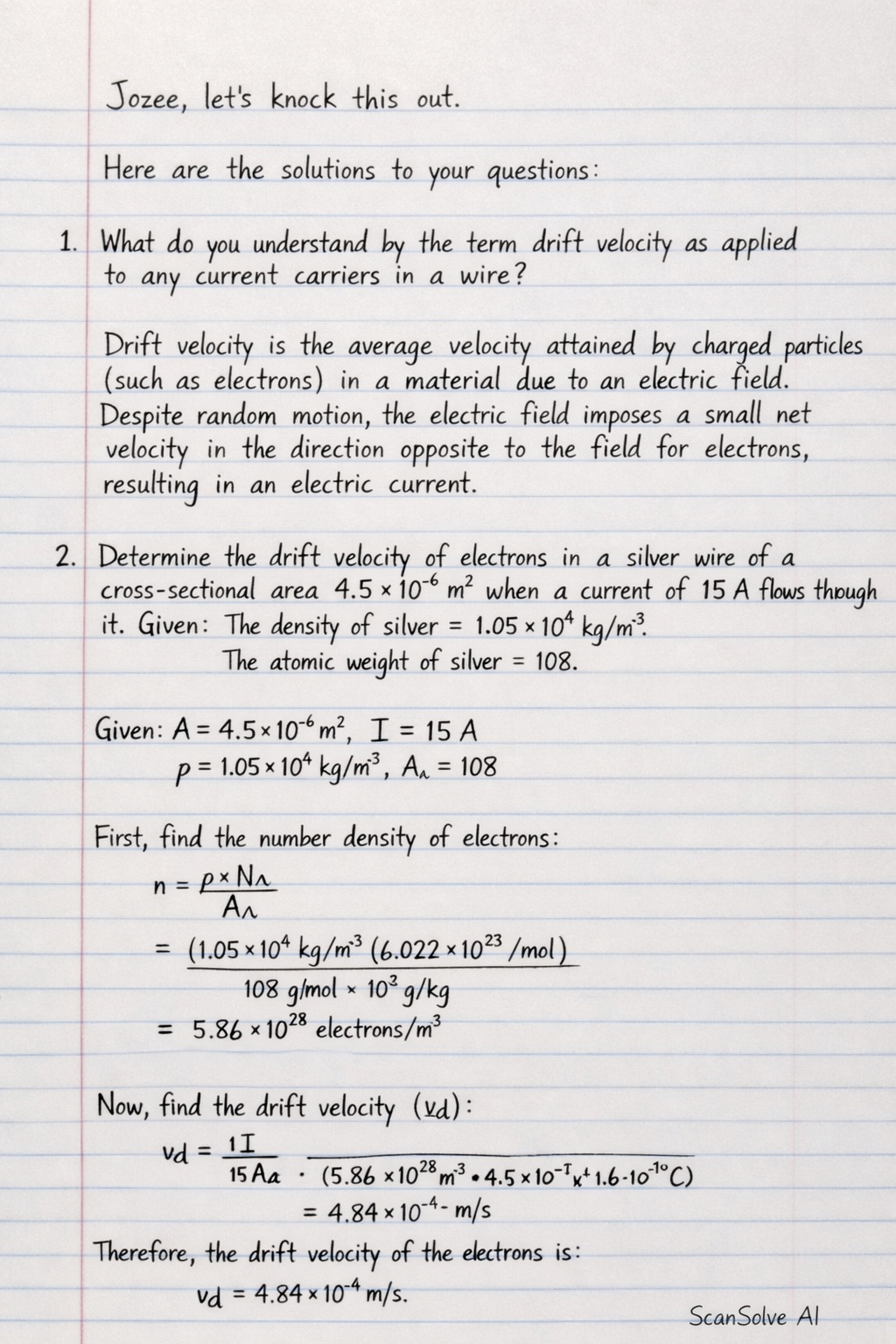
Here are the solutions to your questions: 1. What do you understand by the term drift velocity as applied to any current carriers in a wire? Drift velocity is the average velocity attained by charged particles (such as electrons) in a material due to an electric field. Despite random motion, the electric field imposes a small net velocity in the direction opposite to the field for electrons, resulting in an electric current. 2. Determine the drift velocity of electrons in a silver wire of a cross-sectional area 4.5 × 10^-6 m^2 when a current of 15 A flows through it. Given: The density of silver = 1.05 × 10^4 kg/m^3. The atomic weight of silver = 108. Given: Current I = 15 A Cross-sectional area A = 4.5 × 10^-6 m^2 Density of silver = 1.05 × 10^4 kg/m^3 Atomic weight of silver M = 108 g/mol = 0.108 kg/mol Charge of an electron e = 1.602 × 10^-19 C Avogadro's number N_A = 6.022 × 10^23 mol^-1 Assume 1 free electron per silver atom. Step 1: Calculate the number density of free electrons (n). n = ()/(M) × N_A × (electrons per atom) n = 1.05 × 10^4 kg/m^30.108 kg/mol × 6.022 × 10^23 mol^-1 × 1 n = 9.7222 × 10^4 × 6.022 × 10^23 m^-3 n = 5.855 × 10^28 m^-3 Step 2: Use the formula for drift velocity v_d = (I)/(n A e). v_d = 15 A(5.855 × 10^28 m^-3) × (4.5 × 10^-6 m^2) × (1.602 × 10^-19 C) v_d = (15)/(42.19 × 10^3) v_d = (15)/(42190) v_d = 3.555 × 10^-4 m/s The drift velocity of electrons is 3.56 × 10^-4 m/s. 3. An unknown wire of 1 mm diameter is found to carry and passes a total charge of 90 C in 1 hour and 15 min. If the wire has 5.8 × 10^28 free electrons per m^3, find: Given: Diameter d = 1 mm = 1 × 10^-3 m Radius r = d/2 = 0.5 × 10^-3 m Total charge Q = 90 C Time t = 1 hour 15 min Number of free electrons per m^3, n = 5.8 × 10^28 m^-3 Charge of an electron e = 1.602 × 10^-19 C a) The current in the wire. Step 1: Convert time to seconds. t = (1 × 3600) + (15 × 60) = 3600 + 900 = 4500 s Step 2: Calculate the current using I = (Q)/(t). I = 90 C4500 s I = 0.02 A The current in the wire is 0.02 A. b) The drift velocity of the electrons in m s⁻¹. Step 1: Calculate the cross-sectional area A = r^2. A = (0.5 × 10^-3 m)^2 A = × 0.25 × 10^-6 m^2 A = 0.7854 × 10^-6 m^2 Step 2: Use the formula for drift velocity v_d = (I)/(n A e). v_d = 0.02 A(5.8 × 10^28 m^-3) × (0.7854 × 10^-6 m^2) × (1.602 × 10^-19 C) v_d = (0.02)/(7.30 × 10^3) v_d = (0.02)/(7300) v_d = 2.74 × 10^-6 m/s The drift velocity of the electrons is 2.74 × 10^-6 m/s. 4. The current of 12 A is made to pass through an aluminium wire of radius 1.5 mm which is joined in series with a copper wire of radius 0.8 mm. Determine: Given: Current I = 12 A Aluminium wire radius r_Al = 1.5 mm = 1.5 × 10^-3 m Copper wire radius r_Cu = 0.8 mm = 0.8 × 10^-3 m Number of free electrons per unit volume in copper wire n_Cu = 10^29 m^-3 Charge of an electron e = 1.602 × 10^-19 C a) The current density in an aluminium wire. Step 1: Calculate the cross-sectional area of the aluminium wire A_Al = r_Al^2. A_Al = (1.5 × 10^-3 m)^2 A_Al = × 2.25 × 10^-6 m^2 A_Al = 7.069 × 10^-6 m^2 Step 2: Calculate the current density J_Al = (I)/(A_Al). J_Al = 12 A7.069 × 10^-6 m^2 J_Al = 1.698 × 10^6 A/m^2 The current density in the aluminium wire is 1.70 × 10^6 A/m^2. b) The drift velocity of the electron in the copper wire. Step 1: Calculate the cross-sectional area of the copper wire A_Cu = r_Cu^2. A_Cu = (0.8 × 10^-3 m)^2 A_Cu = × 0.64 × 10^-6 m^2 A_Cu = 2.011 × 10^-6 m^2 Step 2: Use the formula for drift velocity v_d,Cu = (I)/(n_Cu) A_Cu e. v_d,Cu = 12 A(10^29 m^-3) × (2.011 × 10^-6 m^2) × (1.602 × 10^-19 C) v_d,Cu = (12)/(3.221 × 10^4) v_d,Cu = (12)/(32210) v_d,Cu = 3.725 × 10^-4 m/s The drift velocity of the electron in the copper wire is 3.73 × 10^-4 m/s. Send me the next one 📸