
Organic Chemistry Homework Help
Step-by-step AI solutions. Ask your own question →
Organic Chemistry Questions

ASSIGNMENT Write all the possible isomers of Butanol and make sure you define each of the isomerism involved. ✍️Submissi…
View SolutionI need all the molecular formula of alkane, alkene, alkyne, benzene, alcohol, alkanoic acid, aldehydes, ketone, and othe…
View Solution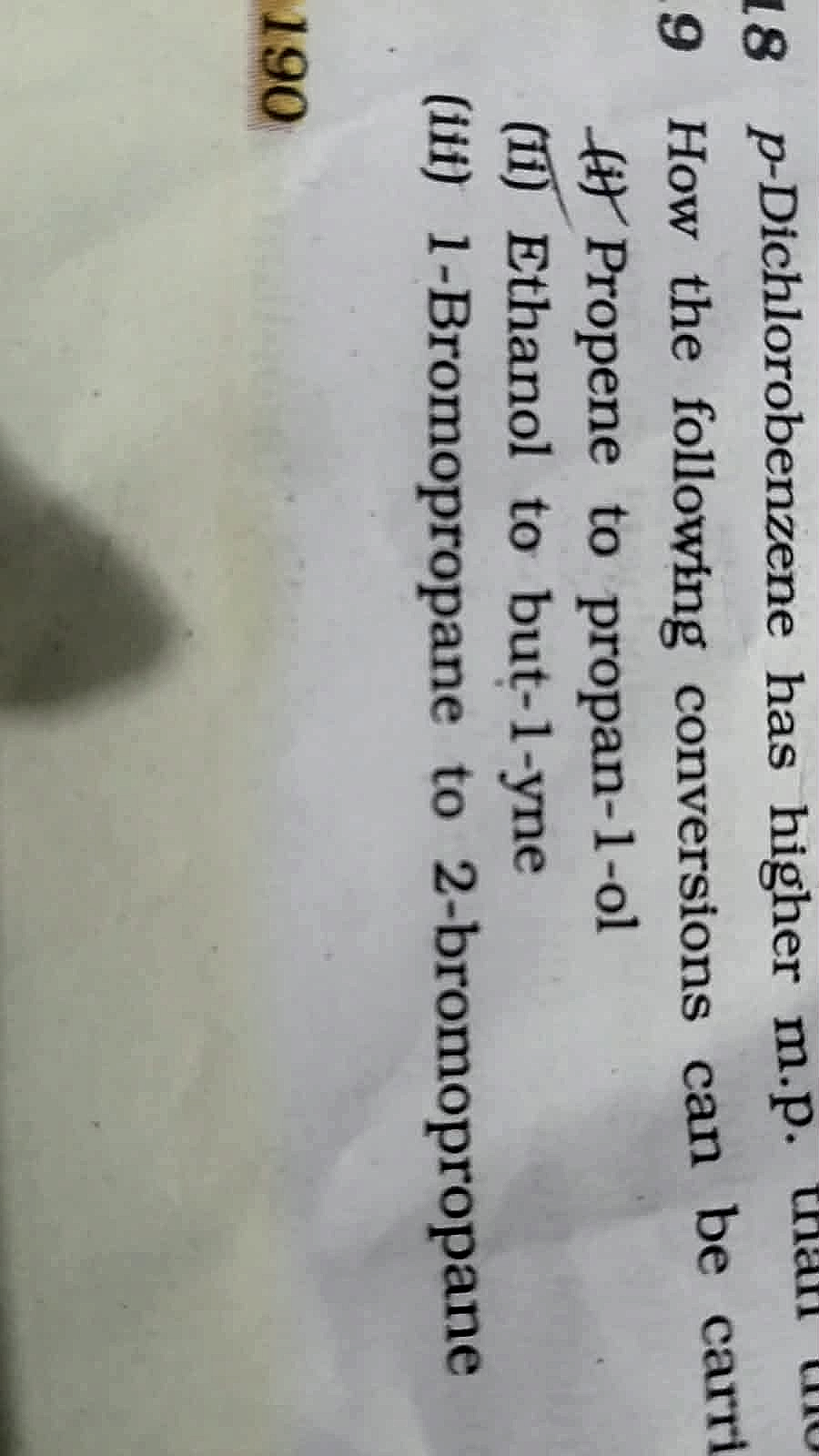
How the following conversions can be carried out: (i) Propene to propan-1-ol (ii) Ethanol to but-1-yne (iii) 1-Bromoprop…
View Solution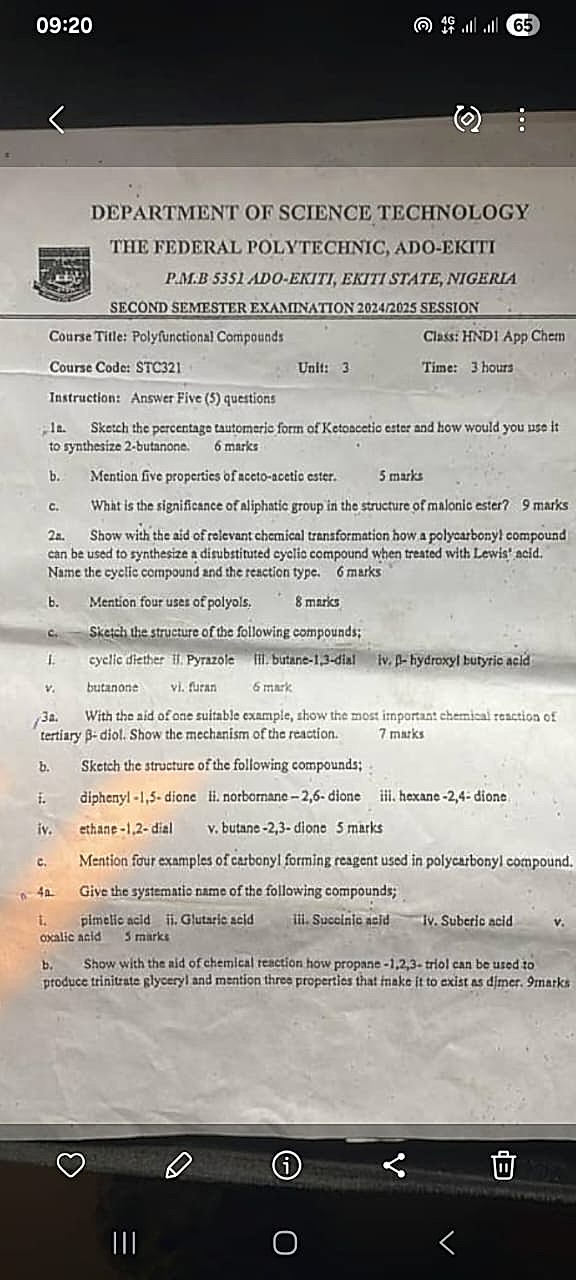
Sketch the percentage tautomeric form of Ketoacetic ester and how would you use it to synthesize 2-butanone.
View Solution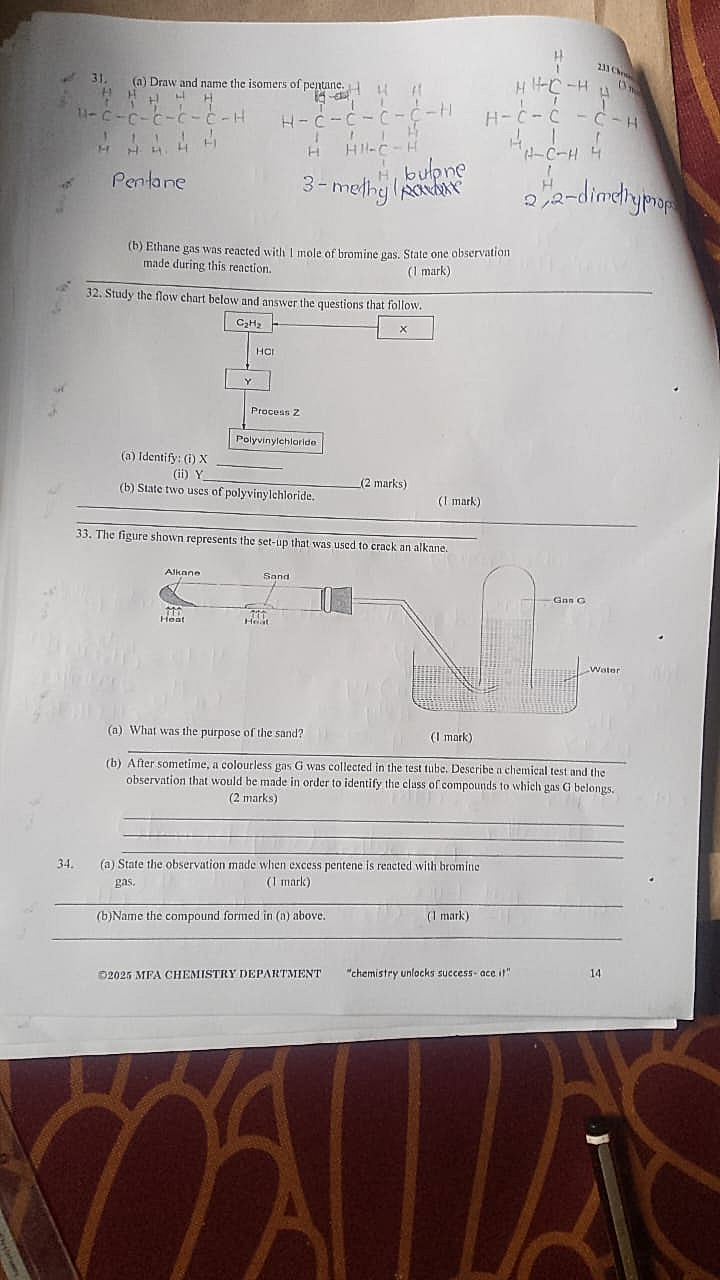
Draw and name the isomers of pentane. (b) Ethane gas was reacted with 1 mole of bromine gas. State one observation made…
View Solution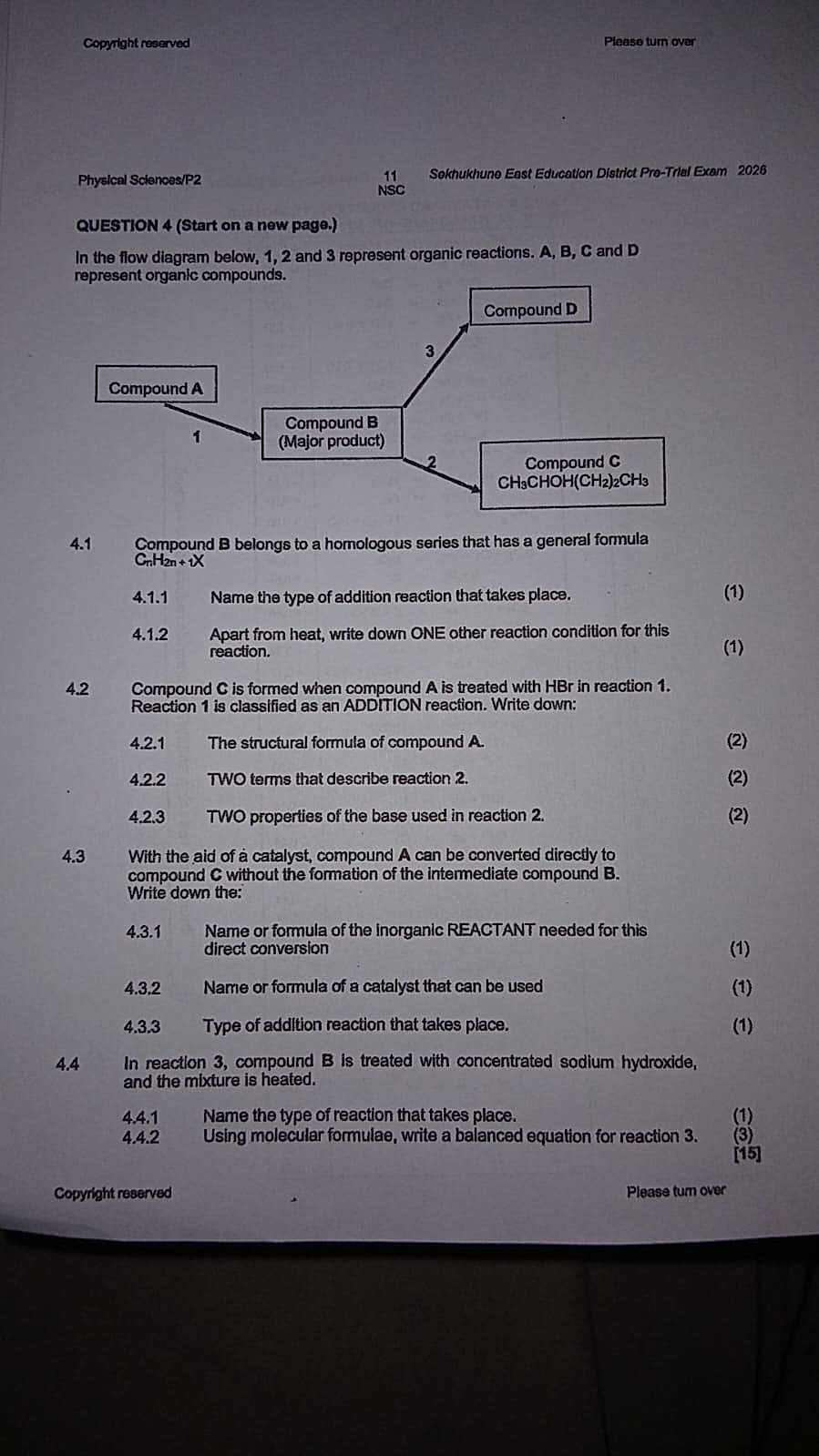
In the flow diagram below, 1, 2 and 3 represent organic reactions. A, B, C and D represent organic compounds.
View Solution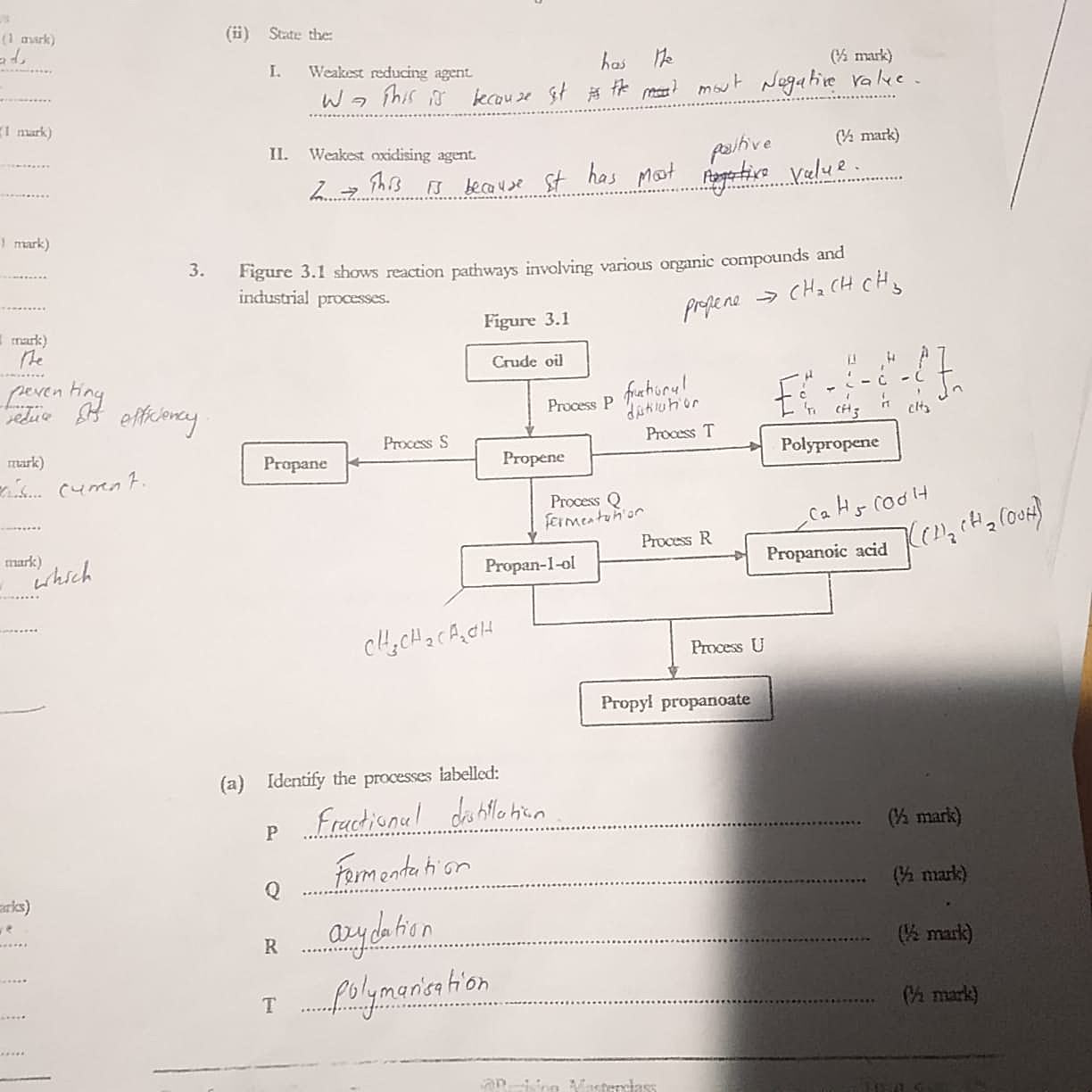
Figure 3.1 shows reaction pathways involving various organic compounds and industrial processes. (a) Identify the proces…
View Solution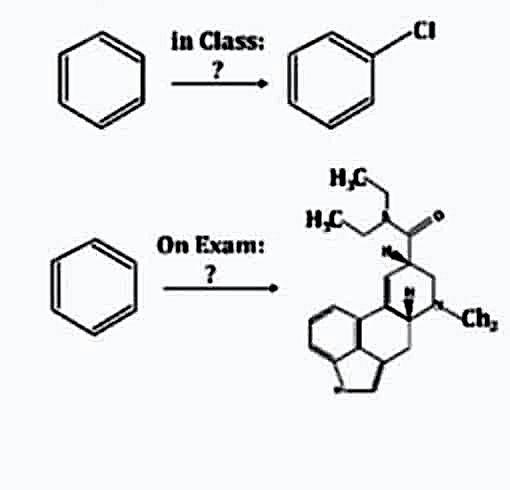
in Class: Benzene -> Chlorobenzene. On Exam: Benzene -> complex molecule with stereocenters. What reagents are missing?
View Solution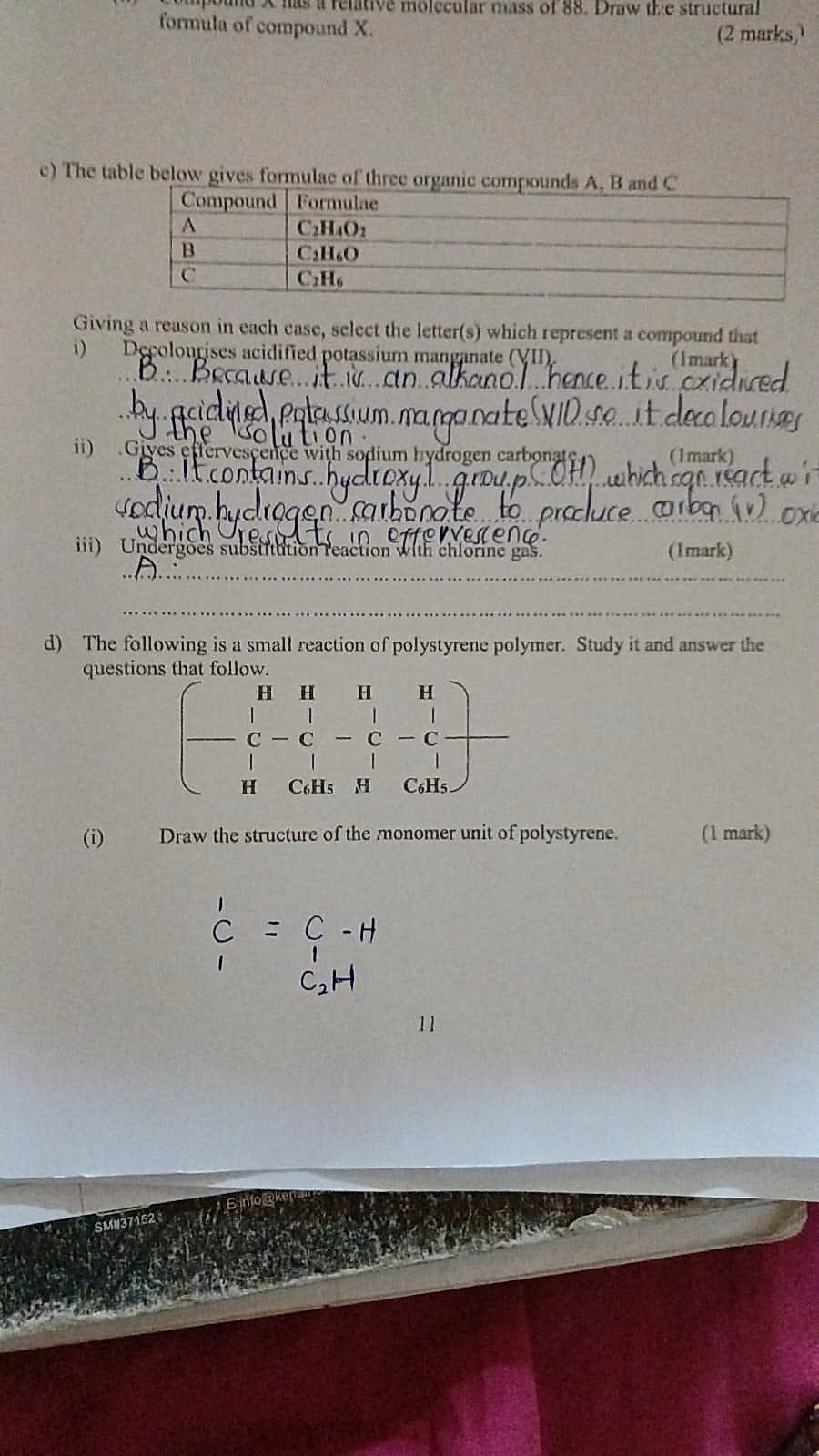
The following is a small reaction of polystyrene polymer. Study it and answer the questions that follow. Draw the struct…
View Solution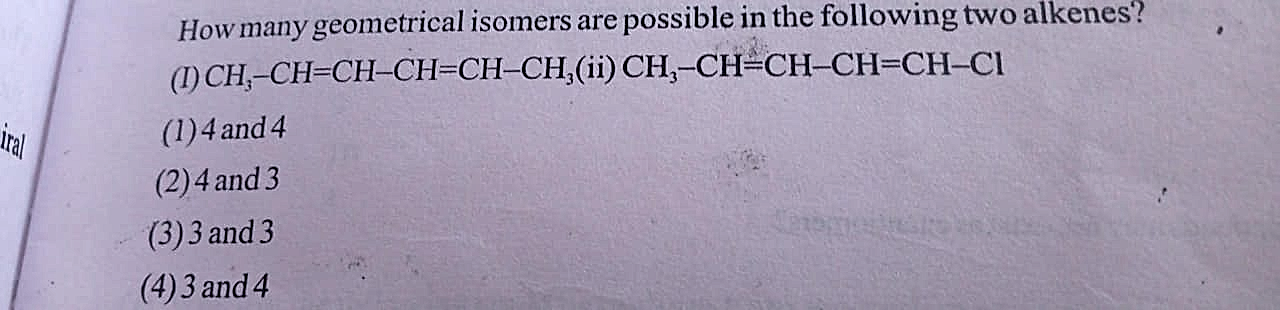
How many geometrical isomers are possible in the following two alkenes? (I) CH3–CH=CH–CH=CH–CH3 (II) CH3–CH=CH–CH=CH–Cl
View Solution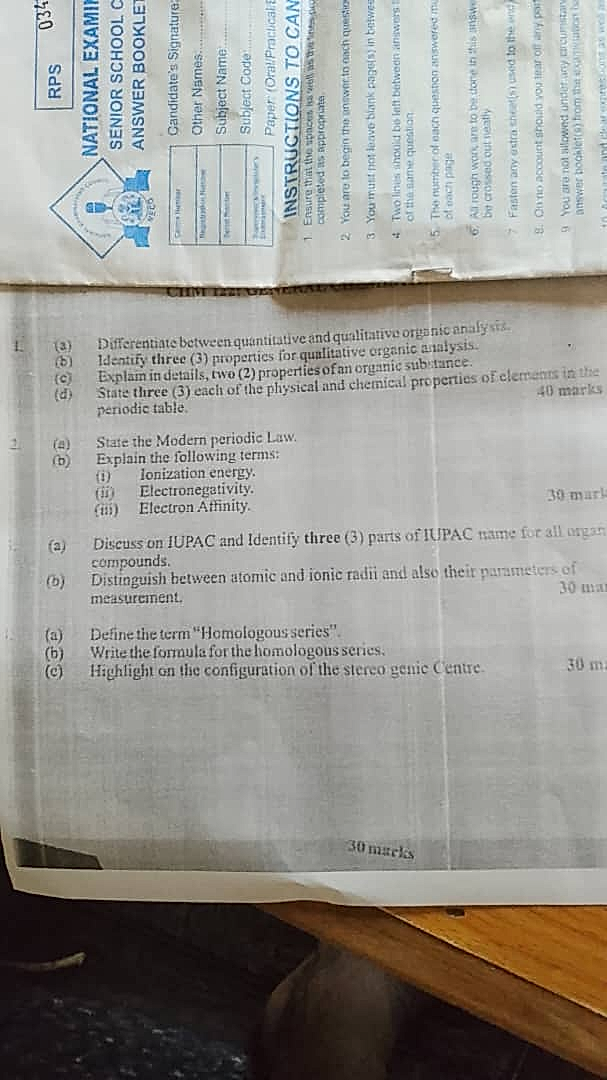
Differentiate between quantitative and qualitative organic analysis. Identify three (3) properties for qualitative organ…
View Solution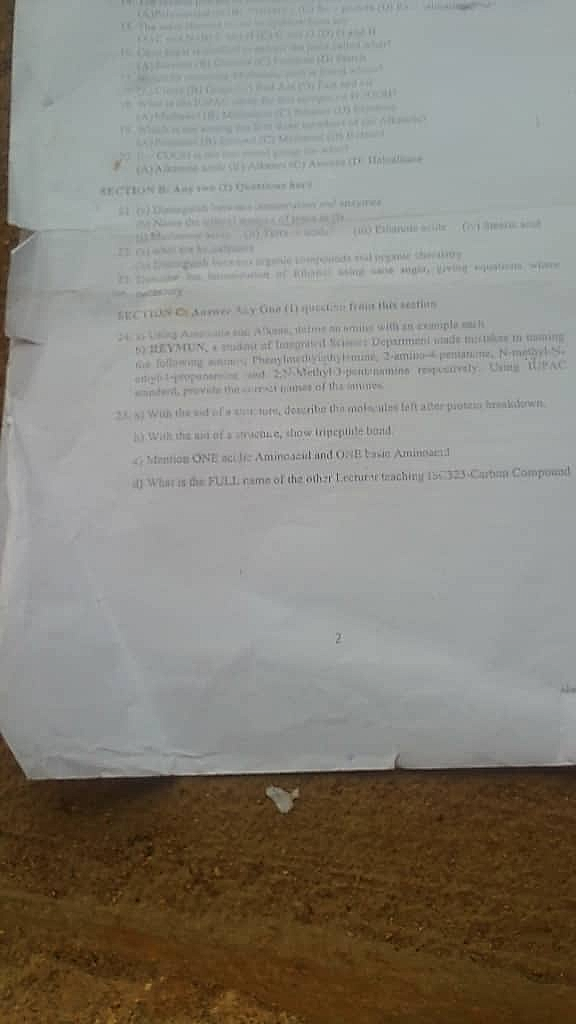
b) REYMUN, a student of Integrated Science Department made mistakes in naming the following amines: Phenylmethylamine, 2…
View SolutionWrite the structure formula of propane,propanol,butanol,pentane 2,1 pentane 3,1 and propanone
View Solution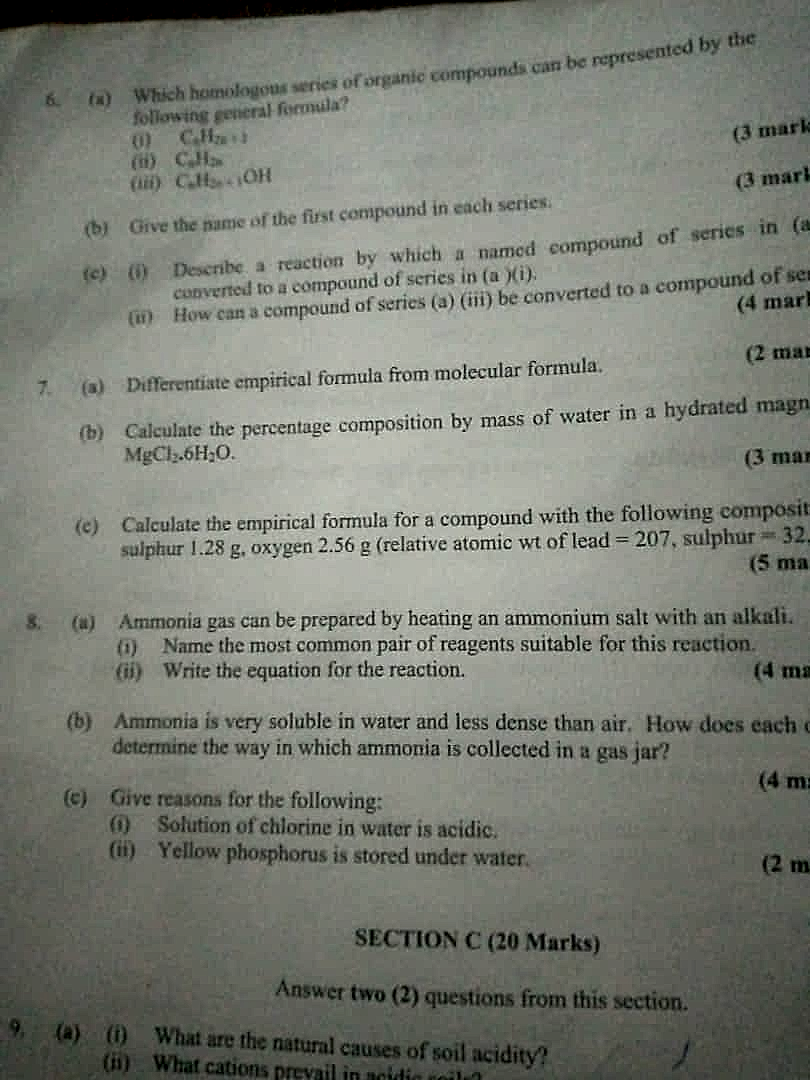
Which homologous series of organic compounds can be represented by the following general formula? (i) CnH2n+1 (ii) CnH2n…
View Solution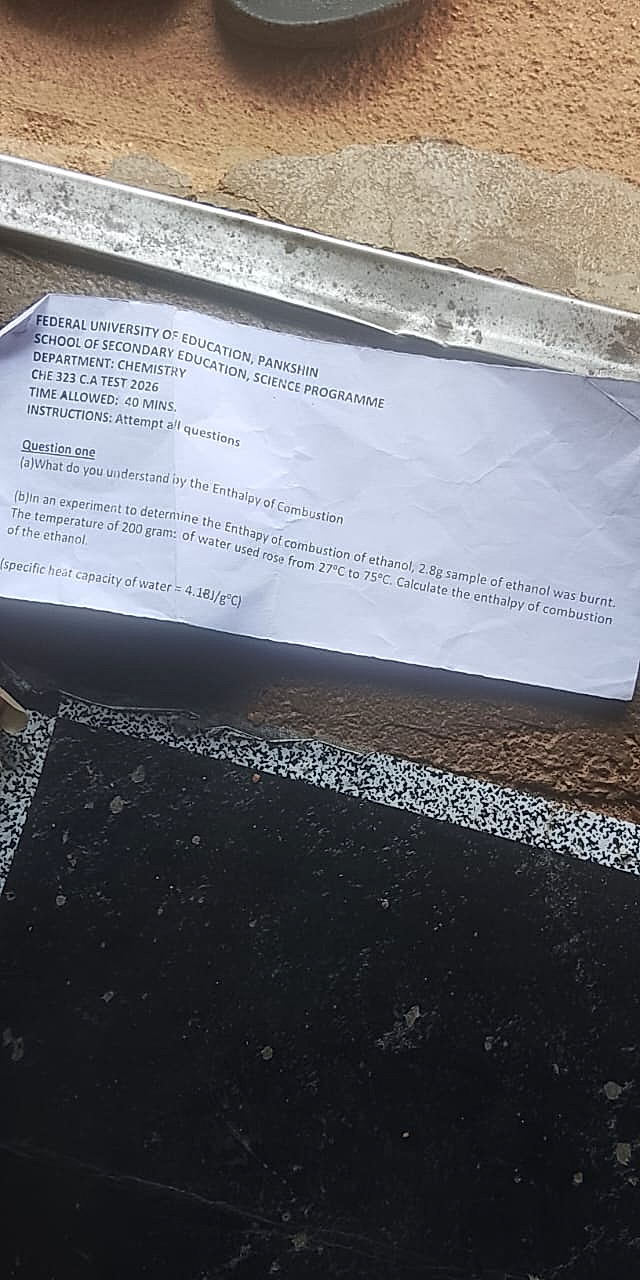
What do you understand by the Enthalpy of Combustion? In an experiment to determine the Enthalpy of combustion of ethano…
View Solution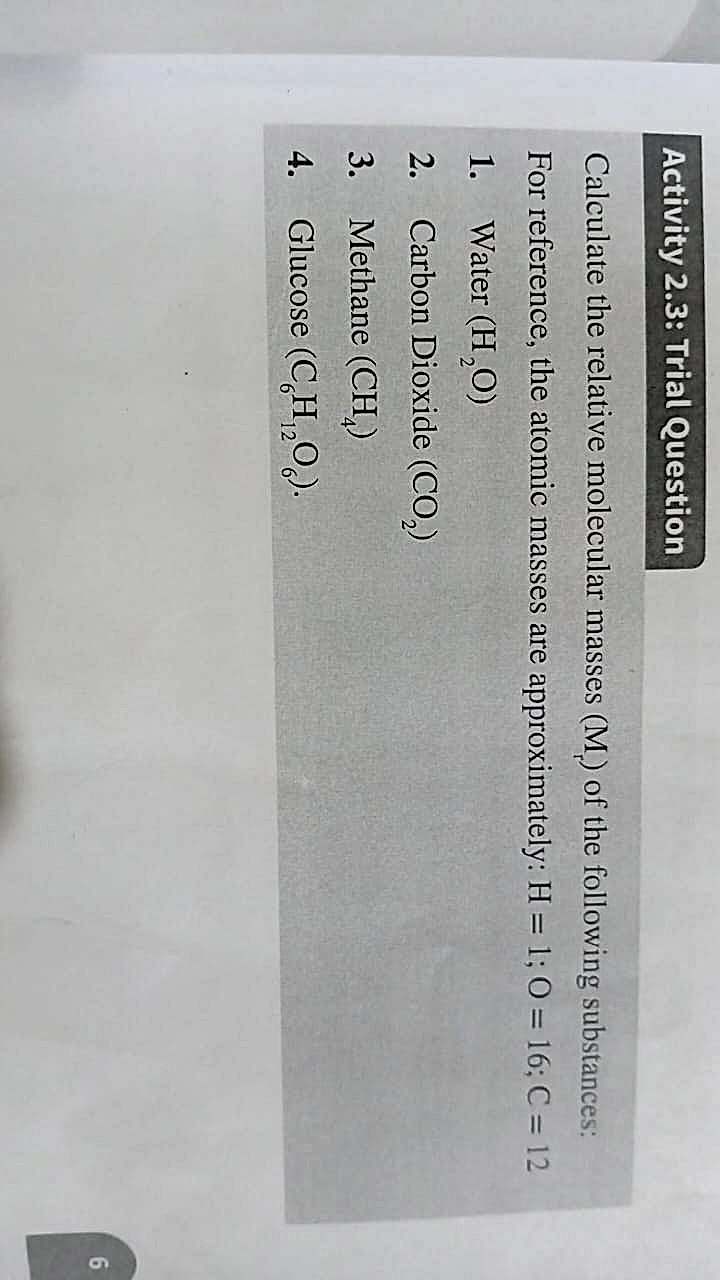
Calculate the relative molecular masses (M,) of the following substances: 1. Water (H 2. Carbon Dioxide (CO2) 3. Methane…
View Solution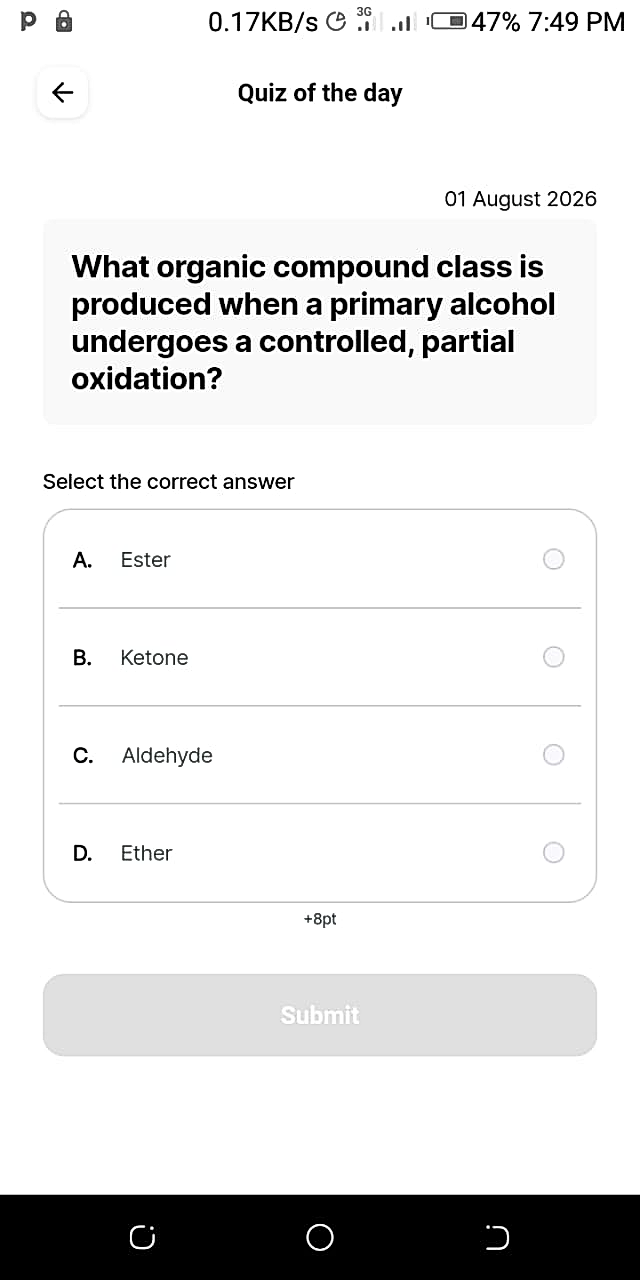
What organic compound class is produced when a primary alcohol undergoes a controlled, partial oxidation?
View Solution
About Organic Chemistry
Organic chemistry is the chemistry of carbon compounds, and it is far more systematic than it first looks: a handful of functional groups, a naming system, and a set of reactions that repeat across families. The questions here are mostly naming and drawing structures, isomers, homologous series, and the conversions that take one functional group to another.
Popular Topics in Organic Chemistry
Alkanes, Alkenes & Alkynes
General formulae, saturation, addition and substitution reactions, and testing for unsaturation with bromine water.
IUPAC Naming
Choosing the parent chain, numbering to give lowest locants, prefixes and suffixes, and naming branched compounds.
Functional Groups
Alcohols, aldehydes, ketones, carboxylic acids, esters, amines and amides, and how each is recognised.
Isomerism
Chain, position and functional group isomerism, geometric (cis-trans) isomers, and drawing all isomers of a formula.
Homologous Series
What members of a series share, the trend in physical properties, and predicting the next member.
Reaction Mechanisms
Nucleophiles and electrophiles, addition, substitution, elimination and the conditions each needs.
Polymers
Addition and condensation polymerisation, monomers and repeat units, and the properties of common plastics.
Alcohols & Esters
Oxidation of primary and secondary alcohols, esterification, hydrolysis, and the smell and uses of esters.
How ScanSolve Helps with Organic Chemistry
Photograph a structure and ScanSolve names it step by step — longest chain, numbering direction, substituents in alphabetical order — so the rule being used is visible rather than assumed. For conversions it gives the reagent and the conditions, because in organic chemistry the conditions are usually where the marks are.
Isomer questions are answered systematically (chain isomers first, then position, then functional group) so nothing is missed, and structures are written in a displayed form that can be copied into an answer booklet. Where a reaction has a mechanism on the syllabus, the arrows are described in words.
Study Tips for Organic Chemistry
Learn the functional groups with one example each. Recognition, not memory, is what organic questions test.
Number the chain from both ends and take the lower set of locants. Most naming errors are numbering errors.
Quote conditions with every reaction — concentrated or dilute, hot or cold, catalyst. A reagent without conditions is half an answer.
When asked for isomers, work through chain, then position, then functional group. A system finds all of them; inspiration finds most.
Get Organic Chemistry Help on WhatsApp
Send a photo of your organic chemistry homework and get step-by-step solutions instantly. No app download needed.
Message Us on WhatsAppFrequently Asked Organic Chemistry Questions
How can ScanSolve help with Organic Chemistry homework?
ScanSolve's AI solves organic chemistry problems step by step. Snap a photo of your homework or type your question to get instant, detailed solutions with clear explanations.
Is Organic Chemistry homework help free on ScanSolve?
Yes, ScanSolve offers free organic chemistry homework help with step-by-step solutions. Upgrade to Pro at $89.99/year (about $7.50/month) or $9.99/week for unlimited answers and priority support.
What Organic Chemistry topics does ScanSolve cover?
ScanSolve covers all organic chemistry topics including Alkanes, Alkenes & Alkynes, IUPAC Naming, Functional Groups, Isomerism, Homologous Series. Upload any organic chemistry problem and get a step-by-step solution.
Can ScanSolve solve organic chemistry problems from a photo?
Yes. Take a photo of your organic chemistry homework and ScanSolve's AI will read the problem, identify the method needed, and provide a complete step-by-step solution.
How accurate are ScanSolve's organic chemistry solutions?
ScanSolve uses advanced AI to deliver accurate, step-by-step organic chemistry solutions. Each answer includes detailed explanations so you can verify the reasoning and learn the method.
More in Science
Explore More Subjects
Have an Organic Chemistry question?
Get an instant AI-powered step-by-step solution in seconds.