
Chemistry Homework Help
Step-by-step AI solutions. Ask your own question →
Chemistry Questions

Hello I just want you to help me notes of chemistry for S2 from term 1 up to term 3
View SolutionAssg Write short note on Haemoparasite and formo-ether concentration technique for the detection of parasites List 4 fix…
View SolutionGenerate for me chemistry questions and answers on kcse prediction 2026 paper one
View SolutionHie l need full information or explanation on titration notes not brief but explain further
View Solution
06 g of sodium carbonate, Na2CO3 is contained in 250 cm3 of solution. Calculate the concentration of the solution in a)…
View Solution

The mass of an adult bone is calculated from its average mass of about 11 kg and 50% of this mass is calculated to be ca…
View Solution
How many sodium ions are present in a aqueous solution of sodium carbonate containing 2.65 g?
View Solution
Dans une solution 1.5 N d'acide phosphorique H3PO4, combien y-a-t-il de grammes d'acide phosphorique ?
View SolutionBy using table, describe the test for starch, glucose, lipids, proteins, vitamin C. Show regent, procedure, observation(…
View Solution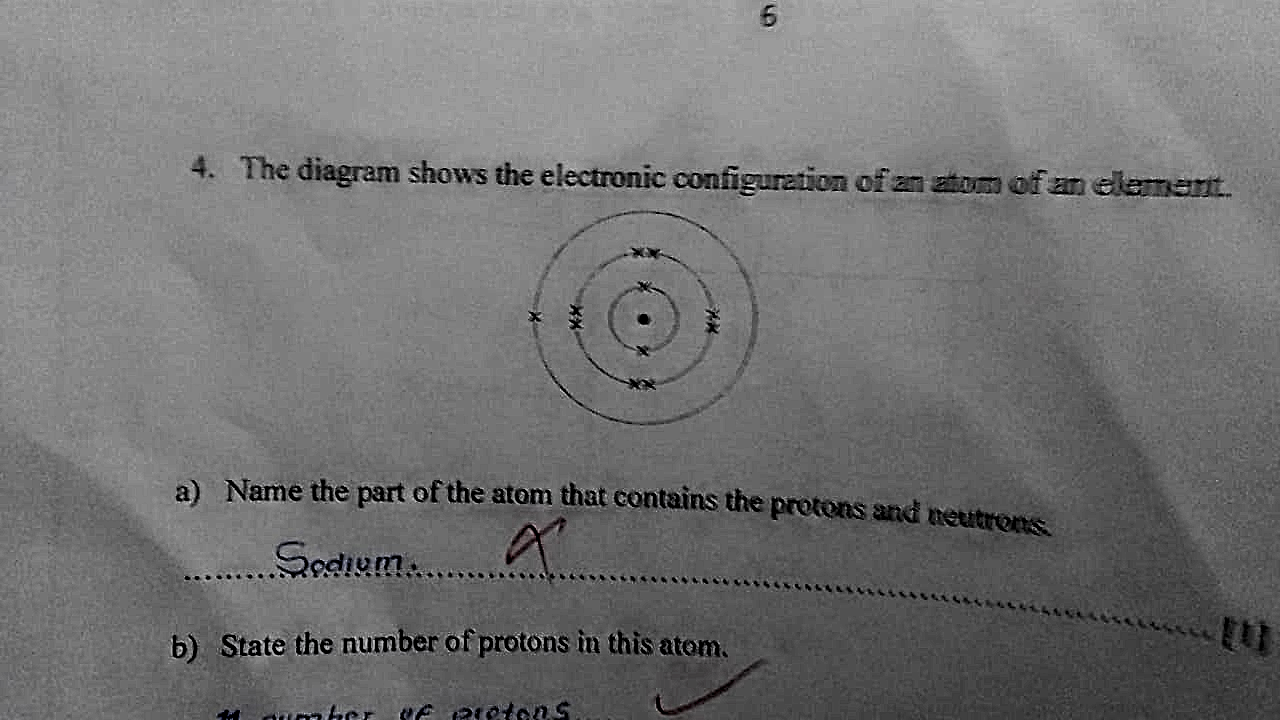
The diagram shows the electronic configuration of an atom of an element. a) Name the part of the atom that contains the…
View SolutionAbout Chemistry
Chemistry is the study of matter — its composition, structure, properties, and the transformations it undergoes. From balancing equations to predicting reaction products, chemistry connects the microscopic world of atoms and molecules to the macroscopic phenomena you observe in the lab and in everyday life. A solid grasp of chemistry opens doors to careers in medicine, engineering, environmental science, and materials research.
Popular Topics in Chemistry
Stoichiometry
Mole conversions, limiting reagents, percent yield, and balancing chemical equations.
Atomic Structure
Electron configurations, quantum numbers, periodic trends, and the relationship between structure and properties.
Chemical Bonding
Ionic, covalent, and metallic bonds, Lewis structures, VSEPR theory, and molecular geometry.
Acid-Base Chemistry
pH calculations, strong vs. weak acids, buffer solutions, and titration curves.
Thermochemistry
Enthalpy, Hess's law, calorimetry, bond energies, and spontaneity with Gibbs free energy.
Equilibrium
Equilibrium constants, Le Chatelier's principle, ICE tables, and solubility product calculations.
Redox Reactions
Oxidation states, half-reactions, balancing redox equations, electrochemical cells, and Nernst equation.
Organic Chemistry
Functional groups, naming conventions, reaction mechanisms, and stereochemistry fundamentals.
Gas Laws
Ideal gas law, partial pressures, molar volume, and real gas deviations.
Kinetics
Reaction rates, rate laws, activation energy, catalysts, and the Arrhenius equation.
How ScanSolve Helps with Chemistry
ScanSolve analyzes your chemistry problem, identifies the concept area, and delivers a solution with every calculation shown and every reasoning step explained. For stoichiometry, it walks through mole ratios, shows unit conversions, and identifies the limiting reagent before calculating yield.
For equilibrium and acid-base problems, the solver sets up ICE tables, writes equilibrium expressions, and solves for unknowns — explaining assumptions like the small-x approximation and when they are valid. For organic chemistry, it traces reaction mechanisms step by step, showing electron movement and intermediate structures.
Each solution is designed to teach the underlying method so you can apply it to similar problems independently.
Study Tips for Chemistry
Master dimensional analysis early. Nearly every chemistry calculation involves unit conversions, and tracking units prevents most arithmetic errors.
Build a reaction type reference sheet: synthesis, decomposition, single replacement, double replacement, combustion. Recognizing the pattern instantly speeds up problem solving.
For organic chemistry, practice drawing mechanisms by hand. Understanding electron flow is the key to predicting products — memorizing reactions without mechanisms leads to confusion.
Use practice problems with answers to self-test regularly. Spaced repetition of problem types is more effective than marathon study sessions.
Get Chemistry Help on WhatsApp
Send a photo of your chemistry homework and get step-by-step solutions instantly. No app download needed.
Message Us on WhatsAppFrequently Asked Chemistry Questions
How do I balance a chemical equation?
Count atoms of each element on both sides, then adjust coefficients until both sides are equal. Start with the most complex molecule.
What is a mole in chemistry?
A mole is 6.022 × 10²³ particles (Avogadro’s number). It lets you convert between atoms/molecules and grams using molar mass.
What is the difference between ionic and covalent bonds?
Ionic bonds transfer electrons between a metal and nonmetal. Covalent bonds share electrons between nonmetals.
How can ScanSolve help with Chemistry homework?
ScanSolve's AI solves chemistry problems step by step. Snap a photo of your homework or type your question to get instant, detailed solutions with clear explanations.
Is Chemistry homework help free on ScanSolve?
Yes, ScanSolve offers free chemistry homework help with step-by-step solutions. Upgrade to Pro at $89.99/year (about $7.50/month) or $9.99/week for unlimited answers and priority support.
Chemistry Study Guides & Articles
How to Balance Chemical Equations: Step-by-Step Method
Master balancing chemical equations with this step-by-step guide. Learn the trial and error method, tips for complex equations, and practice problems for chemistry students.
ChemistryThe Periodic Table Explained: Groups, Periods, Trends & Electron Configuration
Understand the periodic table including groups, periods, periodic trends, and electron configuration. A complete chemistry guide to elements and their properties.
BiologyPhotosynthesis Explained Step by Step: How Plants Make Food
Understand photosynthesis step by step. Learn the light reactions, Calvin cycle, and how plants convert sunlight into energy. Perfect for biology students.
BiologyCell Structure and Function: Organelles, Plant vs Animal Cells & Cell Membrane
Learn about cell structure and function including organelles, the cell membrane, and differences between plant and animal cells. Complete biology guide for students.
More in Science
Explore More Subjects
Have a Chemistry question?
Get an instant AI-powered step-by-step solution in seconds.